
Sixty Degrees North intends to follow the construction of Canada’s heavy icebreaker in Finland,
“I intend to closely follow and document construction of the Polar Class 2 ‘heavy’ Polar Icebreaker at Helsinki Shipyard in my continuing effort to correct the false belief that Finnish companies cannot build the types of icebreakers needed by the U.S. Coast Guard…
“You will also see me reporting on Rauma Marine Construction’s (RMC) progress building the Finnish Navy Corvettes...At the moment, they have three (of a planned four) Corvettes in simultaneous production.”
The corvette is also interesting combining significant anti-air, anti-surface, and anti-submarine capability with a hull designed to operate in ice, all in a hull 15% smaller than that of an OPC. I look forward to hearing more about it.
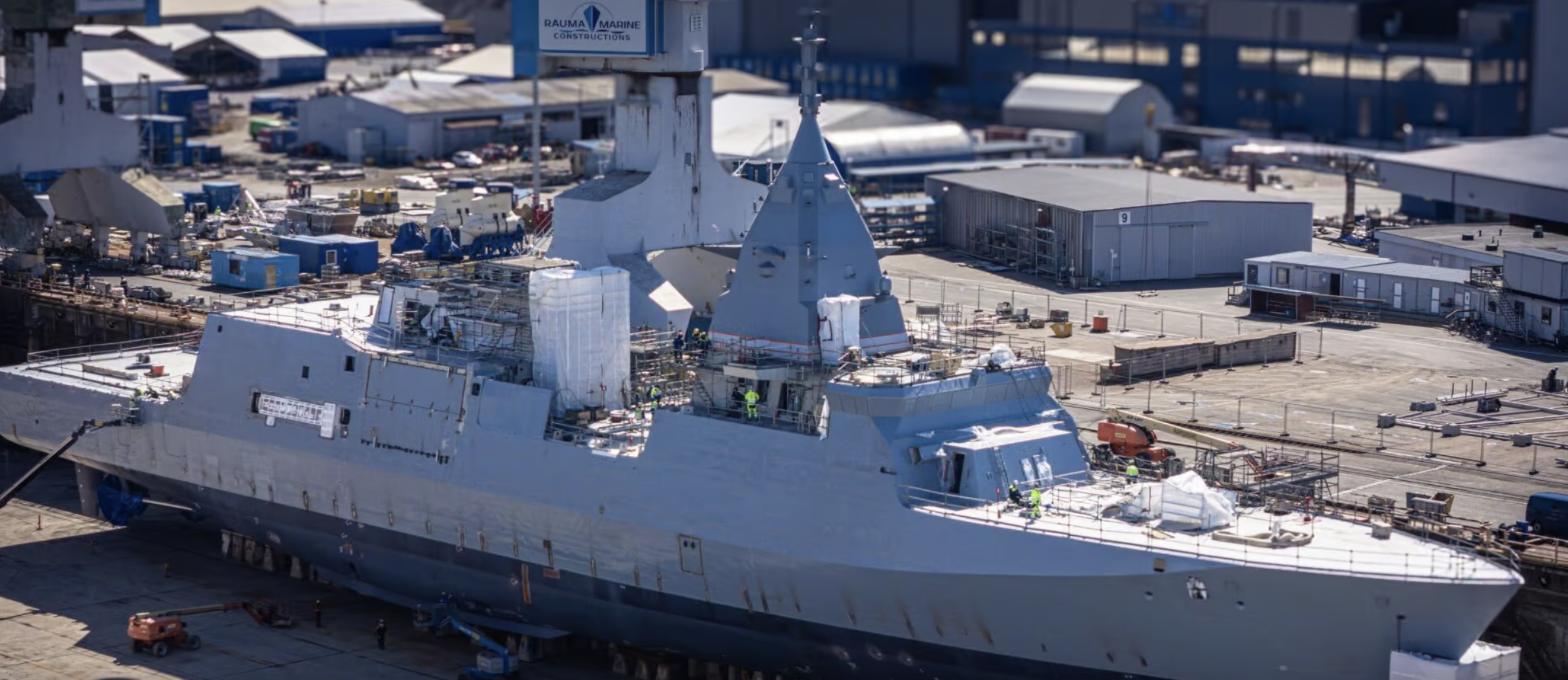
The first multi-purpose corvette built for the Finnish Navy’s Squadron 2020 project was launched at Rauma shipyard on Wednesday 21 May 2025.
 Chuck Hill's CG Blog
Nothing to add, but these two ships are indeed interesting.
Andrew
They seem very serious about building icebreakers and seem to take a lot of pride in them, something to be said for decades of experience and pride in building ships. The schedule is also very seriously fast.
The RMC is EXACTLY what the U.S. should be building in numbers, but call them a Destroyer Escort. Nostalgia not only sells . . . it has a huge HiStoric Record to draw upon, image to maintain, and performance to meet (and exceed) today.
A Reserve Program using distributed basing up and down all coasts make a lot of sense.
We could use some just as they are, but for a larger program we (and the Navy) would want more range. They have less range than the Freedom class LCS.
Afix might not be too difficult.
Diesels for range and efficiency and a turbine for speed.
@Torch, rated range 3500 @ 15 knots. That is 1,000 more than a Webber class but it is less than that of a WMEC210 and if it uses close to full speed it can use fuel about eight times as fast.
It is over 2200 nautical miles from the West coast to Honolulu and over 3300 from Honolulu to Guam.
The vast distances in the Pacific are part of the reason we need more ships.
Precisely . . . many of us have been saying this for a long time, and multiple studies concluded that we needed more small distributed forces.
So . . . what does the U.S. Navy cook up ? . . A super big ship that cost twice as much as a DDG-51.
My observation is that the Navy does not think of a warship in terms of how it will function as a component of the fleet, rather they think of it in isolation and consequently it must do everything.
What I see is a need for an escort across most of the Pacific where the threat is from submarines which will mean the air threat is limited.
We simply cannot say, as one CNO did, that you are on your own when China has satellites ready to provide targeting. When the fighting starts may have clandestinely armed merchant ships in addition to nuclear submarines.
No there is no such thing as an air threat free environment but some areas like the South China Sea are much worse than others. Subs can carry cruise missiles, but most carry relatively few so small ships with a relatively small number of AAW missiles can be viable. As the threat increases, more capable AAW ships can be added to the mix.
AGREED . . . it is a shame we do not build those smaller multi-mission Surface Combatants!
Before WWII the US built some sub chasers but no corvettes, frigates, or destroyer escorts until the British said they wanted to buy destroyer escorts. They were designed for a Royal Navy requirement and then we went on to build hundreds for the USN.
They used just about every cutter as an ASW vessel but many were unsuitable and many had not sonar or when they got sonar they had no one trained to operate it.
So . . . we should wait for the British to ask us to build DEs before we start?
Concerning ASW we should already have a USCG ASW office with folks going to AN/SQQ-89 school and spending time with vessels that already use Multi-Function Towed Array, and CAPTAS-4 variable depth sonar (VDS).
The MH-60Ts are not ASW platforms, and I do not think modifications are an option at this point. If they got their new T901 engines it could handle the extra weight and power generation requirements. The Cutters do not have the S-band data link, though they will get a version of Link-16.
A VLS system on the cutters is only an apple in someone’s eye. The new cutters to have a 3D radar though.
CAPTAS-4 is apparently the best available but if it will not fit there are smaller systems from the same manufacturer.
I would think the Navy could provide both the helicopters and their crews and techs for the sonars upon mobilization.
I believe the NSCs already have LINK16 and the OPCs will. In any case it is a relatively light weight installation.
The Finish Corvette does include VLS. I would like to see both NSCs and OPCs equipped with SeaRAM.
SeaRAM may be superior to Phalanx for defending against missiles, but when it comes to drone swarms, hundreds of drones at once attacking a single ship, SeaRAM will quickly run out of missiles and leave the ship defenseless. As someone wrote in a recent article in USNI’s Proceedings, SeaRAM should be added to Navy ships (and by extension, Coast Guard NSC and OPC cutters) in addition to the Phalanx CIWS, not in place of it. The problem with only having missiles for antiair defense is the advent of drone swarm attacks. Gun-based CIWS systems like the Phalanx are necessary, because when a single ship is swarmed by hundreds of drones at once, having just 11 anti-air missiles in a SeaRAM just won’t cut it; guns are a necessity. The US Navy made a soon-to-be-fatal mistake by lowering the number of CIWS systems on Arleigh Burke destroyers from two to just one. When an Arleigh Burke gets swarmed with hundreds of Chinese drones at once, having only one CIWS, whether it’s a Phalanx or (worse yet) a SeaRAM won’t be enough.
Ok, I admit this argument (which I got from USNI Proceedings) applies more to Navy ships than Coast Guard cutters, because China is the most likely nation to be sending swarms of hundreds of drones, and when China invades Taiwan, I doubt the U.S. will be sending Coast Guard cutters into harms way in the Taiwan Strait. At least I certainly hope not!
I think the Coast Guard and Navy should also develop better anti-drone weapons that don’t cost a million dollars per shot. They could take a cue from the U.S. Army, which has reintroduced the “beehive” cannister rounds for our tanks. A single modern beehive round from a 120mm tank cannon fires thousands of tungsten projectiles at once, sort of like a giant super-shotgun shell containing thousands of tungsten buckshot pellets in one shot. It should be easy and cheap to develop beehive rounds for short-range defense against drone swarms for use in the Navy’s 5-inch guns and the Coast Guard’s 57mm main guns, as they could take out dozens of drones with a single shot. The 25mm MK38 guns on the Sentinel-class and OPC cutters could also use cheap beehive rounds for short-range defense against small drones. The 25 mm might sound small, but it’s still a lot bigger than a 12-gauge shotgun (18.5 mm) and far more accurate. Currently, I don’t believe the MK38 25mm guns have an air-burst proximity round for air defense, so without an air-burst proximity round, the best (easiest, cheapest, fastest) solution to getting anti-drone ammunition on Sentinel-class cutters would be to use beehive rounds for the for the 25mm MK38. Beehive rounds are basically large tungsten buckshot, but far more powerful than a 12 gauge shotgun, more like the “punt guns” that were used in the 19th and 20th century. A single shot from a punt gun could kill over 50 waterfowl, so a 25mm beehive round might do the same to a drone swarm!
In addition to the SeaRAM I would also like to see our cutters armed with a 30mm version of the Mk38 because there is an air-burst round for that weapon.
The combination would probably be adequate for dealing with any UAS attack outside the South China Sea.
A likely possibility is that the cutter is attempting to defend some higher value unit that has no defensive weapons of its own, in which case range becomes important. This is a good reason to equip FRCs with the 30mm gun and possibly APKWS.
The best solution for drone defense is the Mk36 Mod4 mount in 30mm or greater with programmable ammunition. Mk15 CIWS does not have enough missiles just like SeaRAM does not. Reloads take time, and a drone swarm does not give you that. The Mk38 Mod4 can kill a drone with just a few rounds with the Advanced hit efficiency and destruction (AHEAD) ammunition, and it comes in 30mm and 35mm.
There is SO MUCH CAPABILITY available TODAY with Hydra Rockets. There is much more capability available in that form-factor with improved rocket motor fuel technology (speed/range), and new warhead/fuse combination(s).
Concerning shotguns . . . it seems some of the manufacturers are thinking about this and coming out with new models. I’m looking for the resurrection of the 10 Gauge.
https://www.twz.com/air/laser-guided-rockets-now-primary-anti-drone-weapon-for-usaf-jets-in-middle-east
APKWS “Laser-Guided Rockets Now Primary Anti-Drone Weapon For USAF Jets In Middle East”
While icebreakers and ice-capable ships are being built by Finnish shipyards, Finland’s own icebreaker project is also progressing. Tailored for Baltic Sea operations, the 7,500-tonne Polar Class 5 icebreaker of course not suitable for any U.S. Arctic icebreaking missions as such, but it’s again a good example of fast-track procurement for technically advanced icebreaking vessels: the design effort including model tests is currently underway, RFIs will be issued later this year, shipbuilding contract will be signed next year, and delivery is planned for late 2029.
https://akerarctic.fi/arctic-passion/finnish-icebreaker-aino-in-extensive-model-tests/