
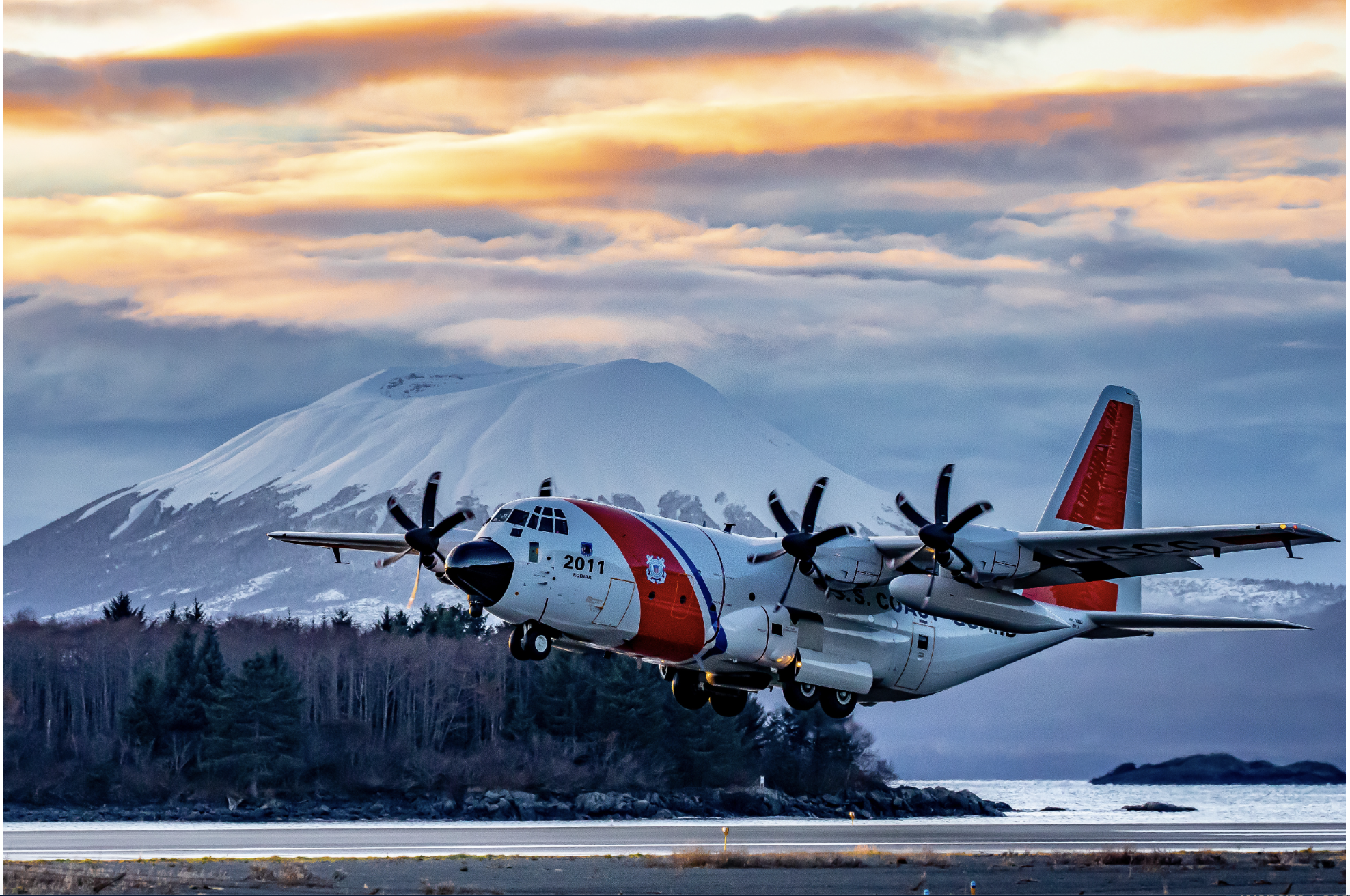
201116-G-G0217-1002
A Coast Guard Air Station Kodiak HC-130 Hercules aircrew takes off from an airstrip in Sitka, Alaska, Nov. 16, 2020. The Kodiak aircrew delivered aircraft parts. Courtesy photo by Don Kluting.
Below is a USCG news release.
Coast Guard prepares for aircraft fleet expansions with awards for engines, radar
WASHINGTON — The Coast Guard recently completed contract actions aimed at accelerating delivery of new MH-60 medium-range recovery helicopters and HC-130J long-range surveillance aircraft and expanding mission capabilities of the expanded aviation fleet.
On Sept. 8, the Coast Guard placed a $14.3 million order for delivery of 13 General Electric T700 engines for its MH-60 helicopter fleet. On Sept. 18, the Service contracted with L3 Harris Technologies Inc. for delivery of three AN/APY-11 multi-mode radar systems, valued at $13.9 million, to be installed on future HC-130Js during the Minotaur missionization process.
Both orders were made possible due to investments in the Coast Guard fleet made by the One Big Beautiful Bill Act (OBBBA).
The T700 engines are among the long lead-time components needed to grow the Coast Guard’s MH-60 fleet and expedite transition of several air stations from the MH-65E to the MH-60. The MH-60’s range, speed, payload and avionics and sensors suite make it a capable platform for all 11 Coast Guard missions. The aircraft’s ability to locate, identify and track surface targets day or night makes it a valuable search and rescue and law enforcement asset. Transition of air stations is necessary to sustain rotary wing capability as the MH-65E continues to face supportability issues driven by a diminishing supply base for an out-of-production aircraft.
The AN/APY-11 radar system was chosen as the optimal multi-mode radar to enhance operational effectiveness as part of the Minotaur Mission System Suite. The Minotaur Mission System enables the collection and correlation of sensor and track data, which is used to conduct drug and alien interdictions, search and rescue, and other statutory missions.
The Coast Guard’s long-range surveillance fleet is a proven asset vital to control, secure and defend the U.S. border and maritime approaches, facilitate commerce vital to economic prosperity, and respond to crises and contingencies. The Coast Guard HC-130J fleet is the Department of Homeland Security’s airlift asset and can provide critical support to DHS partners in response to national events as well as logistical support during routine operations.
The OBBBA includes more than $3.3 billion to expand the Coast Guard’s HC-130J and MH-60 fleets. Nearly $2.3 billion is for the production and fielding of new MH-60 aircraft and delivery of multiple simulators. Approximately $1.1 billion is for production and missionization of six additional HC-130J aircraft, along with associated spare parts and the service’s first HC-130J simulator.
 Chuck Hill's CG Blog
IMHO . . . one new MH-60T should be selected and dedicated to the T901 engine upgrade. Designate a USCG program officer and let them develop the installation package, and conduct flight tests. They will need multiple engines for engine-swaps, and continuing testing, and inspection cycles.
The USCG can receive the most from this upgrade with longer range, greater power, longer on-station time, and less maintenance. THIS is an investment worth the effort and will pay for itself in time with saved down-time, lower fuel consumption, and better availability.
Air Station Elizabeth City is quite good at this. They have been making over H-60s for quite a while.
AMEN! That is where the MH-60T New Engine Program Office can reside. An aircraft should be assigned, engines procured/provided by G.E., form the maintenance team, and hopefully the Program Officer is a USCG Aviator who has graduated form PAX Flight Test Program. If not a USN Aviator will do. They should get started ASAP.
Not going to happen! It was announced in May 2025 that ITEP (Improved Turbine Engine Program), such as the T901 turboshaft is going to funded for limited production for the U.S. Army “only”! USCG was purposely left out of the T901 turboshaft engine upgrades, as was the U.S. Navy, USAF and USMC…
Absolutism . . . death knells for the proud . . . There is always room for improvement and nothing is as constant as change. The program will pay for itself in time. Few programs can promise that. So . . . you keep being NEGATIVE Secundius . . . and I will continue to wait for them . . . to WAKE UP.