
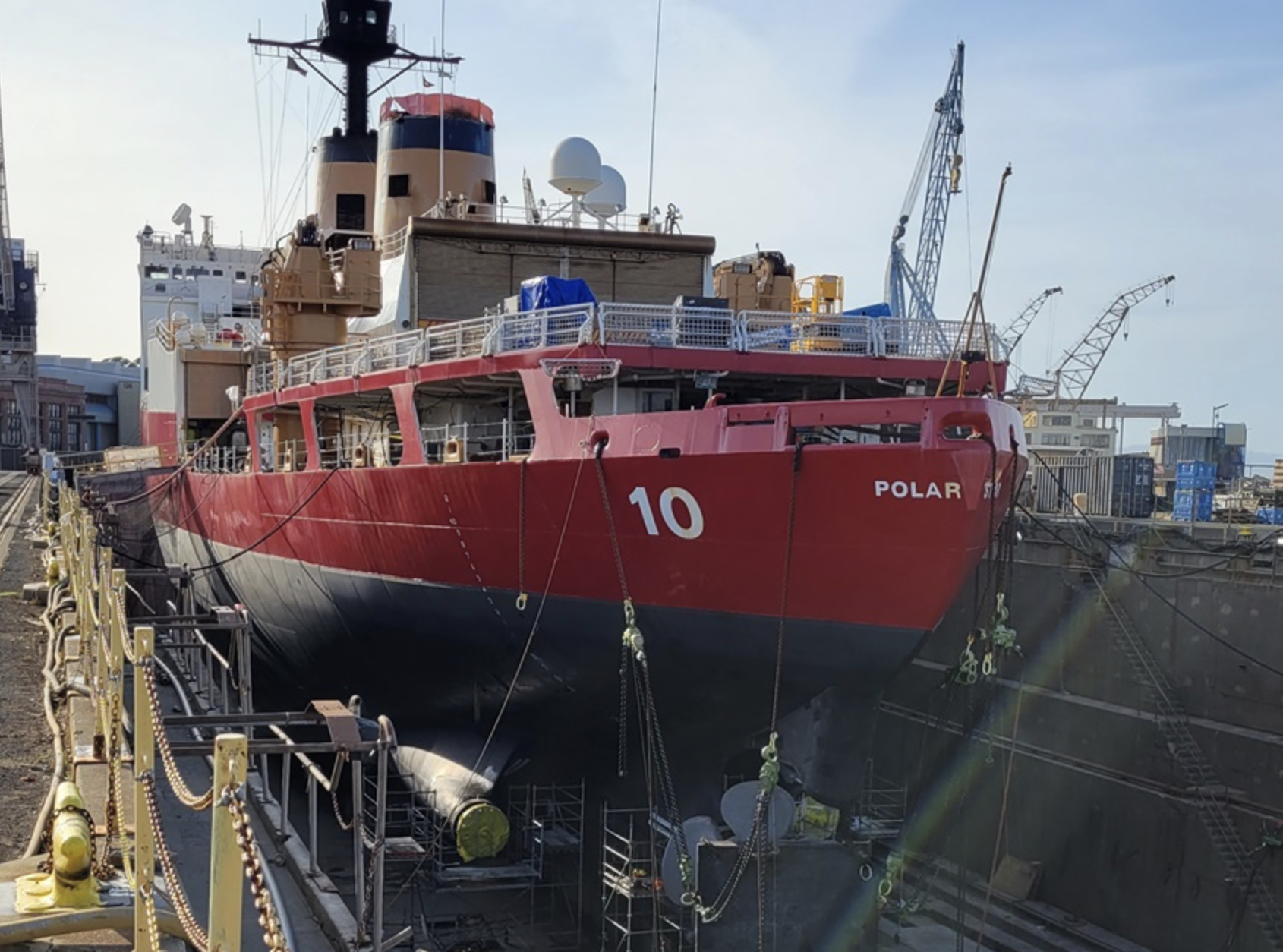
The rudder of the USCGC Polar Star (WAGB 10) is being removed while in a Vallejo, Calif., dry dock, April 1, 2025. The maintenance work completed over the past five years recapitalized integral systems, including propulsion, communication, and machinery control systems. (U.S. Coast Guard photo by Seaman Nestor Molina)
Below is a Coast Guard News Release.
The Coast Guard did a Service Life Extension Program on a 49 year old ship because its replacement is still not ready. Let that sink in for a while.
In addition to the work listed in the release, they removed the centerline shaft for servicing and inspection, exchanged all three propellers, and renewed both forward and aft main deck surfaces.
The ship has not seen its homeport for ten months and the intention is to do the same sort of five year phased SLEP on USCGC Healy, meaning she will have similar long periods away from homeport. At least she is at an age where SLEP is appropriate.
Ships should be home-ported in places they can be worked on.
50 year old ships should be the exception not the rule.
Coast Guard Cutter Polar Star Returns to Seattle after 308 days
SEATTLE — After 308 days away from its Seattle home port, the 49-year-old U.S. Coast Guard Cutter Polar Star (WAGB 10) and crew returned home Tuesday.
Upon completing Operation Deep Freeze (ODF) 2025, Polar Star returned directly to Mare Island Dry Dock in Vallejo, Calif., to complete the final year of a five-year Service Life Extension Program (SLEP).
Polar Star’s SLEP completion comes at a time when the Polar Regions are becoming more consequential, and the demand for U.S. Coast Guard presence, leadership, and vigilance continues to grow.
The maintenance work completed over the past five years recapitalized integral systems, including propulsion, communication, and machinery control systems. These efforts are designed to extend the cutter’s service life as the Coast Guard begins construction of its first Polar Security Cutter. Until PSCs becomes operational, Polar Star will remain the only U.S. icebreaker capable of completing the annual breakout of McMurdo Sound, Antarctica in support of the U.S. Antarctic program (USAP).
“Much has been asked of this ship over the past five decades,” said Capt. Jeff Rasnake, Polar Star’s commanding officer. “The completion of this extensive five-year maintenance and recapitalization project is a major milestone in enabling Polar Star’s operations into the future.”
Polar Star’s SLEP has been completed in five phases to maintain its operational capability to complete annual polar deployments. Phase Five, the last phase in its SLEP, began March 30, 2024, focusing on these projects:
- Gyro repeater recapitalization to ensure that these critical pieces of navigation equipment are updated to modern standards, enabling safe navigation of the cutter.
- Ancillary pumps and motors recapitalization through the replacement of critical main propulsion and auxiliary systems with modern supportable units.
-
Heating, ventilation, and air conditioning systems refurbishments; multiple zones were refurbished with ventilation trunks, fans, and heaters to improve air circulation and maintain a comfortable living environment for the ship’s crew during extended deployments.
The completion of Polar Star’s five-year SLEP underscores the importance of the annual ODF mission, the U.S. military support mission for the USAP, which facilitates the transport of personnel, equipment and supplies required to maintain the U.S.’s strategic presence in Antarctica. Having participated in a majority of these missions since they began in the 1950s, the U.S. Coast Guard will continue to support the U.S.’s continued presence on the Antarctic continent as part of the Joint Task Force – Support Forces Antarctica.
Work completed in Phase Five took 175 days and represented an additional $12.7 million investment in the U.S. Polar capability. While at Mare Island, Polar Star received support from both Coast Guard Base Seattle and Base Charleston’s Naval Engineering Departments to perform a center section overhaul on one of Polar Star’s nine main diesel engines. In parallel with this work, members from the Coast Guard Yard in Baltimore completed vital work on the ship’s sanitary systems.
Additional major work completed includes removing the centerline shaft for servicing and inspection, exchanging all three propellers, and renewing both forward and aft main deck surfaces.
“This is a tremendous ship, and it is in better shape today than it was ten years ago,” said Rasnake. “That’s a testament to the unrelenting efforts of the crew, the enduring support of our mission partners, and the renewed enthusiasm and investment in our nation’s polar icebreaking capabilities.”
Commissioned in 1976, Polar Star is 399 feet, weighing 13,500 tons with a 34-foot draft. Despite reaching nearly 50 years of age, Polar Star remains the world’s most powerful non-nuclear icebreaker with the ability to produce up to 75,000 shaft horsepower.
 Chuck Hill's CG Blog
https://www.dcms.uscg.mil/Our-Organization/Assistant-Commandant-for-Acquisitions-CG-9/Newsroom/Latest-Acquisition-News/Article/4339212/polar-star-completes-final-phase-of-service-life-extension-program/
Polar Star completes final phase of service life extension program
Nov. 20, 2025 —
Coast Guard Cutter Polar Star undocking at Mare Island Dry Dock in Vallejo, California. U.S. Coast Guard photo.
Coast Guard Cutter Polar Star completed the fifth and final phase of its five-year service life extension program (SLEP) on Sept. 17 at Mare Island Dry Dock LLC in Vallejo, California. The cutter departed the San Francisco Bay Area on Sept. 20 for its homeport in Seattle.
The SLEP, a key initiative within the Coast Guard’s In-Service Vessel Sustainment (ISVS) Program, has extended Polar Star’s service life by modernizing targeted systems, including propulsion, communication and machinery control systems. Concurrent with the SLEP activities, crews performed other significant maintenance to ensure the cutter remains capable of operating in some of the most extreme environmental conditions on Earth.
SLEP work on Polar Star was conducted in phases to align with the cutter’s operational commitments, such as its annual Antarctic deployment in support of Operation Deep Freeze. The fifth and final annual phase began on March 30, 2025, focusing on the following systems:
In addition, personnel from Coast Guard Yard in Baltimore recapitalized sewage pumps, tank level indicators and control panels, improving system reliability during extended deployments to ensure the crew can successfully monitor and manage sewage capacity while the cutter is executing its missions in ice.
Kenneth King, program manager for the ISVS program, commented on the milestone: “An outstanding team effort! I am tremendously proud of the In-Service Vessel Sustainment staff, the Long Range Enforcer Product Line, Resident Inspection Office Seattle and Coast Guard Yard in their significant efforts completing Phase 5. Our dedicated professionals continue to exemplify our service’s core values to ensure Polar Star meets its multifaced missions in the polar regions until the arrival of the polar security cutter fleet.”
Polar Star is the nation’s sole operational heavy polar icebreaker. To address emerging geopolitical challenges and increased human activity in the Arctic and Antarctic regions, the Coast Guard is investing in polar security cutters (PSCs) that will sustain the service’s heavy icebreaking capabilities. On April 30, 2025, the Coast Guard received approval from the Department of Homeland Security for full production of the first PSC. The One Big Beautiful Bill Act provides funds to complete the first and second PSCs and begin construction of a third.