
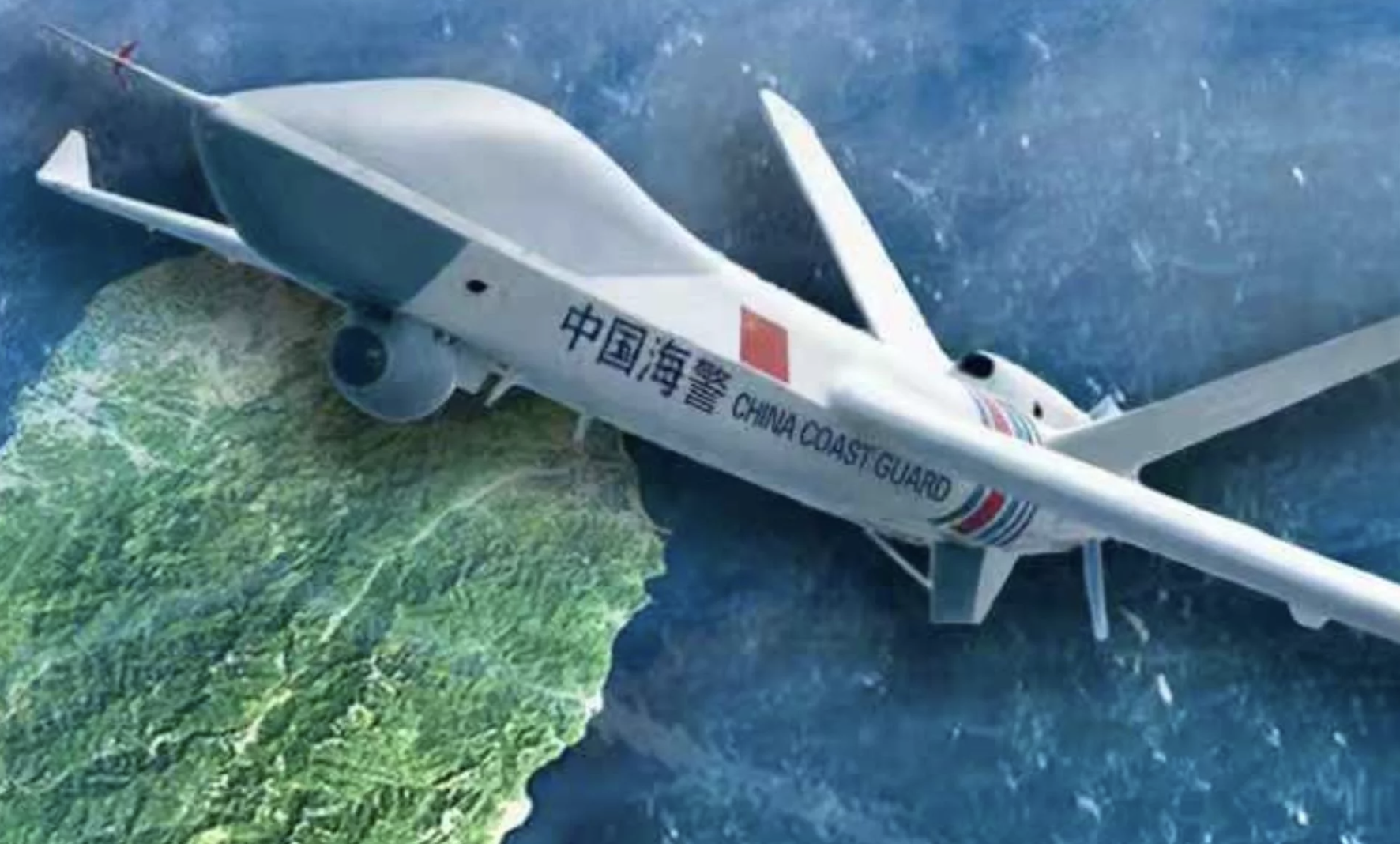
Manufactured by AVIC (Aviation Industry Corporation of China), the Wing Loong II is an advanced iteration of the earlier Wing Loong I. It features a wingspan of 20.5 meters, a length of 11 meters, a height of 4.1 meters, a maximum takeoff weight of 4.2 tons, and a payload capacity of up to 480 kilograms. It is powered by a rear-mounted turbocharged engine with a three-bladed propeller, allowing for a top speed of 370 km/h, a service ceiling of 9,900 meters, and a flight endurance exceeding 20 hours. Its satellite communications system enables long-range control over distances of more than 2,000 kilometers, covering the full expanse of the South China Sea and the Taiwan Strait.
Army Recognition Group’s Navy News reports,
“Illustrative images released by the China Coast Guard on December 30, 2025, suggest the operational use of the Wing Loong II unmanned aerial vehicle during the Justice Mission-2025 exercise. If confirmed, this would mark the first publicly documented appearance of the MALE drone in a coast guard mission, highlighting a potential shift in China’s maritime law enforcement capabilities.”
This only illustrates that China is following a world wide trend of employing land based medium altitude long endurance (MALE) UAS for Maritime Domain Awareness. The US Coast Guard is planning on getting some MQ-9s, but if anything, we may be behind the curve. Current MQ-9 maritime users include Canada, India, Italy, Japan, the UK, and the US Navy.
Wing Loong II appears to be similar to the MQ-9, perhaps a bit smaller. There is no indication if it has detect and avoid capability that would allow it to be certifiable in civil airspace like the MQ-9B. The Wing Loong II’s operational history is interesting and perhaps even a bit surprising. It has been used against Iran, Boko Haram, and the Houthi.
The exercise mentioned, Justice Mission 2025, simulated a blockade of Taiwan. Not surprisingly China Coast Guard seemed to have a significant role to play. This series of exercises might be used to normalize occasional movement of significant forces to surround Taiwan. Ultimately this apparent routine may be used to delay response prior to an attempt to forcibly unify Taiwan with the PRC.
 Chuck Hill's CG Blog