
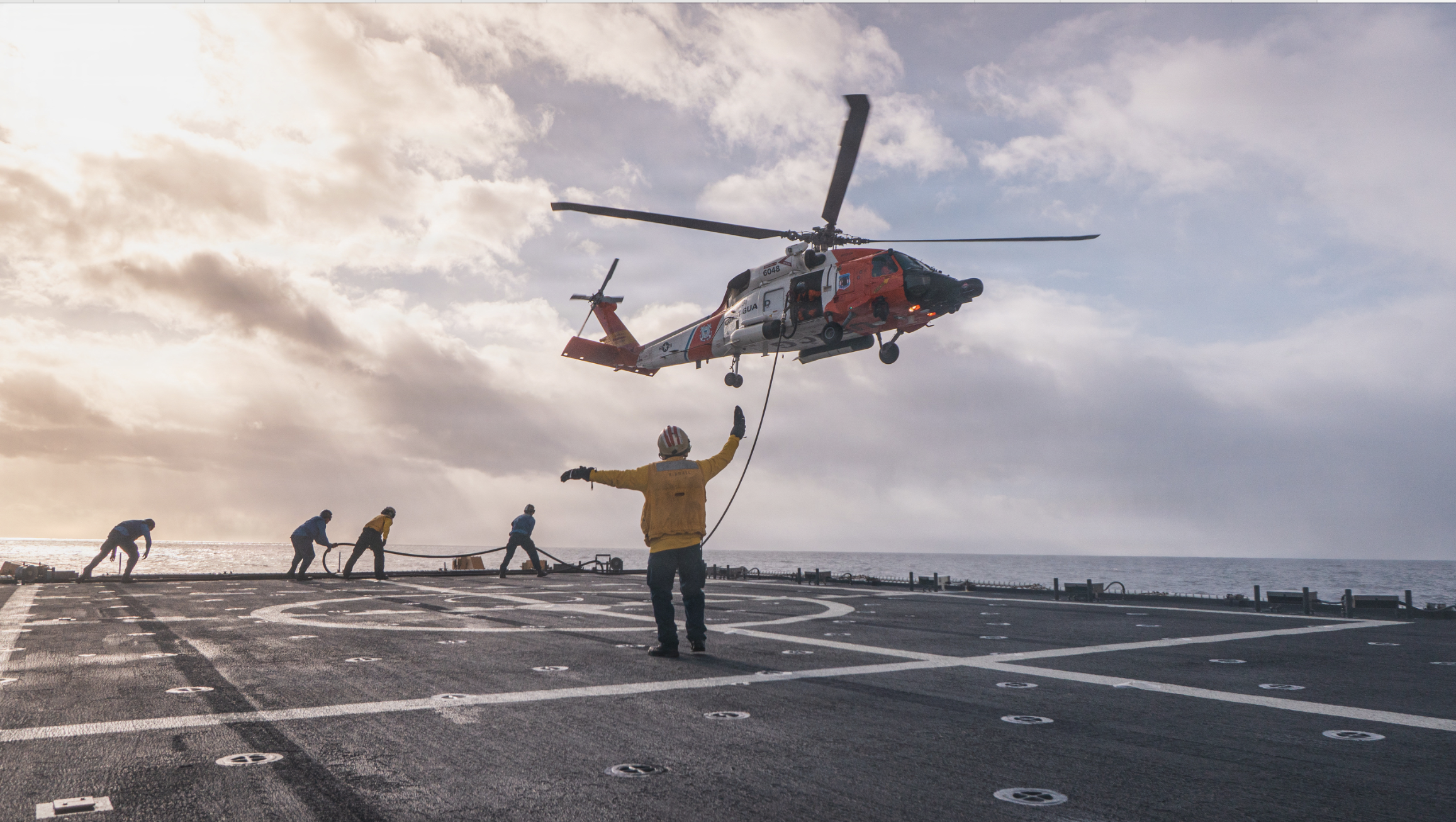
A Landing Signals Officer aboard USCGC Kimball (WMSL 756) directs a Cold Bay-based MH-60 helicopter during helicopter in-flight refueling operations in the Bering Sea, Oct. 31, 2025. The hook-up crew stood by to attach the fuel hose, a capability that allows the aircraft to remain airborne during refueling to support a sustained operational tempo and mission readiness. (U.S. Coast Guard photo by Petty Officer 2nd Class Peter Holtzhausen)
Just wanted to pass this along. Cutter still doing the unglamorous work. Away from home over the holidays. A third of a year in a hostile environment. Away for lots of birthdays and anniversaries and other special days.

“Civilian contractors aboard USCGC Kimball (WMSL 756) from Shield A.I. demonstrate the capabilities of the Vertical Takeoff and Landing Battery (V-BAT) unmanned aerial vehicle to Air Station Kodiak leadership on the flight deck, Sep. 12, 2025, in Kodiak, Alaska. Kimball utilized the V-BAT for several fisheries law enforcement boardings throughout the Alaska Patrol. (U.S. Coast Guard photo by Petty Officer 3rd Class Elizabeth Collins)”
There are references in the release to the V-BAT as “Vertical Takeoff and Landing Battery (V-BAT).” V-BAT is not a battery powered UAS. It has a heavy fuel engine that runs on JP-5.
The U.S. Coast Guard awarded Shield AI a $198 million contract to provide maritime unmanned aircraft system services with the V-BAT.
“The Coast Guard awarded a contract on June 26, 2024, to Shield AI Inc. of San Diego for unmanned aircraft system (UAS) capability that can be deployed from Coast Guard cutters. The indefinite-delivery, indefinite-quantity firm fixed-price contract runs through 2029 and is structured as five one-year ordering periods.”
Jan. 9, 2026
Coast Guard Cutter Kimball returns to Honolulu after 120-day Arctic patrol
HONOLULU — The crew of the Coast Guard Cutter Kimball (WMSL 756) returned to Honolulu, Jan. 1, after a 120-day, 16,500-nautical-mile deployment to the Bering Sea and Gulf of Alaska reinforcing maritime safety, security, and national sovereignty in the region.
As the Arctic region continues to become more accessible and consequential, the demand for U.S. Coast Guard statutory mission services, leadership, and presence continues to grow. Kimball’s crew exemplified these efforts.
Throughout the deployment, Kimball’s crew conducted law enforcement operations, provided critical emergency response, and participated in joint exercises with the Department of War, showcasing the versatility and capability of the national security cutter platform.
Kimball’s law enforcement teams conducted 13 inspections of fishing vessels and conducted joint boardings with the National Oceanic and Atmospheric Administration Office of Law Enforcement. Three citations were issued for violations that included two cases of illegally retained catches.
The crew also conducted extensive training with MH-60 helicopters from Air Station Kodiak to enhance proficiency between cutters and air crews. In addition, Kimball tested the new Vertical Takeoff and Landing Battery (V-BAT) unmanned aerial system while patrolling the Bering Sea, conducting several operations to evaluate and enhance the cutter’s surveillance capabilities.
Following the aftermath of Typhoon Halong, Kimball’s crew provided critical support to the area by positioning as a ready fueling platform for responding air assets. The crew also served as the on-scene coordinator and rendered assistance to a disabled and adrift bulk carrier that lost propulsion near a heavily trafficked pass through the Aleutian Islands.
Kimball participated in two joint operations with United States Alaskan Command under Operation TUNDRA MERLIN. These activities involved Kimball and multiple U.S. Air Force aircraft in simulated joint maritime strikes, providing valuable insight into the national security cutter’s capabilities and demonstrates integration of Department of Homeland Security and Department of War assets in support of homeland defense.
“I am immensely proud of this crew for standing the watch over one of the harshest maritime operational areas in the world,” said Capt. Craig Allen, Kimball’s commanding officer. “This crew demonstrated remarkable skill, tenacity, and teamwork across a wide spectrum of Coast Guard missions. Their professionalism made a direct positive impact to the safety and security of the Alaskan community.”
While on patrol, Kimball’s crew crossed the Arctic Circle, earning the designation as “Blue Nose Polar Bears.” The crew also engaged with the Dutch Harbor, Alaksa, community by volunteering for a beach clean-up and hosting a holiday-themed tour of the cutter for nearly 250 local residents.
Commissioned in 2019, Kimball is one of two 418-foot, Legend-class national security cutters homeported in Honolulu. The cutter’s primary missions are counter-drug operations and defense readiness. The namesake of U.S. Coast Guard Cutter Kimball is Sumner Increase Kimball, the organizer of the United States Life-Saving Service and its general superintendent from 1878–1915.
 Chuck Hill's CG Blog
This USCGC Kimball (WMSL 756) Arctic Patrol should become a standard, and we maintain a PRESENCE (Show-the-Flag) operation in the Arctic Circle 24/7/365.