
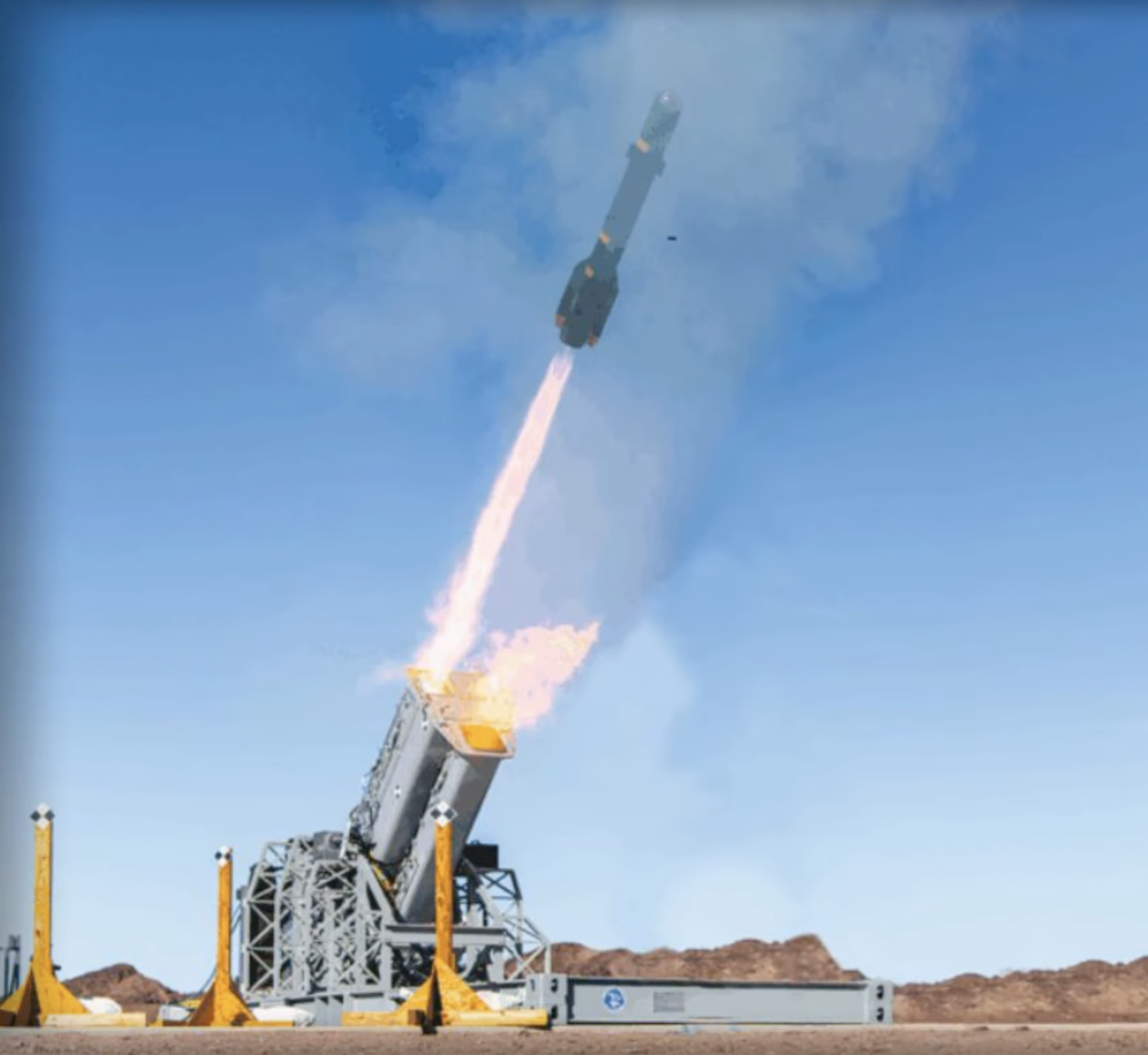
An earlier launch using the JASM Quad Launcher (JQL)
Below is a Lockheed Martin news release. Hellfire, JAGM, and the longer ranged JAGM MR can be fired from this launcher. The launcher has been in the works since 2020.

Lockheed prepare for the first JAGM test fire from a JQL launcher in October 2025. Credit: Lockheed Martin.
Even only one quad launcher would be a huge upgrade in the capabilities of Webber class WPCs. It appears Lockheed has decided they will market the launchers in trainable mounts that allow the canisters to be reloaded with little or no special equipment, either as single quad launchers or as multiple quad launchers mounted together. Our larger cutters might also benefit from adding this capability.
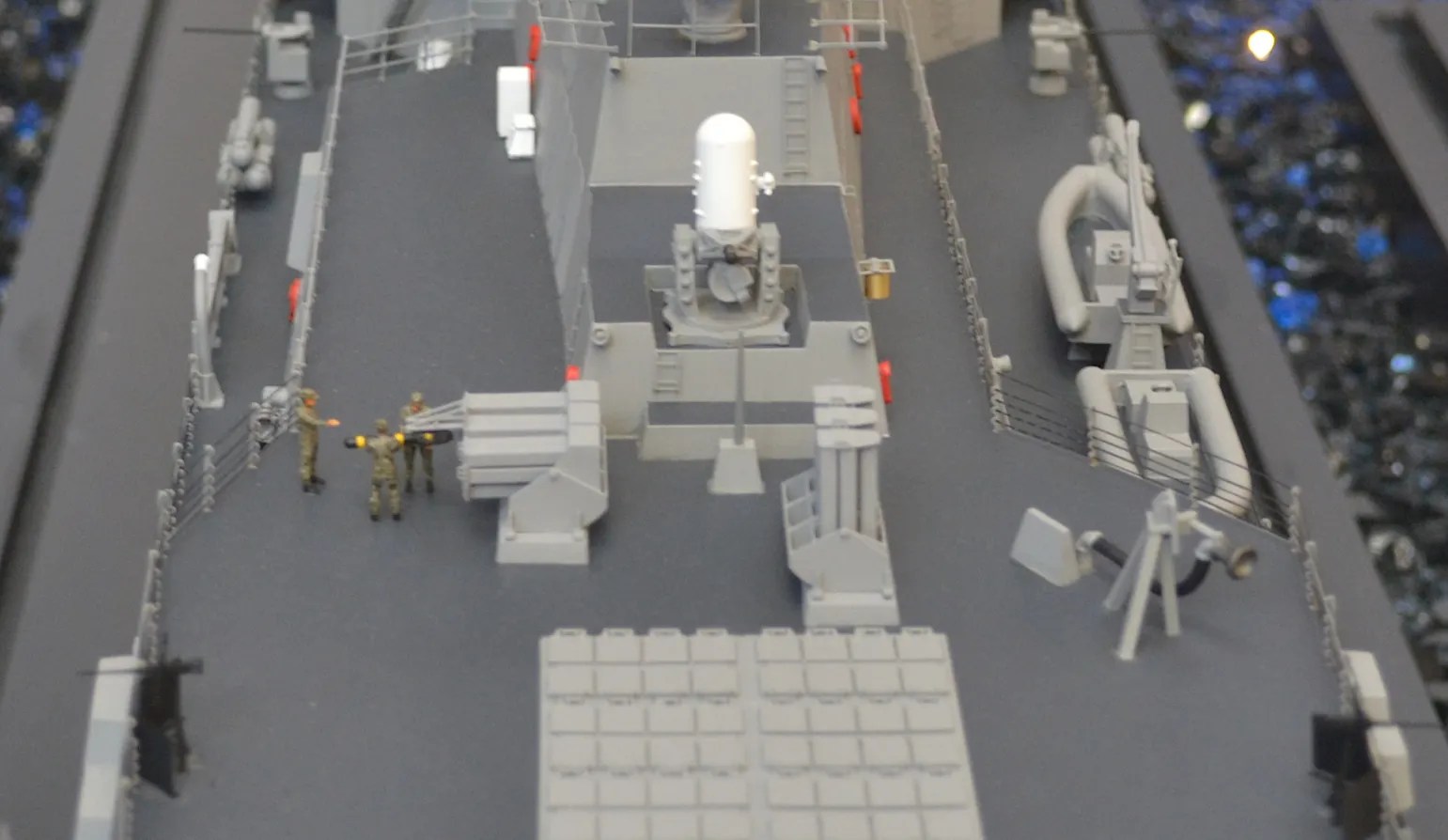
A close-up of the Hellfire/JAGM launchers on the Arleigh Burke model on display at the 2025 Surface Navy Association symposium. Joseph Trevithick
CHINA LAKE, Calif., Jan. 15, 2026 – For the first time, Lockheed Martin (NYSE: LMT) conducted a successful 90-degree launch of a Joint-Air-to-Ground Missile (JAGM) from the JAGM Quad Launcher (JQL) during a demonstration in China Lake, California.
THE BIG PICTURE
- In the demonstration, JAGM proved its ability to neutralize UAS threat systems.
- It also demonstrated the versatility of the JQL launcher, which was mounted to a Richard Childress Racing 6×6 Mothership vehicle.
WHY IT MATTERS
- Validating JAGM & JQL full vertical-launch capability: This demonstration validated JAGM’s full vertical‑launch capability across multiple platforms, including surface‑combatant vessels, which provides a 360‑degree defensive envelope for maritime vessels and other platforms. With JAGM’s advanced dual-mode seeker (SAL/MMW), this integration effort presents JAGM as the ideal munition solution for the U.S. Navy and its allies’ mission-critical needs.
- Showcasing counter-UAS technology: The successful engagement of a UAS threat with JAGM underscores the missile’s ability to detect, track and neutralize hostile threats including drones, unmanned surface vehicles (USVs) and other air threats. This is an increasingly vital capability that modern naval forces need to address emerging threats.
- Multidomain mission integration: The integration of JAGM with the JQL highlights Lockheed Martin’s ability to provide flexible, mission‑tailored deployment across air, sea and land environments. Operators can select from a range of engagement envelopes to meet specific user mission objectives.
EXPERT PERSPECTIVES
- “The successful JQL vertical‑launch demonstration confirms that JAGM can be rapidly deployed from a multimissile launcher across a variety of scenarios, while delivering the network‑centric integration our global users demand,” said Casey Walsh, program management director, Lockheed Martin Multi-Domain Missile Systems. “This milestone validates our vision of a unified missile architecture that seamlessly operates across air, land and sea domains, enhancing survivability and flexibility for future combat operations.”
- “Lockheed Martin continues to push the boundaries of what is possible in vertical launch system development, driving innovation and advancement in the field,” said Edward Dobeck, director, Lockheed Martin Launching Systems. “This proven combat-ready capability meets multidomain deployment objectives today, and provides the same reliability expected of all our launching systems.”
For additional information, visit our website: www.lockheedmartin.com.
About Lockheed Martin
Lockheed Martin is a global defense technology company driving innovation and advancing scientific discovery. Our all-domain mission solutions and 21st Century Security® vision accelerate the delivery of transformative technologies to ensure those we serve always stay ahead of ready. More information at Lockheedmartin.com.
 Chuck Hill's CG Blog
This would be a good fit for the Coast Guard especially as Lockheed developed a lightweight launcher requiring little to no deck penetration.
The FRCs would gain a credible fire-and-forget defense against both UAS and surface craft.
The launchers could be installed when the operating environment warranted it.
The quad launchers do not have to penetrate the deck except for cabling.
On the Webber class WPCs appears we might be able to put one fixed quad vertical launcher on each side of the O-1 deck aft of the bridge or one trainable quad launcher on the O-1 deck forward of the bridge.
We could probably mount multiple quad launchers on the OPC and NSCs since they can launch vertically and cover 360 degrees. Unlike the Mk38s don’t have to worry about antenna in the firing arcs.
Two JQL on each FRC would provide a credible capability against multi-domain targets. The ability to pack them into 20′ TEU containers also offers flexibility for the Arctic Security Cutters and Polar Security Cutters.
This is a very flexible system which should be a ubiquitous as the Mk38.
Sorry to be that guy, but in the first half of the post you’ve written “JASM”, instead of “JAGM”.
Otherwise, I think it’s be great to see something like this, although I think the price of each JAGM is too high imho, and I’d like to see a more Martlet sized price. I know the warhead is lighter, but the lighter weight has allowed the UK to build 30mm guns with Martlets mounted on the guns , so it’d save on space.
As an amateur, I’m going to throw out an amateur scenario where the CG ship has, say 16 JAGM’s and is surrounded by a bunch of non compliant Chinese super fleets which refuses to move when ordered, so they just fire a large number of missiles which fly out at 10+ fishing boats simultaneously go up in a ball of flame , hehe, all caught in 4k video, from launch to hit
It just occured to me Chuck you mentioned a while back the 57mm gun possibly couldn’t stop large cargo ships because it might not be able to damage the 2000 ton engines. Hellfires are designed to destroy tanks. THink this would make a difference?
Cheers,
Andrew
We are going to have a hard time stopping any large ship with a weapon that hits above the waterline.
The problem using any weapon that detonates at the hull is that there is a lot of space between the hull and the engine. Even a shaped charge is going activate at the hull and throw a stream of hot metal at the interior. We might get lucky and hit a fuel line or some essential piece of electrical but it would not likely damage the engine block.
The best targets for this weapon might be the bridge and the rudder post.
I didn’t know that. Thanks for the info.
Andrew
We would want to keep a large terrorist controlled vessel from reaching its target. A torpedo that targets the propeIler(S) and rudder(s) looks most promising to me. Destroying the steering is a possibility.
Flooding the engine room is another possibility, but it is hard to make a hit at or below the waterline.
I did think of another possibility. Usually there is sea water sucked in to cool the engines and then the water is discharged at near the waterline. It might be possible to target the discharge so that the pipe leading to the discharge is broken in which case the cooling water would flood the engine room.
@Andrew, thanks, corrected JASM to JAGM, even though JASM (Joint-Air-Surface-Missile) would make more sense for naval applications.