
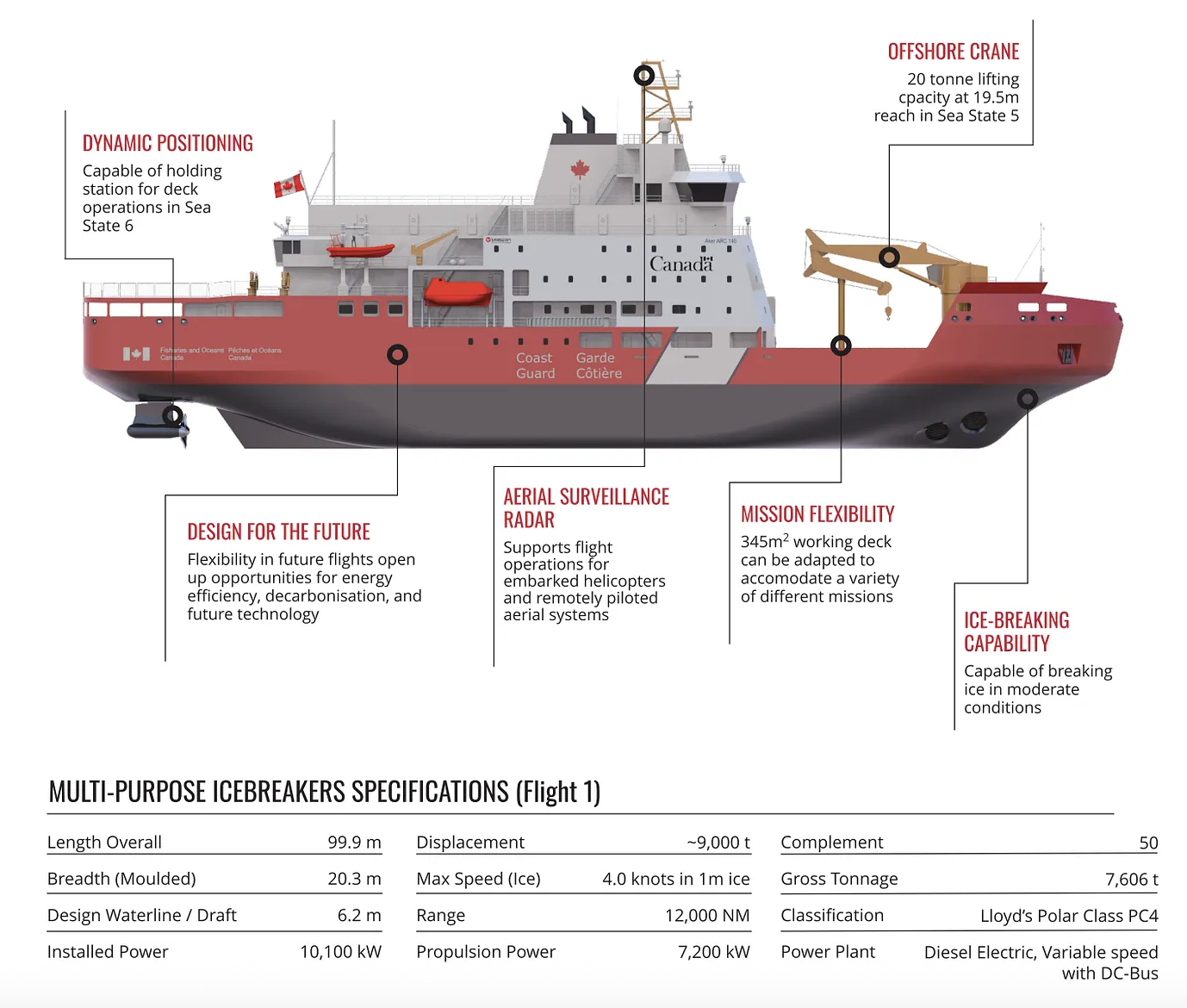
Canadian Coast Guard Multi-Purpose Icebreaker (MPI). Source: Seaspan
This is also the design for the six Arctic Security Cutters recently contracted.
The Navy League’s on line magazine, Seapower, reports,
Adm. Keven Lunday, commandant of the Coast Guard, testifying Jan. 29, 2026, before the Senate Committee on Commerce, Science, and Transportation, said the reconciliation law passed in 2025 was the “most significant investment in Coast Guard history.”
Lunday told the committee that with the expanded force bought with the reconciliation law, the service would need congressional support for consistent, sustained funding to operate it.
An earlier news release gave a more detailed list of what was included in the “Big Beautiful Bill,” but the Commandant is pointing out is that the Coast Guard will need significant additional funding to operate and maintain the additional units.
A frequently mentioned aspect of “Force Design 2028” is the assertion that the Coast Guard will need to grow by 15,000 members. I have been unable to ascertain where these 15,000 new coast guardsmen will go but the Commandant,
“…Lunday pointed out that 13,000 personnel will be needed to crew the 11 Arctic Security Cutters.”
Support personnel will be required in addition to crew, but that sounds excessive. For comparison, our large sea going buoy tenders of the USCGC Juniper class have a crew of 48, eight officers and 40 enlisted. The Great Lakes icebreaker, USCGC Mackinaw has a crew of 55, nine Officers, 46 Enlisted. The Arctic Security Cutters are larger, but the crew size required is related more to complexity rather than size, with super tankers having a crew no larger than the buoy tenders. The Canadians are planning on running their sister ships of the Arctic Security Cutters with a crew of 50 (see graphic above). The Arctic Security Cutters will operate helicopters and UAS and will probably be armed, but certainly the crew would be less than 100, or 1100 total for eleven ships. Will they really require 12000 support personnel?
 Chuck Hill's CG Blog
“USCG Commandant Outlines Investments at Senate Hearing”
https://www.marinelink.com/news/uscg-commandant-outlines-investments-535105