
Below is a Coast Guard news release.
U.S. Coast Guard authenticates keels for first three Waterways Commerce Cutters
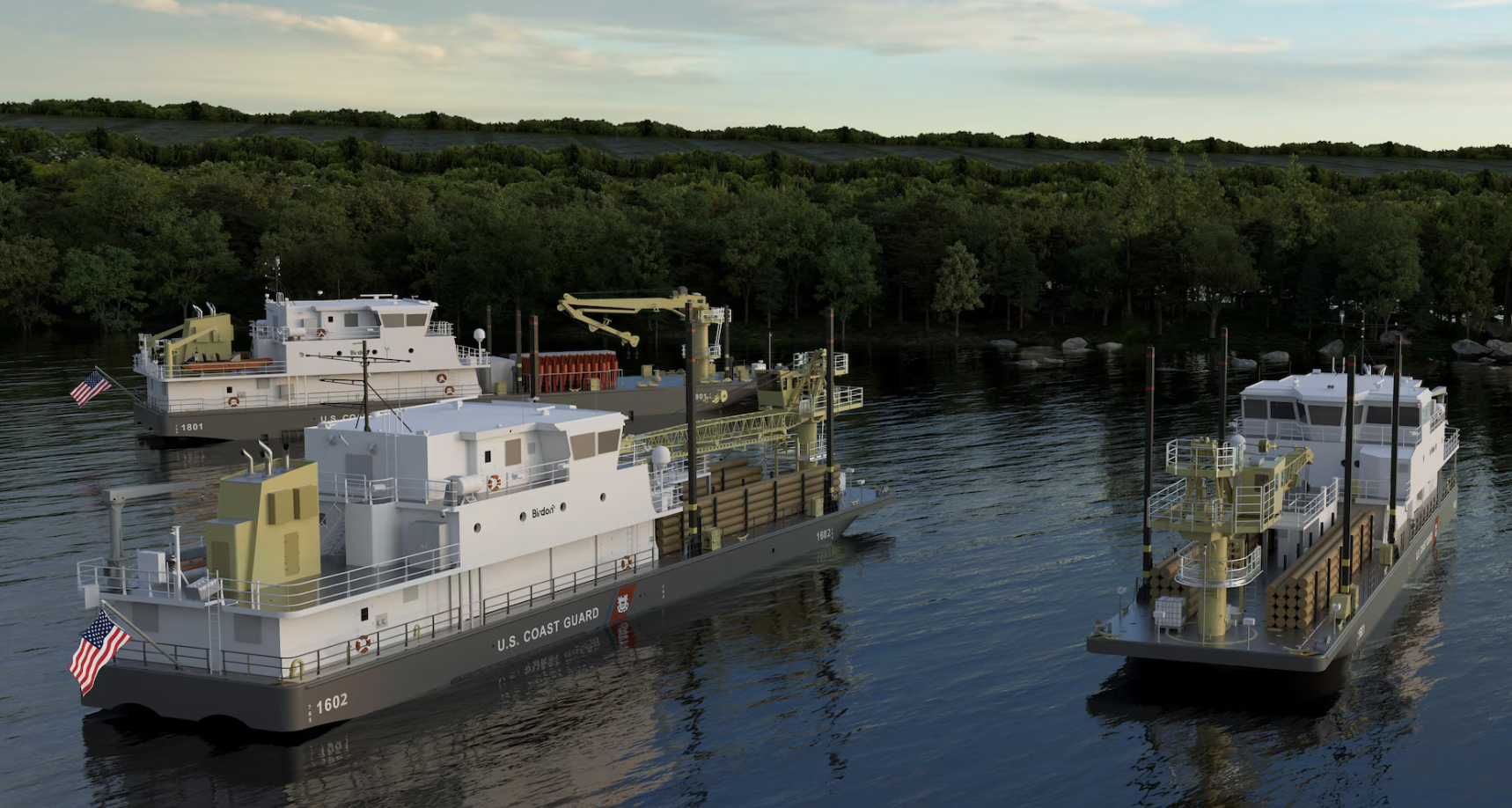
WASHINGTON – The U.S. Coast Guard authenticated the keels for future Coast Guard cutters Allen Thiele, Fred Permenter and Samuel Wilson on Friday in Bayou La Batre, Alabama.
In a special proceeding, the keels for three cutters were authenticated simultaneously, a departure from the traditional single-vessel ceremony. Keel authentication is a time-honored maritime tradition in which the ship’s sponsor welds their initials onto a ceremonial plate that is permanently affixed to the cutter, signifying the foundation of the vessel.
“Today marks a monumental step forward in the modernization of our inland fleet,” said Master Chief Petty Officer of the Coast Guard Phillip Waldron. “The new fleet has been designated the ‘Chief Petty Officer’s Class’ and the crews onboard who carry out critical missions on behalf of the Nation will honor the legacy of the senior enlisted leaders whose names they bear.”
The “Chief Petty Officer Class” designation for these cutters highlights the close involvement of the chief petty officer community, many of whom were in attendance.
All three cutter sponsors attended the ceremony. They are Delia Corbley, sponsor for future cutter Allen Thiele and daughter of the cutter’s namesake; Kristin Permenter Melvin, sponsor for future cutter Fred Permenter and granddaughter of the cutter’s namesake; and Barbara Wilson, sponsor for future cutter Samuel Wilson and widow of the cutter’s namesake.
Master Chief Petty Officer Allen Thiele, a boatswain’s mate, served in the Coast Guard from 1958 to 1990 and was selected as the fifth master chief petty officer of the Coast Guard.
Chief Petty Officer Fred Permenter, a boatswain’s mate, was awarded the Gold Lifesaving Medal in 1952 following the rescue of four of five crew members when St. George’s Reef Light Station’s motor launch capsized as it was lowered in heavy seas.
Chief Petty Officer Samuel Wilson, a boatswain’s mate, was awarded the Coast Guard Medal of Extraordinary Heroism in 1979 during the rescue of 81 crew members from the Japanese Fishing Vessel Ryuyo Maru No.2 that ran aground on St. Paul Island, Alaska.
The cutters are the first three of 30 future WCCs that will replace the Coast Guard’s legacy inland tender fleet, which will strengthen the Coast Guard’s capabilities to facilitate commerce vital to economic prosperity, strategic mobility, and maritime dominance. The WCC fleet will will play a critical role in controlling, securing, and defending America’s ports and waterways. and maintaining the United States’ 12,000-mile marine transportation system. This critical waterway network supports more than $5.4 trillion in annual economic activity and millions of American jobs.
Acquisition of the WCC fleet is supported by funding from the One Big Beautiful Bill Act – the largest single funding commitment in Coast Guard history – which included $162 million to accelerate production rates and deliver three cutters ahead of schedule. The first Waterways Commerce Cutter is expected to be completed in 2027.
 Chuck Hill's CG Blog