CG Yard Completes WLB Major Maintenance Availability Program

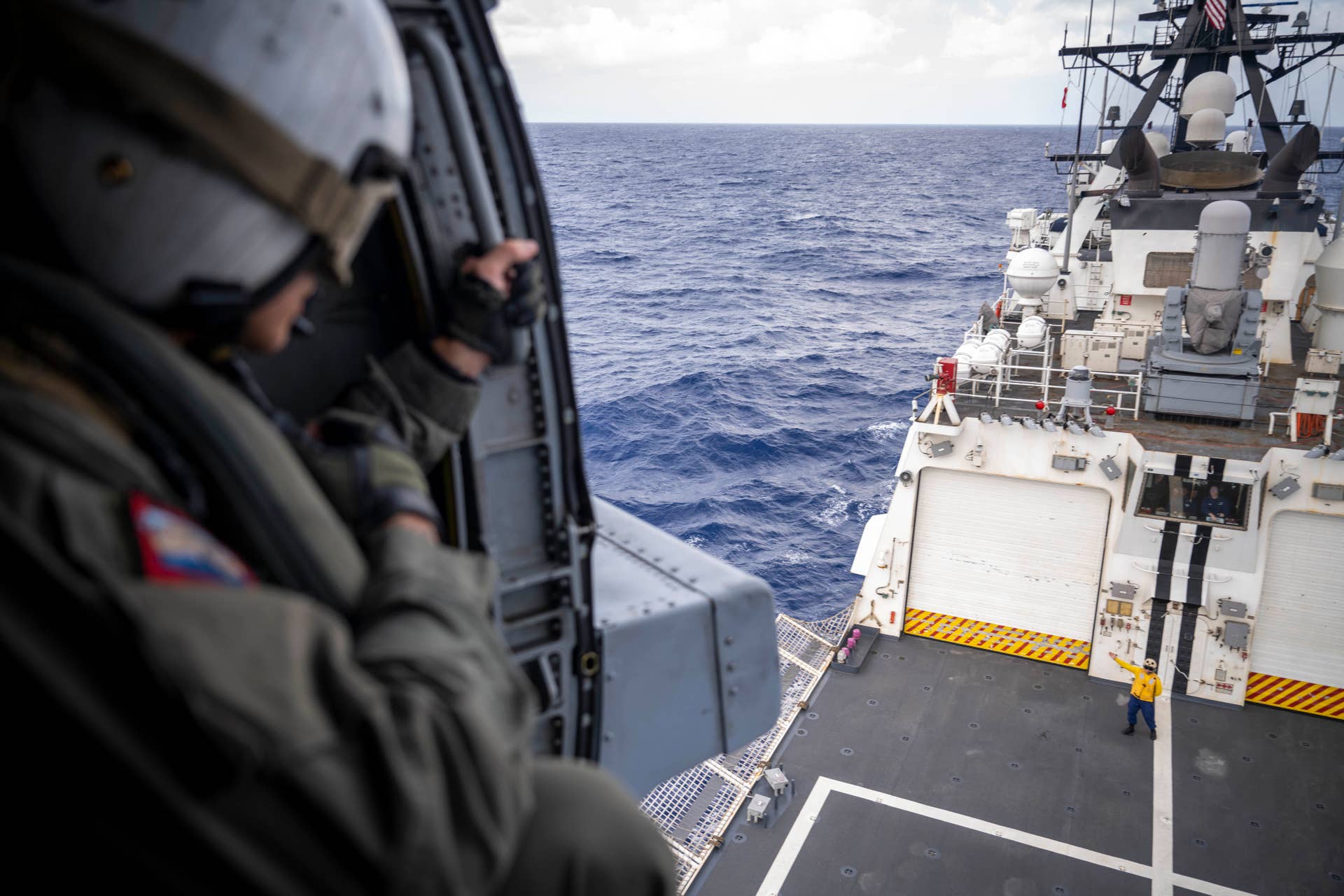
A completion ceremony at Coast Guard Yard marked the conclusion of the 225-foot Juniper-class seagoing buoy tender major maintenance availability program. The event was aboard Coast Guard Cutter Hollyhock, the last cutter to have gone through the maintenance program. U.S. Coast Guard photo by Lt. Stephanie Hurley.

Below is a Coast Guard news release. 


Coast Guard completes major maintenance program on seagoing buoy tender fleet

The Coast Guard In-Service Vessel Sustainment (ISVS) Program reached a significant milestone on July 29 with the completion of the major maintenance availability (MMA) program for the 225-foot Juniper-class seagoing buoy tender fleet.

Coast Guard Cutter Hollyhock was the last of the service’s 16 seagoing buoy tenders to have completed the MMA, which executed hull and structural repairs, removed and replaced obsolete, unsupportable and maintenance-intensive equipment, and updated the machinery control system, propellers, and heating, ventilation and air conditioning systems. Hollyhock remains at Coast Guard Yard, where the MMA work was completed, so the ceremony marking completion of the seagoing buoy tender MMA program was held aboard the cutter.

The ISVS program restores mission readiness, improves reliability and reduces maintenance costs of the service’s legacy cutter fleet through two types of projects: major maintenance availabilities and service life extension programs. These programs offer the most cost-effective solution for delivering essential maintenance and upgrades, ensuring Coast Guard surface vessels meet or exceed their expected service life.

“This outstanding accomplishment highlights the Coast Guard’s commitment to delivering reliable, mission-ready vessels both efficiently and cost-effectively,” said Kenneth King, program manager for ISVS. “Completing these 16 major maintenance availabilities on time and under budget exemplifies the service’s strategic approach to recapitalization, ensuring greater operational availability, reduced lifecycle costs and enhanced readiness to meet the Coast Guard’s critical missions.”

Commissioned in the late 1990s, the Coast Guard’s fleet of 225-foot seagoing buoy tenders began undergoing MMA work in 2015 to ensure each cutter achieves its full 30-year designed service life.

The seagoing buoy tenders are a multi-mission platform, with their primary mission to service aids to navigation throughout U.S. waters and wherever American shipping interests require assistance. The Coast Guard’s history of maintaining a fleet of seagoing buoy tenders dates back to the U.S. Lighthouse Service, one of the predecessor agencies that comprise the modern-day Coast Guard.

For more information: In-Service Vessel Sustainment Program page

“4,500 Marines and sailors deploy to Caribbean for anti-cartel mission” –Task and Purposes

Task and Purpose reports, 

The Navy and Marine Corps deployed thousands of sailors and Marines to the southern Caribbean on Friday in support of anti-drug cartel operations.

The Iwo Jima Amphibious Ready Group and the 22nd Marine Expeditionary Unit set sail out of Naval Station Norfolk on Aug. 14. The force includes more than 4,500 sailors and Marines on three ships: The Wasp-class amphibious assault ship, the USS Iwo Jima, and San Antonio-class amphibious transport dock ships the USS San Antonio and USS Fort Lauderdale.

The Navy described it as a “regularly scheduled deployment” and did not specify where it would be heading or for what purpose.

Despite the “regularly scheduled deployment” statement, this is definitely not normal.

Can’t say the US never sends subs into the Caribbean, be we don’t normally send ships like these into the Caribbean for counter drug operations.

USS Fort Lauderdale

USS San Antonio

USS IWO Jima


“U.S. Coast Guard Cutter Bertholf Returns Home from Deployment in Support of Southern Border Operations” –CG News

250806-G-G0200-1001, U.S. Coast Guard Cutter Bertholf (WSML 750) rendezvoused with U.S. Coast Guard Cutter Eagle (WIX 327) for a passenger exchange and formation steaming in the Pacific Ocean, August 6, 2025. Eagle is underway for her West Coast summer cadet tour, and Bertholf was nearing the completion of her Deployment in support of Operation Border Trident. (U.S. Coast Guard photo by Ensign Holli Welcker)

Below is a US Coast Guard news release.

Bertholf found some useful things to do, but they intercepted no drugs and apparently intercepted no migrants while smaller units did.

Is this really the way we want to use one of the most expensive Coast Guard assets?

As a former Coast Guard liaison to Fleet Training Group San Diego I would also note that the 378s used to train annually for four weeks, but of course they had an ASW missions.


Aug. 13, 2025

U.S. Coast Guard Cutter Bertholf Returns Home from Deployment in Support of Southern Border Operations

ALAMEDA, Calif. — The U.S. Coast Guard Cutter Bertholf (WMSL 750) crew returned to their home port on Coast Guard Base Alameda, California, Sunday, following a 70-day patrol operating along the Southwest maritime boundary line (MBL) near San Diego.

Bertholf deployed in support of Operation Border Trident, Coast Guard District Southwest’s (CGD-SW) standing operation to counter-illicit maritime activity along the Southwest MBL.

Operation Border Trident is a Coast Guard-led interagency approach to detection, monitoring, interdiction, and apprehension operations to combat transnational criminal organizations and illegal alien activity in the California Coastal Region. Bertholf increased Coast Guard operational presence in the area, maintaining border control and territorial integrity of the United States.

While at sea executing Operation Border Trident, Bertholf conducted 86 security boardings and queries in the vicinity of San Diego, checking more than 250 IDs and inspecting closed cabin vessels to thwart illegal activity. This included more than 250-crew hours deployed in Bertholf’s cutter response boats, providing law enforcement presence and deterrence on the Southwest MBL.

Departing Alameda on June 2, Bertholf conducted a change of command followed by an annual readiness assessment and training in San Diego prior to deploying to their assigned operating area. On June 9, 2025, Capt. Andrew Pate relieved Capt. Billy Mees as Bertholf’s 10th commanding officer.

Beginning on June 10, under the guidance of Afloat Training Organization San Diego, Bertholf conducted the first full Basic Cutter Operations assessment for the Legend-Class national security cutter fleet which included two weeks of drills, evaluations, and training reviews. The crew was tested against simulated shipboard fires and flooding in both the in port and underway environments, as well as shipboard emergencies in various tactical scenarios. Bertholf displayed high proficiency in several complex ship evolutions, including mooring, unmooring, and anchoring. Scoring a 95% average across all training areas, Bertholf earned certifications in naval warfare, damage control, seamanship, navigation, medical, and engineering proficiency.

Bertholf was twice diverted to respond to search and rescue tasking, a core responsibility that remains a sacred trust between the U.S. Coast Guard and the maritime public. The first case involved the search for a downed aircraft about 460 miles off San Diego. Bertholf conducted search patterns, including flying its embarked small, unmanned aircraft system (sUAS) and used one of its cutter response boats as part of a multi-service search effort.

Later in the deployment, Bertholf received tasking from Coast Guard Sector San Diego to respond to a person in the water 36 miles west of San Diego reported to be experiencing medical distress. Once on scene, Bertholf response boat crewmembers safely recovered the person in distress and brought them aboard Bertholf for initial medical care. Onboard health services technicians provided medical evaluations and care to stabilize the survivor until they were transferred to Emergency Medical Personnel for further care in San Diego.

“Bertholf’s crew displayed exceptional proficiency and professionalism recovering the survivor, stabilizing their condition, and conducting a smooth transfer via cutter boat to waiting EMS at Sector San Diego for further transfer to higher level care,” said Capt. Andrew Pate, commanding officer of Bertholf.

To maintain the cutter’s shipboard helicopter operation proficiency, Bertholf conducted 180 helicopter deck landings with U.S. Coast Guard Air Stations (AIRSTA) San Diego and Ventura aircrews. Bertholf also completed 24 fast rope exercises with AIRSTA Ventura and U.S. Coast Guard Maritime Security Response Team West. Coordination of flight operations provided critical training and proficiency opportunities for helicopter crews and Bertholf’s crew, supporting their ability to respond to emergencies requiring shipboard helicopter operations both during the day and at night.

Routinely operating independently, far from other U.S. Coast Guard cutters, Bertholf capitalized on several unexpected opportunities to rendezvous at sea with multiple cutters deployed from other districts.

Teaming with the U.S. Coast Guard Cutter Active (WMEC 618) early in the deployment, the cutters ran several small boat exercises to certify Bertholf’s boarding teams for law enforcement operations.

Later, while transiting south to evade a hurricane in Puerto Vallarta, Mexico, Bertholf rendezvoused with the U.S. Coast Guard Cutter Storis (WAGB 21), the first polar icebreaker acquired by the U.S. Coast Guard in over 25 years. Storis was partway through its maiden voyage and briefly conducted formation steaming with Bertholf.

Finally, Bertholf capitalized on the U.S. Coast Guard Cutter Eagle’s (WIX 327) visit to the west coast, coordinating a passenger exchange for 36 crew members and formation steaming. Eagle is a 295-foot, three-masted barque used exclusively as a training vessel for future officers of the United States Coast Guard. Bertholf and Eagle were briefly joined by the U.S. Coast Guard Cutter Florence Finch (WPC 1157), one of the Coast Guard’s newest 154-foot Fast Response Cutters.

During this deployment, Bertholf had several opportunities to interact with Department of Defense and international partners. While on a port visit in San Diego, Bertholf’s crew hosted the 89th Military Police Brigade and the 716th Military Police Battalion, strengthening relationships between the land and maritime services and enhanced their understanding of domain awareness capabilities in support of Operation Border Trident.

“I couldn’t be prouder of the Bertholf crew,” said Pate. “Their proficiency, professionalism, and pride throughout this deployment reflect a selfless commitment to defeating adversaries and providing security for the American people we serve.”

Bertholf is named for Commodore Ellsworth Price Bertholf, the Coast Guard’s first Commandant. Commodore Bertholf’s most notable service was his role in the famous Alaska Overland Expedition in 1897. When over 265 American whalers became trapped in ice at Point Barrow, Bertholf led the relief party 1,600 miles via dogsled. Along with Lt. David Jarvis and Dr. Samuel Call, Bertholf herded almost 400 reindeer through a frozen Alaska winter to feed the starving whalers, an act that would later earn him the Congressional Gold Medal.

Homeported in Alameda, Bertholf was commissioned on August 4, 2008, as the Coast Guard’s first Legend-class national security cutter. National security cutters are 418-feet long, 54-feet wide, and have a 4,600 long-ton displacement. They have a top speed of 28 knots, a range of 12,000 nautical miles, and can hold a crew of up to 170. Bertholf routinely conducts operations throughout the Pacific, where the cutter’s combination of range, speed, and ability to operate in extreme-weather conditions provides the mission flexibility necessary to conduct vital strategic missions. The ship’s motto is “Legends Begin Here.”


“The ICE Pact: One Year Later” –Sixty Degrees North

Canadian Coast Guard Multi-Purpose Icebreaker (MPI). Source: Seaspan
Note: The MPI image does not show the right propulsors; it will use Steerprop’s contra-rotating propulsors (CRP). Additionally according to Seaspan, the design could easily be upgraded to PC3. Confirmation from Seaspan and Aker Arctic. 

To get a realistic view of the potential of the ICE Pact, I recommend a review of the Sixty Degrees North’s review of the state of the agreement after the first year–useful, but perhaps less than we might have hoped.

“Coast Guard announces agreement to construct new polar security cutter shipyard facilities” –CG-9

I am trying to catch up on things, but while this is an August 4 release from the Acquisitions Directorate, I think it is an important step in integrating the PSC’s machinery and providing training.


Coast Guard announces agreement to construct new polar security cutter shipyard facilities

As part of continuing efforts to foster growth within the domestic shipbuilding industry and maintain momentum for acquisition priorities, the Coast Guard on July 23 formalized an agreement with Bollinger Mississippi Shipbuilding (BMS) to construct a production integration facility and land-based test facility at the shipyard in Pascagoula, Mississippi, in support of the Polar Security Cutter (PSC) Program.

This action represents a significant step in the Coast Guard’s continuing investment in the domestic shipbuilding sector and collaboration with industry partners to deliver critical assets to the nation. The construction of both facilities represents a significant capital investment partnership between the Coast Guard and BMS that will support streamlined production and integration of PSC mechanical and communication systems for a simplified installation process.

The Coast Guard modified the construction contract for the first PSC, originally awarded on March 25, 2025, to provide funding for the integration and test facilities via capital expenditure incentives. These incentives benefit the shipyard by providing access to funding for facility upgrades, workforce training and wage increases.

For more information: Polar Security Cutter Program page

“Chinese ships slam into one another during a South China Sea chase, Philippine Coast Guard video shows”

Business Insider Reports,

  • Two Chinese ships collided in the South China Sea on Monday.

  • A China Coast Guard vessel was chasing a Philippine ship when it hit one of Beijing’s destroyers.

The smaller China CG cutters appears to have been one of 22 Type 056 corvettes passed from the Chinese Navy to the China CG.

Thanks to Paul for bringing this to my attention.

Waterways Commerce Cutters to be “Chief Petty Officer” Class

Notional vendor rendering of two Chief Petty Officer class waterways commerce cutter variants: a river buoy tender (left) and an inland construction tender. Image courtesy of Birdon America Inc.

Marine Log reports,

The U.S. Coast Guard is to designate its new fleet of Waterways Commerce Cutters (WCCs) as the “Chief Petty Officer Class.” Each cutter will be named in honor of a Coast Guard Chief Petty Officer, recognizing the profound impact and legacy of these leaders within the service.

Sounds like a good idea.

Thanks to Paul for bringing this to my attention.