“U.S. Coast Guard encounters People’s Republic of China military naval presence in Bering Sea” –D17

A Coast Guard Cutter Kimball crewmember observing a Russian Destroyer in the Bering Sea, September 19, 2022. Coast Guard Photo

Below is a District 17 (Alaska) news release. USCGC Kimball was doing the same thing two years ago. Last year the US Navy had four destroyers doing the shadowing. In 2021 it was Bertholf. Chinese warship operated legally off American shores back in 2015. NORTHCOM’s on-line magazine, The Watch, suggested how these visits should be viewed.

Two items of note, (1) this is a little earlier in the year than we have seen them in the past, (2) where are the Russians? Usually there are Russian ships with the Chinese.

This provides another example of how the National Security Cutters are taking on a role comparable to AGIs of the Soviet Era.

It is ironic and a bit funny that the Chinese are doing “freedom of navigation operations.”

I will note again that the nearest US Navy surface ship is probably at least 1000 miles away, probably in Japan.


July 10, 2024

JUNEAU, AK –The U.S. Coast Guard encountered multiple People’s Republic of China military ships in the Bering Sea, Saturday and Sunday.

The crew of U.S. Coast Guard Cutter Kimball (WMSL 756) detected three vessels approximately 124 miles north of the Amchitka Pass in the Aleutian Islands, and an HC-130J aircrew from U.S. Coast Guard Air Station Kodiak detected an additional vessel approximately 84 miles north of the Amukta Pass.

All four of the People’s Republic of China vessels were transiting in international waters but still inside the U.S. Exclusive Economic Zone, which extends 200 nautical miles from the U.S. shoreline.

“The Chinese naval presence operated in accordance with international rules and norms,” said Rear Adm. Megan Dean, Seventeenth Coast Guard District commander. “We met presence with presence to ensure there were no disruptions to U.S. interests in the maritime environment around Alaska.”

The Chinese vessels responded to U.S. Coast Guard radio communication and their stated purpose was “freedom of navigation operations.” Coast Guard cutter Kimball continued to monitor all ships until they transited south of the Aleutian Islands into the North Pacific Ocean. The Kimball continues to monitor activities in the U.S. Exclusive Economic Zone to ensure the safety of U.S. vessels and international commerce in the area.

The Coast Guard, in coordination with U.S. Northern Command, was fully aware of and tracked the Chinese naval presence. In September of 2021 and 2022, Coast Guard cutters deployed in the Bering Sea also encountered Chinese surface action groups.

The Kimball patrolled under Operation Frontier Sentinel, a Coast Guard operation designed to meet presence with presence when strategic competitors operate in and around U.S. waters. The U.S Coast Guard’s presence strengthens the international rules-based order and promotes the conduct of operations in a manner that follows international norms.

Coast Guard Cutter Kimball is a 418-foot legend class national security cutter homeported in Honolulu, Hawaii.
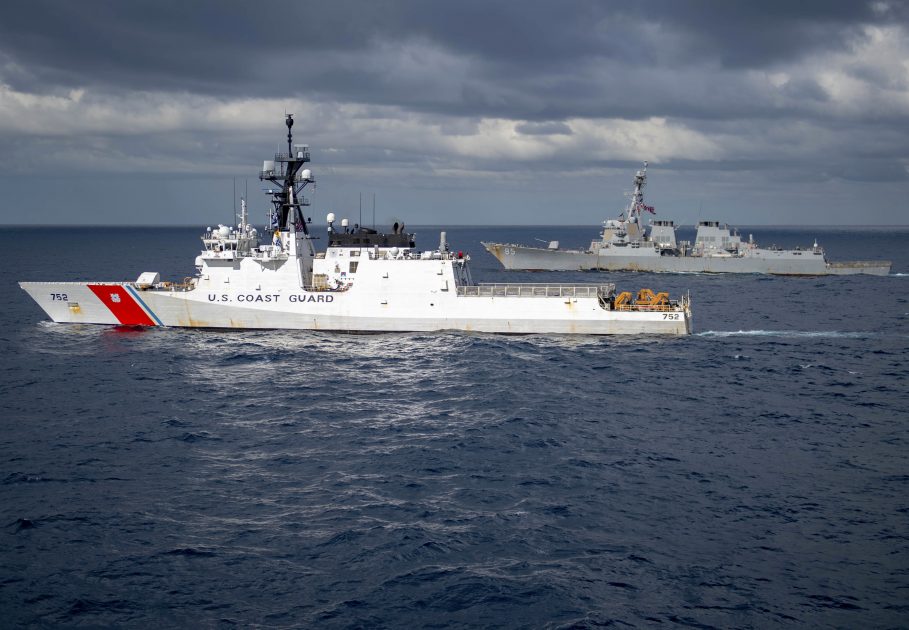
“Use the Coast Guard for Freedom of Navigation Operations” –USNI

USCGC Stratton (WMSL-752), left, and the U.S. Navy Arleigh Burke-class guided-missile destroyer USS McCampbell (DDG-85) maneuver in formation during Talisman Sabre 2019 on July 11, 2019. US Navy Photo

The December 2021 issue of US Naval Institute Proceedings has an article that suggests, “NSCs and OPCs are ideal vessels to take over FONOPs.”

Why do the authors, two Navy LCdr. and a Marine Capt., think this? They contend:

  • Their destroyers are overworked.
  • The Navy is having a hard time keeping their ships maintained.
  • Cutters are less intimidating
  • and less expensive
  • If the Chinese start playing bumper boats with Destroyers, they might damage expensive equipment. “…if a ship from the Chinese Navy, Coast Guard, or maritime militia were to ram a U.S. vessel conducting a FONOP, the ensuing visuals, narratives, and potential loss of combat capability would be starkly different between a Navy gray hull and a Coast Guard white hull.”

They talk about using LCS as an alternative, but then denigrate the possibility,

The Navy has rightfully used littoral combat ships (LCSs) to conduct limited FONOPs in the South China Sea, somewhat relieving overworked destroyers like the USS John S. McCain. However, the smaller LCS’s myriad of problems, curtailed acquisition numbers, and early retirement of the first four hulls mean the Navy will soon have to lean even more heavily on larger and generally older ships. With only 10 to 14 cruisers and destroyers available to Seventh Fleet at any given time, the Navy can ill-afford to use these high-demand, low-density, Aegis ships for FONOPs.

This, in spite of the fact, that LCS have only recently begun making regular deployments to the Western Pacific and LCSs are being added to the fleet at a rate of four per year.

First, I have no problem with Cutters doing FONOPs when they are in the Western Pacific, but that should not be the only reason, they are there.

US Navy ships are not overworked. That is a fiction. Having looked at the “USNI News Fleet and Marine Tracker” over many years, I can say, Navy ships are typically deployed about one third of the time, and they are underway only about 25% of the time, far less than Coast Guard cutters. That is not to say the people are not overworked, by burdensome administrative and overly broad qualification requirements for their junior officers. The ships are behind in maintenance because of lack of support, not time underway. Ships don’t need to spend 75% of their time, tied up in maintenance, to remain effective.

In war time, well over half the navy should be underway and forward deployed. The fact that they cannot support a much smaller forward presence, of which much of the time is not underway, in peacetime, points to a serious deficit in the Navy’s support structure. Where are the repairs ships, the tenders, the floating dry docks that allow a navy to be truly expeditionary?

If the Navy does not want to use carriers, cruisers, or destroyers for FONOPs because they are afraid of having them damaged, there are other alternatives. They could use amphibs: LHAs, LHDs, LPDs, and LSDs. They could use Military Sealift Command ships. MSC ships are clearly not as intimidating as carriers, cruisers, and destroyers. Were they to be damaged “the ensuing visuals, narratives, and potential loss of combat capability would be starkly different…” 

I would suggest using the new Navaho class tug and salvage ships. They are an excellent choice for playing bumper boats. They have strong steel hulls and are powerful enough to tow a nuclear-powered carrier. Their hulls are reinforced to allow hull to hull contact with other ships. Plus, they are a lot less expensive. Even less expensive than a Coast Guard cutter.

But really, using tugs or cutters to do FONOP kind of misses the point. The Chinese and the Russians are not upset because foreign ships are transiting waters they claim. They are upset because foreign warships are transiting the waters the claim. If we stop sending warships into the waters they claim, we are creating a defacto case that they have a right to such exclusion. That Coast Guard cutters may not be considered warships would weaken our case that, foreign warships in these waters is the norm.