This Day in Coast Guard History, October 26

Based on the Coast Guard Historian’s timeline, https://www.history.uscg.mil/research/chronology/
With inspiration from Mike Kelso

131107-N-WX059-125 PEARL HARBOR (Nov. 7, 2013) The Bangladesh Navy Ship (BNS) Somudra Joy (F-28) arrives at Joint Base Pearl Harbor-Hickam for a scheduled port visit. From 1972 to 2012 the ship was known as the U.S. Coast Guard Hamilton-class high endurance Cutter USCGC Jarvis (WHEC-725). (U.S. Navy photo by Mass Communication Specialist 2nd Class Sean Furey/Released) Note CIWS, air search radars, and 25mm Mk38 gun mounts have been removed.

2013 BNS Somudra Joy, formerly the Coast Guard Cutter Jarvis, departed Saturday from Alameda, marking a major milestone in international cooperation between the United States and Bangladesh. Joined by a small Coast Guard team of advisors, led by CDR Wendy Tomko, the Bangladeshi crew planned to make port calls at San Diego, Honolulu, Guam and Malaysia on their way to Bangladesh.

Coast Guard Cutter Reliance patrols the Western Caribbean in support of the Joint Interagency Task Force – South October 2014. The cutter’s crew worked with an aviation detachment from the Coast Guard Helicopter Interdiction Tactical Squadron based in Jacksonville, Fla., to detect and interdict suspected smugglers. (U.S. Coast Guard photo by Petty Officer 3rd Class Clinton McDonald)

2022 USCGC Reliance (WMEC 615) returned to homeport in Pensacola on 26 October 2022 after a 63-day Caribbean Sea patrol. Reliance supported the U.S. Coast Guard 7th District throughout their patrol, aiding in missions to interdict and disrupt the flow of illegal drugs and migrant trafficking while supporting national security and strengthening relationships with regional partners throughout the Caribbean. “I am extremely proud of our crew for their adaptability and professionalism throughout the patrol. Regardless of the mission set, whether that was responding immediately to the aftermath of the devastating earthquake in Haiti by conducting critical port assessments or stopping the flow of illegal narcotics, Reliance was always ready to respond to the needs of our Service and our Nation,” said CDR Robert Hill, commanding officer. Significantly, the crew supported the relief efforts in response to the earthquake in Haiti in August, conducting two separate port assessments on Haitian ports to ensure the harbors were safe for vessels to deliver vital aid and assistance to the region following the disaster.  During the patrol, Reliance’s crew intercepted one vessel attempting to smuggle approximately 1,132 lbs. of cocaine and detained a total of four suspected smugglers. Additionally, Reliance received more than 4,291 lbs. of cocaine, ten suspected smugglers, and 96 migrants from other U.S. Coast Guard cutters operating in the region.  The crew also rescued 50 Dominican nationals from an unseaworthy vessel off the coast of Puerto Rico and repatriated 158 migrants to the Dominican Republic’s navy. The 63-day patrol was critical in allowing the cutter crew to work on shipboard training, qualifications, and proficiency to maintain operational readiness. This training enabled Reliance’s team to complete a five-day major shipboard training exercise in Mayport, which tested their readiness in all aspects of damage control, seamanship, and navigational procedures. Reliance, a 210-foot medium endurance cutter, is homeported in Pensacola with a crew of 71.

This Day in Coast Guard History, October 25

Based on the Coast Guard Historian’s timeline, https://www.history.uscg.mil/research/chronology/
With inspiration from Mike Kelso

Appearing very different from its last Greenland visit in 1884, the USS Bear returned in 1944. Unlike in 1884, the Bear relied on a Coast Guard crew during World War II. As part of the Greenland Patrol, it cruised Greenland’s waters and, in October 1941, brought home the German trawler Buskø, the first enemy vessel captured by the U.S. in WWII. (Coast Guard photo)

1941  The Navy formally established the Greenland Patrol by combining the South Greenland Patrol with the three cutters of the Northeast Greenland Patrol.

USCGC Polar Sea

1985  CGC Polar Sea arrived home to Seattle after a voyage through the Northwest Passage by way of the Panama Canal, the east coast, and then Greenland, sparking an international incident with Canada.  She completed the first solo circumnavigation of the North American continent by a U.S. vessel and the first trip by a Polar-Class icebreaker.  She also captured the record for the fastest transit of the historic northern route.  She had departed Seattle to begin the voyage on June 6, 1985.

This Day in Coast Guard History, October 24

Based on the Coast Guard Historian’s timeline, https://www.history.uscg.mil/research/chronology/
With inspiration from Mike Kelso

Cutter Sherman returns home after a 52 day deployment

2014  CGC Sherman returned to its homeport of San Diego after completing a 52-day deployment to the Eastern Pacific Ocean participating in UNITAS 2014 and conducting counter maritime drug interdiction operations.  At the beginning of their deployment, Sherman represented the United States, one of 14 partner nations that participated in UNITAS 2014 from September 12-26.  Toward the conclusion of its deployment, Sherman interdicted two suspected smuggling boats that resulted in the seizure of approximately 120 pounds of cocaine with a wholesale value of nearly $2 million.

This Day in Coast Guard History, October 23

Based on the Coast Guard Historian’s timeline, https://www.history.uscg.mil/research/chronology/
With inspiration from Mike Kelso

1818  USRC Monroe captured the armed brig Columbia inside the Virginia Capes.  Columbia had been “cut out” of a Venezuelan fleet by pirates.

Algonquin, no caption/date; Neg. No. 148-2; Marine Photo Shop-Joe D. Williamson photo.

1907  The first wireless operator joined the Revenue Cutter Service, H. I. Logan, enlisted on the USRC Manhattan, a harbor tug based in New York City, as an “Electrician (acting).”  He was assigned to the cruising cutter USRC Algonquin where he reported on board on October 30, 1907.  Logan remained in the service until 22 December 1923 when he retired after serving on board the USCGC Bear.  He crossed the bar in 1936.

This Day in Coast Guard History, October 22

Based on the Coast Guard Historian’s timeline, https://www.history.uscg.mil/research/chronology/
With inspiration from Mike Kelso

1853  The English ship Western World grounded off Spring Lake, New Jersey, during a gale with about 600 persons on board. Everyone was rescued using equipment at the nearby station.

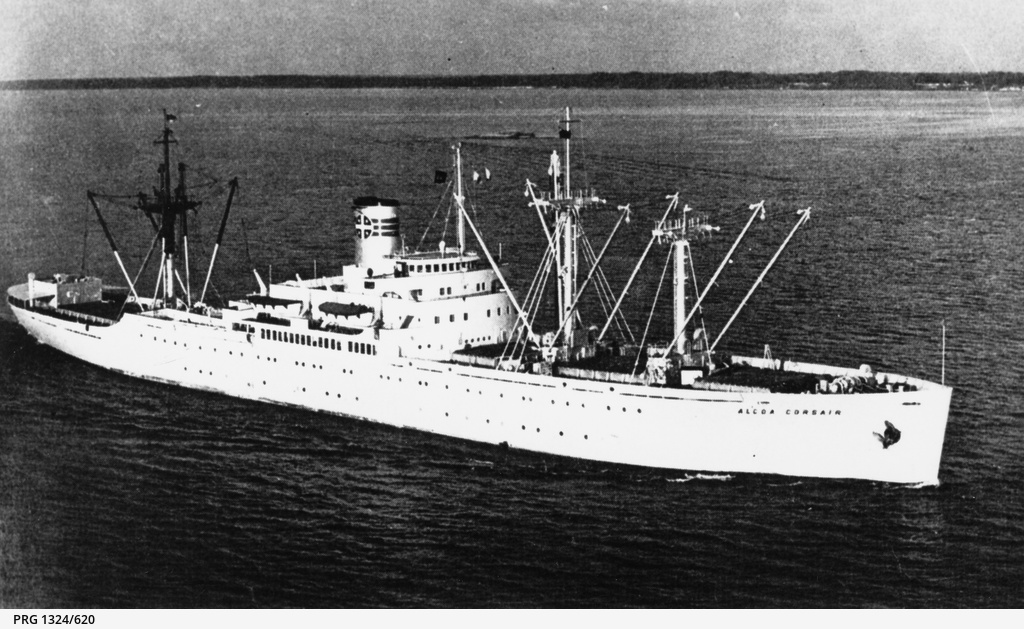
SS Alcoa Corsair

1960  Early in the morning on October 22, 1960, SS Alcoa Corsair and SS Lorenzo Marcello collided near the mouth of the Mississippi River.  Although the Lorenzo Marcello suffered no casualties and proceeded to New Orleans, Alcoa Corsair had eight fatalities, nine injured, and one missing, besides being forced to beach because of severe damages.  A Coast Guard helicopter removed four of the critically injured crewmen while Coast Guard boats and other craft ferried the remaining ones ashore to waiting ambulances.

Northwest Airlines DC-7

1962  Shortly after a Northwest Airlines DC-7 with 102 occupants ditched in the waters of Sitka Sound, Alaska, a Coast Guard amphibian sighted five life rafts.  All on board survived, although three suffered minor injuries.  A Federal Aviation Administration supply boat picked up the survivors, later transferring them to CGC Sorrel, which took them to Sitka, Alaska.

USCGC Charles Sexton (WPC-1108). US Coast Guard photo.

2014  The crew of CGC Charles David Jr. repatriated 43 Cuban migrants to Bahia de Cabañas, Cuba. These repatriations were a result of three separate interdictions of people attempting to illegally migrate to the United States. On October 18, 2014, the crew of CGC Charles Sexton interdicted 22 Cuban migrants from two separate interdictions in the Florida Straits. The next day, October 19, Sexton interdicted another 21 Cuban migrants. All of the migrants were safely removed from their makeshift vessels and were transferred to the Charles David Jr. for repatriation.

This Day in Coast Guard History, October 21

Based on the Coast Guard Historian’s timeline, https://www.history.uscg.mil/research/chronology/
With inspiration from Mike Kelso

Throughout the 1970s, Confidence’s crews seized international vessels originating from the Soviet Union, South Korea, Panama, and other nations for violating U.S. fishery laws.

1971  Alaska Senator Mike Gravel criticized the punishment of 18 crewmen of CGC Confidence for showing support for Greenpeace and asked the Commandant, Admiral Chester Bender, to investigate.

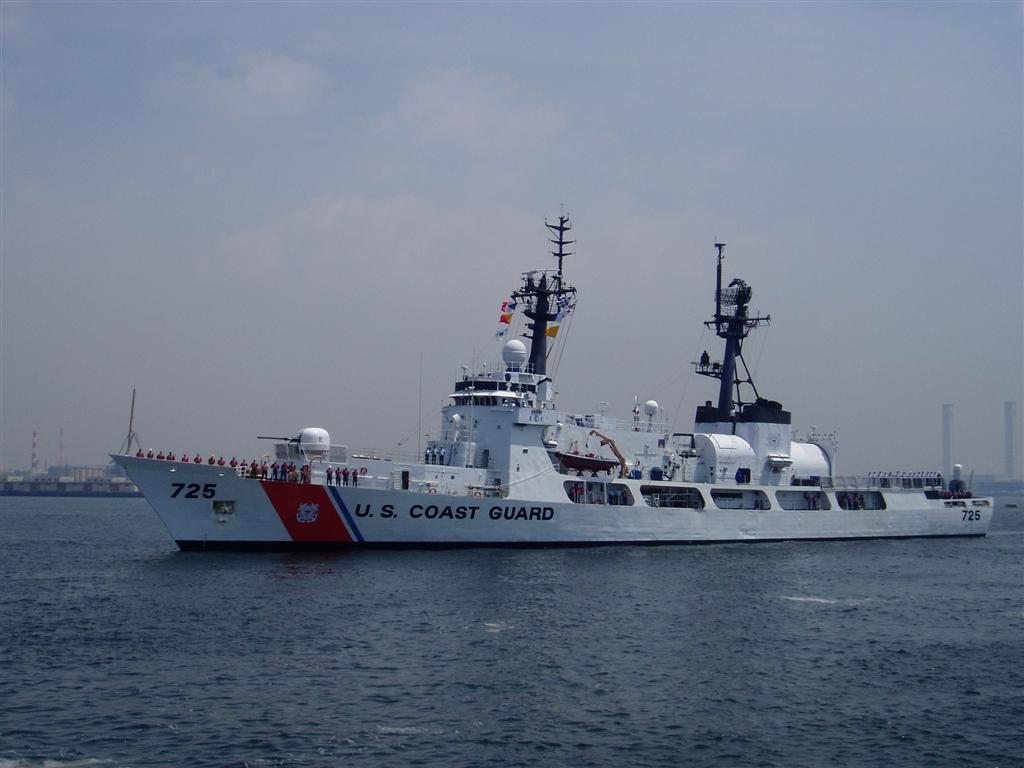
USCGC Jarvis (WHEC-725) participating in RIMPAC 2005.

2009  While on a law enforcement patrol in the Eastern Pacific off the coast of Central America, CGC Jarvis intercepted and captured a self-propelled semi-submersible (SPSS) first located by a U.S. Customs and Border Protection patrol aircraft.  Jarvis’s boarding team discovered 4,500 kilos of narcotics aboard the craft and arrested the SPSS’s four crewman.

This Day in Coast Guard History, October 19

Based on the Coast Guard Historian’s timeline, https://www.history.uscg.mil/research/chronology/
With inspiration from Mike Kelso

1881  The sloop Zulu Chief with four passengers and a crew of two men struck the bar off Hog Island Inlet, Virginia at a point about half a mile from the beach. The accident occurred at 11 o’clock am in plain view of the crew of Station No. 9, Fifth District, on Hog Island.  They launched the surfboat and went to the sloop’s assistance.  She was pounding heavily and lay in a very dangerous position.  The life-saving crew went to work without delay and carried out her anchors and succeeded in saving the vessel.

This Day in Coast Guard History, October 18

Based on the Coast Guard Historian’s timeline, https://www.history.uscg.mil/research/chronology/
With inspiration from Mike Kelso

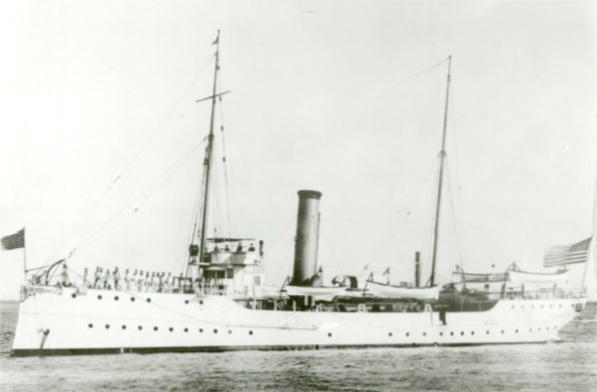
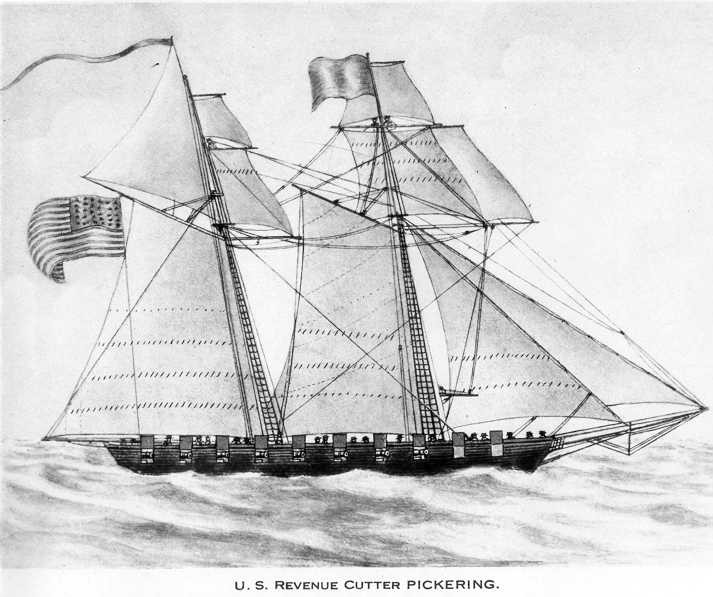
United States Revenue Cutter Service Ship Pickering, later renamed to USS Pickering U.S. Navy Historical Center Photograph- -Released

1799  USRC Pickering (70 men) (having been transferred to the US Navy 20 May) captured the French privateer L’Egypte Conquiste (250 men) on this date during the Quasi-War with France.

Earliest known photo of the 1849 station, circa 1900. National Archives, Record Group 26

1848  Captain Douglas Ottinger, USRM, was designated by the Secretary of the Treasury to supervise the construction of the first Life-Saving stations and the equipment and boats to be placed at them.

This Day in Coast Guard History, October 15

Based on the Coast Guard Historian’s timeline, https://www.history.uscg.mil/research/chronology/
With inspiration from Mike Kelso

1846  USRC McLane ran aground while attempting to tow three ships across the bar of the River Alvarado during the Mexican War in support of U.S. operations there. (McLane was refloated. This was part of the First Battle of Tabasco. Also involved was USRC Forward. McLane and Forward subsequently blockaded the port. Eleven cutters were assigned to cooperate with Army and Navy in the Mexican War. Cutters McLane, Legare, Woodbury, Ewing, Forward, and Van Buren were assigned to the Army. Cutters Wolcott, Bibb, Morris, and Polk were assigned to the Navy.)

1966  Coast Guard Port Security & Waterways Detail arrived for service in Vietnam.

2001  President George W. Bush announced that a letter sent to Senate Majority Leader Tom Daschle was laced with anthrax.  This followed a number of other anthrax attacks in Florida and New York.  The EPA requested Coast Guard assistance.  Members of the Atlantic Strike Team (AST) deployed to Washington, D.C., while Gulf Strike Team (GST) members were deployed to Florida.  Strike team members conducted entries into the affected areas, collected samples, and assisted in the cleanup of those areas.  The AST members in Washington coordinated entries into the U.S. Capitol, Hart Senate Building, the U.S. Supreme Court, and the Government Printing Office, among others.  The GST members took samples and provided decontamination stations at the American Media Inc. headquarters building and post offices in Boca Raton, Florida, the site of the first reported anthrax attack. (History of the National Strike Force)

This Day in Coast Guard History, October 14

Based on the Coast Guard Historian’s timeline, https://www.history.uscg.mil/research/chronology/
With inspiration from Mike Kelso

October 14

1801  Secretary of the Treasury Albert Gallatin announced his decision to reduce the “Revenue Cutter Establishment…as near as circumstances will permit within its original limits” after the Quasi-War with France.  During that conflict the service had acquired larger cutters with more numerous crews.

Photo of EM DOW’s sister cutter EM ROWE

1943  CGC E.M. Dow grounded and was abandoned (in a category 2 hurricane) near Mayaguez, Puerto Rico. All hands were saved.

Callao (IX-205) as the armed German Naval Auxiliary vessel Externsteine off Greenland after being captured by the Coast Guard in October 1944. US Coast photo

1944  CGCs Eastwind and Southwind captured the Nazi weather and supply vessel Externsteine off the coast of Greenland after a brief fire-fight (three salvos from its 5″/38 guns one short, one over and one across the bow–no return fire from Externsteine).  There were no casualties.  The Coast Guardsmen christened their prize-of-war USS Eastbreeze and placed a prize crew on board.  The prize crew was commanded by LT Curtiss Howard and consisted of 36 men, including some from Southwind.  After sailing with the Greenland Patrol for three weeks, Eastbreeze sailed on to Boston where the Navy renamed it as USS Callao. The Externsteine/Eastbreeze/Callao was the only enemy surface vessel captured at sea by U.S. naval forces during the war. (USCGC Northland also seized the German-controlled Norwegian sealer SS Buskø on 12 September 1941.) Eastwind and Southwind had gone farther north and returned under their own power than any vessel ever before. (An interesting sidelight from the Wikipedia report of the capture, “On 2 October, a Grumman J2F Duck aircraft from USCGC Eastwind spotted a trawler camouflaged in a field of unconsolidated pack ice off North Little Koldewey Island, where the Germans had set up a weather station. The camouflaged ship was visible on the aircraft’s radar”–surprising the little float plane had radar!)

1947  CGC Bibb rescued all 62 passengers and seven crew members of the transatlantic flying boat Bermuda Sky Queen in the mid-Atlantic after the flying boat made an emergency landing near the cutter.  The rescue was of the most dramatic rescues ever undertaken by the Coast Guard on the open ocean.

1961  After an Air Force B-52G [serial number 58-196??] with eight persons on board was reported overdue and possibly down in the Atlantic Ocean somewhere off Newfoundland, the Coast Guard commander, Eastern Area, coordinated the extensive search that resulted.  Participating in it were 79 U.S. Coast Guard, Navy, Air Force, and Canadian aircraft, five U.S. Coast Guard cutters, and two merchant ships.  Despite this search that lasted through October 18 and covered 286,225 square miles, no trace of the missing B-52 or its crew was found.