Ryan Erickson has been busy over at the Naval Institute Blog, posting both a remembrance video to CG 6505, lost this day in 2008, and linking to the flicker page for the new CG HQ construction project.
Category Archives: News
Helping Build and Maintain Narco-subs.
Recent news, a group arrested for helping narco traffickers build their “subs” included former members of the Colombian Navy and at least one serving officer. Not really surprising that with the temptation of big money they have a few “bad apples,” but a cautionary tale.
NSC #3 Delivered, #4 Started, #5 to be Contracted.
USCGC Stratton, WMSL-752 was delivered on Friday, Sept. 2. More here.
Fabrication of USCGC Hamilton, WMSL 753, began two days earlier on August 31.
I have heard USCGC James, WMSL 754, will be contracted next week.
The Coast Guard has gotten its act together. Now, will Congress fully funds USCGC Stone , WMSL 755, in FY2013?
Piracy Update, 1 September, 2011
Background:
If you are new to this topic there is some good background here in the form of advice from the International Sailing Federation intended primarily for yatchsmen. “ISAF Warning Letter”.
Changing Tactic:
Too early to tell if this is a trend, but the pirates seem to be changing their tactics attempting to swamp the defenses of even armed vessels by using as many as twelve skiffs, “Pirates Hunting in Packs.” Chart here. This incident took place near Somali shores where it is easier to gather a large number of boats.
Frustrated by an armed guard while it was under way, pirates subsequently seized a chemical tanker after the armed guard had left, while the ship was anchored in port in Oman, taking 21 hostages. Chart here.
Geographic spread:
The pirates seem to be extending their reach to operate beyond the waters patrolled by naval forces. There is a report that they may now be exploiting a business arrangement with the remnants of the Tamil insurgency to allow them to operate south of India in the vicinity of Sri Lanka, “Recommended Reading “Deadly Business”-at American Shipper.”
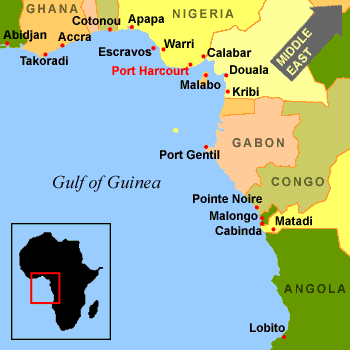
Piracy also seems to be spreading to the Gulf of Guinea on Africa’s Atlantic coast where oil is the prize.

A report carried by the Associated Press quoted Bergen Risk Solutions, a Norway-based consultancy:
“Our investigations indicate that the organized group responsible is based in Nigeria and has high-level patronage in that country,” it said, with prominent Nigerians having often been accused of involvement in the lucrative black market for oil and fuel. This cargo, Bergen suggests, has been sold in: “several West African ports, possibly including Abidjan in Cote d’Ivoire and Port Gentil in Gabon.”
There are some indications that there is a recognition of the problem and a desire to address it, “Steps toward and Iintegrated African Coastguard” and “West African Piracy Cooperation.”
Top 10 Technology ideas for the Coast Guard
gCaptain offers some interesting ideas for the Coast Guard, and a challenge to find more, “Top 10 Technology Ideas for the Coast Guard.”
Iranian Shell Game
gCaptain has an interesting post, “Tehran’s Ghost Fleet,” on how Iran has re-flagged and renamed some of their vessels and used shell corporations in an attempt to circumvent sanctions, including references to connections in China and Mexico.
Air Force Hourly Operating Costs
Thought some of your might find these figures interesting. these two postings list cost per operating hour for several Air Force aircraft including C-130H and C-130J that are also operated by the Coast Guard. (There is a real surprise here in that the costs to operate the C-17 are essentially the same as for the C-130H.)
Fighters, Bombers, Airlifters, and ISR and C2 aircraft here. The F-22, CV-22, and some very exotic aircraft here.
“CG’s Deepwater Program Continues to Flounder”–AP/Navy Times
I wanted to draw your attention to an article that appeared on the Navy Times website, “CG’s Deepwater Program Continues to Flounder,” by Alicia A. Caldwell – The Associated Press, Posted : Sunday Aug 21, 2011 13:45:51 EDT.
This story was not a Navy Times exclusive. Through the AP, it has been widely published. You may have seen a version of it on your local media. Unfortunately this article while perhaps “true” is written in such a way as to be misleading, irresponsible, and damaging because of what it left out. I have already posted my comments on the Navy Times Website.
“…the Coast Guard has two new ships to show after spending $7 billion-plus” gives the impression the Coast Guard spent $7B for two ships which is far from the truth.
The money in question has purchased six C-130Js, twelve HC-144 maritime patrol aircraft and 12 associated mission pallets, upgraded older C-130Hs and 102 H-65 helicopters. It has refurbished 16 medium endurance cutters and 13 patrol boats. It has upgraded C4ISR equipment. In addition two more large ships and at least four smaller 154 foot cutters are paid for and will be delivered soon.
For many the takeaway from the article is that the Coast Guard is incompetent and cannot be trusted. In fact the cost of the two ships mentioned is about the same as the lead ships of the Navy’s LCS classes in spite of the fact that the cutters are almost 50% larger.
…
The Coast Guard had to rebuild its procurement staff because previous economy measures had stripped it of it’s in house expertise when a previous administration decided that the Government should outsource its decision making.I know this was an AP article, but I would expect more balance from Navy Times.
I hate to see these allegations go unanswered.
African Coast Guard Network
Here is an interesting proposal for an African Coast Guard Operational Network.
MONROVIA, Liberia—Cmdr. Robert Hendrickson, commanding officer of the Coast Guard Cutter Mohawk, speaks to the media in Monrovia, Liberia, Aug. 12, 2010. The Mohawk traveled to Monrovia to begin with the Liberian Coast Guard as part of the African Partnership Station, an international security cooperation initiative, facilitated by U.S. Naval Forces Africa, aimed at strengthening global maritime partnerships through training and other collaborative activities in order to improve maritime safety and security in Africa. U.S. Coast Guard photo by Petty Officer 3rd Class Victoria Bonk.
Obviously it would be easy to be cynical about the prospect of this sort of thing happening, but there are strong incentives and the African nations have sometimes shown a willingness to work together through the African Union.
A look at a map of Africa will show many places where criminals can move quickly among the territorial seas of various nations. Without law and order, economic development is difficult at best and frequently impossible. The Somali piracy problem is already adversely effecting the economies of it’s neighbors, and it appears that piracy is becoming more of a problem in the Gulf of Guinea.
The US Coast Guard certainly has a role to play through the African Partnership Station, if such an organization is to be realized. Not that I would ever expect them to be literally integrated, but if the USCG can cooperate with their Russian counterparts, there is reason to hope that African nations can also cooperate.
Budget Cut/Stimulus Implications for the Coast Guard
OMB guidance for the FY 2013 budget submission is out.
“Unless your agency has been given explicit direction otherwise by OMB, your overall agency request for 2013 should be at least 5 percent below your 2011 enacted discretionary appropriation. As discussed at the recent Cabinet meetings, your 2013 budget submission should also identify additional discretionary funding reductions that would bring your request to a level that is at least 10 percent below your 2011 enacted discretionary appropriation.”
But in addition to cuts of 5 to 10% they are also looking for “positive economic impact.”
“…you should identify programs to “double down” on because they provide the best opportunity to enhance economic growth.”
I don’t see how cutting a manpower intensive service like the Coast Guard can help unemployment, but to me “positive economic impact” means:
- Should be something the country is going to buy sooner or later, things that have lasting value, preferably saving money in the long term.
- Employs Americans–what percentage goes directly into American pockets should be a consideration.
- Reduces dependence on foreign oil.
- Requires minimum imports.
Galrahn (Raymond Pritchett) over at Informationdissemination sees very little evidence of meaningful security review, “Thoughts on Future of DOD Budget”. If that is true for the DOD, then it is also probably true for the Coast Guard as well. We probably can’t expect any significant change, other than budget cuts, but we can still hope. Galrahn did make a very specific reference to the Coast Guard:
“…it is hard to believe the Obama administration would recommend anything favorable to the maritime services…That doesn’t mean they shouldn’t. I strongly agree with the economists who have been critical of the Obama administrations implementation of Keynesian economics, because I believe it has been a spectacular failure primarily because the focus on service related jobs has done almost nothing to create legitimate supply chains throughout the economy with the government investment. Several economists have noted that most of the money headed to the private sector ends up going to suppliers that are outside the United States, and have thus far produced far less economic impact (and jobs) than the administration was hoping for. The only manufacturing industry in the United States where money is almost guaranteed to hit suppliers in the United States is shipbuilding, which ironically is largely a government dependent manufacturing sector anyway. It is hard to imagine a scenario where the Obama administration would consider the option of increasing spending in shipbuilding as a jobs program for manufacturing. If they did, building Coast Guard vessels would be as much if not more important priority than building Navy ships (emphasis applied), but the likelihood the Obama administration would try something as intelligent as spend government money on the shipbuilding sector as a jobs program is fairly close to zero. One of the primary reasons is because shipbuilding could takes years to produce desired economic results, and it is hard to imagine the Obama administration has a long term vision for jobs with an election only 15 months away.”
New ship building programs may be a long way off although I believe the OPC program could be considerably accelerated, but the Coast Guard has lots of other programs where perhaps the government should “double down.”
The Inland River Tender program is, I believe, ready to go. They build the infrastructure for the most fuel efficient transportation system in the US. They can be built in multiple small ship yards (benefiting more than one Congressional district).
Response Boat, Medium (RB-M) and Response Boat, Small (RB-S) projects are in progress. The much smaller cutter boat programs, the 11-meter Long Range Interceptor II (LRI-II) and the 7-meter Cutter Boat Over the Horizon IV (CB-OTH-IV) should be ready for investment now or in the near future. These new boats should also be more efficient to operate.
Many of the Coast Guard’s buildings ashore seriously need replacement or refurbishment. These projects all provide jobs to the local economy and with the more efficient buildings and solar power installations will reduce fuel consumption.
The NSC and FRC programs are also mature, and well understood. The Coast Guard would, I’m sure be delighted to have funds to accelerate these programs in FY2013. It might be a logical move, but the CG will be lucky if one NSC and six FRCs are fully funded.
Something that might be considered is switching from buying European built HC-144s to much more fuel efficient, American built Beech C-12s. These aircraft also known as the Super King Air, are already used by all the other armed services. The Army and Air Force use them for ISR (intelligence, Surveillance and Reconnaissance) and internationally they are widely used as Maritime Patrol Aircraft. Recent variants match the HC-144’s range, speed and endurance. Their operating costs are lower. There may even be other service contracts that the Coast Guard could exploit to ease procurement.
In a side note, with the Navy facing down sizing, it is more important than ever that Coast Guard assets have meaningful military mission capabilities. I consider that a moral obligation, but that the service can do “double duty” could also be a potential selling point.