Today, Alejandro Mayorkas was officially sworn in as the seventh Secretary of Homeland Security. Secretary Mayorkas took the oath this afternoon after the Senate voted to confirm him. As Secretary of Homeland Security, Mayorkas now leads the third largest federal department in the United States. (DHS Photo by Benjamin Applebaum/Released)
February 2, 2021
WASHINGTON – Today, Alejandro Mayorkas was officially sworn in as the seventh Secretary of Homeland Security. Secretary Mayorkas took the oath this afternoon after the Senate voted to confirm him. As Secretary of Homeland Security, Mayorkas now leads the third largest federal department in the United States, which includes the Cybersecurity and Infrastructure Security Agency, Federal Emergency Management Agency, Transportation Security Administration, U.S. Coast Guard, U.S. Customs and Border Protection, U.S. Immigration and Customs Enforcement, U.S. Citizenship and Immigration Services, and the United States Secret Service.
“DHS bears an extraordinary weight on behalf of the American people, the weight of grave challenges seen and unseen,” said Secretary Mayorkas. “It is the greatest privilege of my life to return to the Department to lead the men and women who dedicate their talent and energy to the safety and security of our nation. I will work every day to ensure that they have the tools they need to execute their missions with honor and integrity. The mission of the Department of Homeland Security is to safeguard the American people, our homeland, and our values. The United States is a welcoming and empathetic nation, one that finds strength in its diversity. I pledge to defend and secure our country without sacrificing these American values.”
Secretary Mayorkas is the first immigrant to serve in the role of DHS Secretary. His parents arrived with him and his sister to the United States as refugees after fleeing Cuba in 1960. Secretary Mayorkas previously served as the DHS Deputy Secretary from 2013 to 2016. Prior to holding that position, he was the Director of U.S. Citizenship and Immigration Services, the agency charged with operating the largest immigration system in the world.
On February 2, 2021, Vice President Kamala Harris swore in Alajandro Mayorkas as Secretary of Homeland Security. Vice President Harris tweeted ‘Congratulations to @AliMayorkas, our new Secretary of Homeland Security. Secretary Mayorkas is a dedicated public servant with a wealth of experience, who will keep America safe while upholding our values.’ (DHS Photo by The White House/Released)
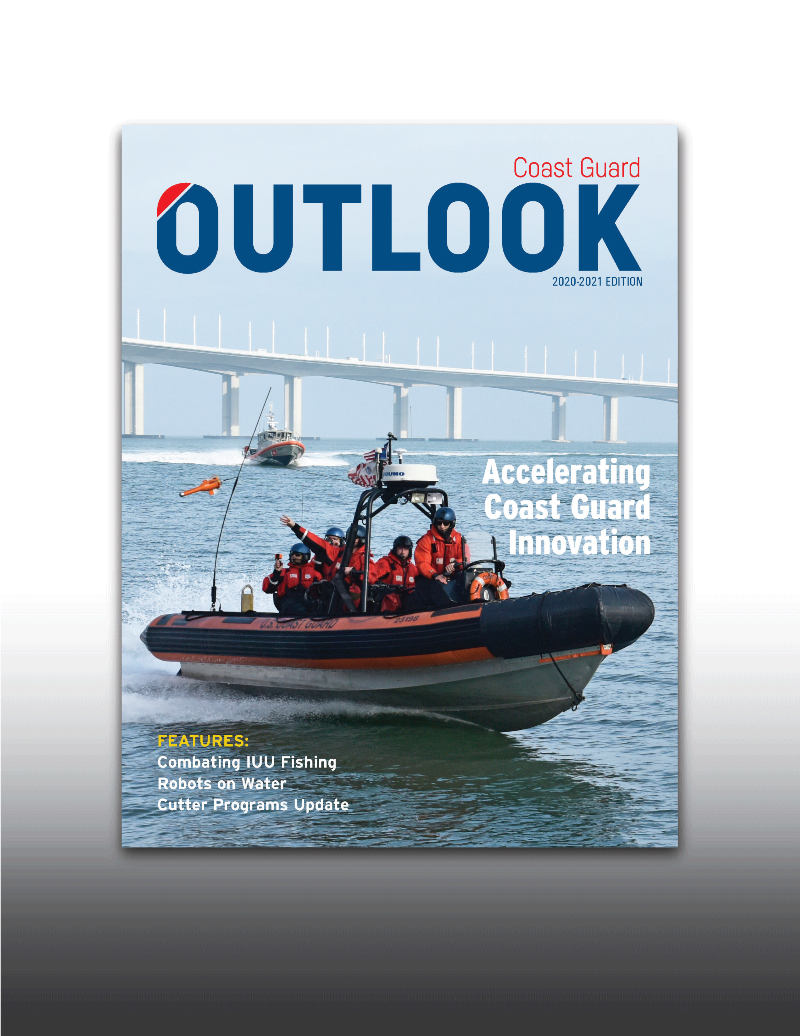
A new edition of the “Coast Guard Outlook” on line magazine is available. It is a slick product of over 100 pages. Even has descriptions of Coast Guard assets (ships, boats, aircraft) beginning on page 72, including homeports for the various cutter types. Description of aircraft types begin on page 98.
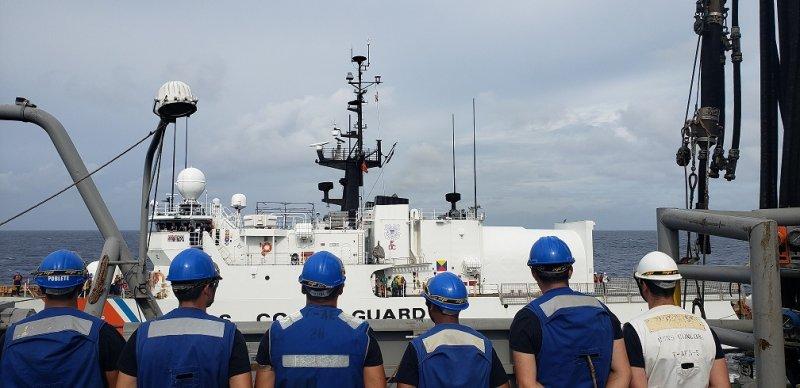
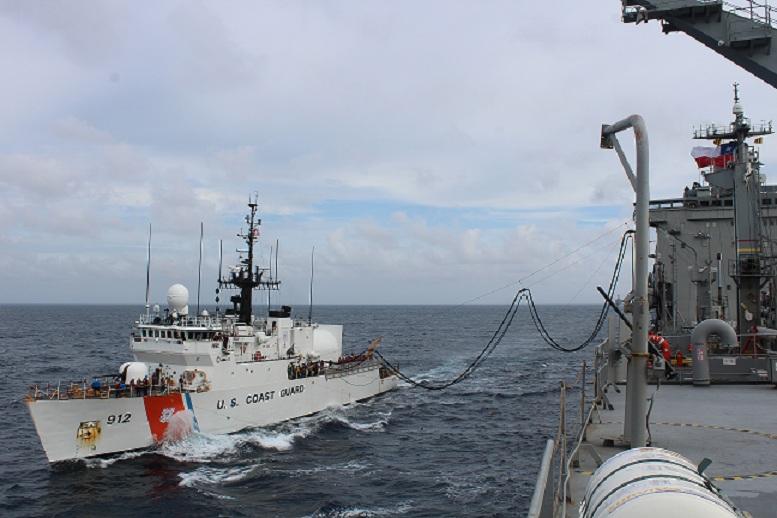
These are a bit old. I had intended to publish them earlier but got distracted. Photos curtesy of Andres Navolari, author of one our most popular posts, Three Nations Share German OPV Design. It was published in 2014 and still getting views.
USCGC Seneca WMEC-912 refueling from Chilean Navy Oiler Almirante Montt
“Dennis L. Bryant graduated from the US Coast Guard Academy in 1968 and served 27 years active duty, retiring as a Captain. During that career, he made Arctic cruises back when there was real ice there. He attended law school, served as the USCG Law of the Sea officer, advised on international affairs, and supervised the Coast Guard’s implementation of the Oil Pollution Act of 1990 (OPA 90). After leaving the Coast Guard, he joined a law firm, serving as Senior Maritime Counsel. Since 2009, he has operated an independent consultancy, advising clients worldwide.”
Dennis L. Bryant’s blog “Bryant’s Maritime Consulting” has been on my recommended blogs list for many years. I have tried to read it every week day because it has been such a good source of information. Many of my posts have been prompted by his reports. He reports (quote below) he will no longer maintain his blog after 31 May, but asked if anyone is “interested in picking up the mantle.” Any “M types” interested?
He will be missed.
“After more than 20 years writing and distributing my maritime newsletter and almost 20 years writing a monthly column for Maritime Reporter & Engineering News (MREN), I will be stepping back effective 31 May 2021. I have enjoyed both and have had the opportunity to meet numerous new friends, particularly Greg Trauthwein, MREN’s Editor and Associate Publisher, who has endured my ramblings, which often got far afield. Unfortunately, those missions have become very time-consuming and increasingly expensive. I will be turning my attention more to my family (including my very patient wife of over 50 years), my maritime consulting practice, and to my writing. I have recently completed (if anything is ever completed) a novel and now begin my search for an agent and a publisher. I do not intend to quit paying attention to maritime matters nor closing my maritime consulting practice, but I will quit polluting your in-boxes on an almost daily basis. If anyone is interested in picking up the mantle, please contact me.”
This is the President’s nominee for Secretary of the Dept. of Homeland Security, Alejandro Mayorkas. Wikipedia bio here.
He had an interesting early life,
His father was a Cuban Jew of Sephardic background who owned and operated a steel wool factory in Havana. His mother was a Romanian Jew whose family escaped the Holocaust and fled to Cuba in the 1940s. The Cuban Revolution marked the second time his mother would be forced to flee a country she considered home.
He is not new to the Department, having been first Director of U.S. Citizenship and Immigration Services and then Deputy Secretary DHS during the Obama administration.
7.62 mm Chain Gun as Coax as optionally installed on 25 mm Mark 38 Mod 3. Image copyrighted by NAVSEA Dahlgren.
The Navy League’s on line magazine has an interview with the Navy’s director N96. Most of it, is not Coast Guard related, although, in the future, we may see some CG applications of the lower powered laser systems being developed and CG personnel may use of some of the simulators being discussed.
There was a paragraph that may have near term significance to the Coast Guard,
“In addition to extended missile ranges, we’re also increasing our close-in battlespace lethality. The updated Mk38 Mod 4 Gun Weapon System provides an updated electro-optical sensor system with combat system integration for improved accuracy and close-in engagements against fast-attack craft and fast inland attack craft threats. In the near future, these guns will be paired with other weapon systems for greater lethality against close- in air threats as well.” (Emphasis applied–Chuck)
Since we have versions of the Mk38 Gun Weapon Systems on all our Webber class WPCs and will have them on all our Offshore Patrol Cutters, this could be significant.
I will speculate that he may be referring to adding APKWS to the mount. Weapon systems was plural so Hellfire/JADM and Stinger are also possibilities.
Thomas W. Harker, Acting Secretary of the Navy. US Navy photo
Interesting little piece of trivia. Acting Secretary of the Navy Thomas W. Harker was (is?) a Coast Guard Commander. USNI reports his first message to the fleet.
As reported here earlier, PACAREA Commander VAdm Fagan expressed concern that the Coast Guard might be seen differently if its ships were better armed. “… the reaction might be different if the Coast Guard were to sort of look like the Navy combatant.”
I have a lot of respect for Adm. Fagan. PACAREA has taken some bold initiatives in law enforcement, operating Webber class far from home.
The Coast Guard is welcome in many places where the Navy is not, so this is a valid concern.
But (there is always the but) I will argue that the difference is because of the Coast Guard’s history and reputation, not because of how are ships are armed and add that, in fact, peacetime missions of law enforcement/counter terrorism, at least as much as military readiness, requires that our ships should be better armed. Meanwhile, the deteriorating international system indicates this is a time when the Coast Guard needs to prioritize its military capabilities.
A Personal Perspective:
There are a few places, notably in Central America where the Coast Guard is welcome, but the US Navy is not. Several Central American countries have had history with the US military, that has left an unfavorable impression.
I am most familiar with the situation in Costa Rica, although my experience was long ago, when I visited there to arrange joint exercises. Since then I have seen information that Coast Guard cutters were allowed to visit and replenish in Costa Rican ports, but Navy ships were not.
Costa Rica’s distrust in of the US Navy is probably most firmly routed in their distrust of the military in general. In 1948, following a civil war, they abolished their military and the ban was included in their constitution in 1949. But, they do have a Coast Guard, last I heard, their uniforms were modelled after that of school children, but it is well provided with small arms. When I visited, long before there were regular drug interdiction operations in the Eastern Pacific, there was a US Coast Guard liaison officer there, as there had been for many years. That long relationship of mutual understanding is probably the most important reason of the current level of trust.
Perceptions:
What is it that a foreign national sees when he or she sees a Coast Guard Cutter? Do they feel threatened? They know it is a warship because it has a gun on it. Most will not know how powerful the gun or other weapons might be. The color, white, rather than gray does look less menacing.
Would they recognize vertical launch tubes for Hellfire that can be painted white, are no more than about eight feet high and look like uptakes. Would they consider a towed array on the stern or torpedo tubes threatening? Would it make a difference to them?
Simply put, most people are not qualified to differentiate between a well armed warship and one not so well armed. When vertical launch tubes first appeared on ships, I remember people saying that they made the ships look less well armed. The people that are qualified to make the distinction know that even an up-armed cutter is not a ship that you would send to overthrow a government or subjugate even the smallest country. ASW equipment that might be appropriate to defend our ports and shipping, in particular, presents no danger to anyone on land.
We need more capability for counter terrorism:
Terrorism can come to the US from the sea. The weapon could be a jet ski or a giant LNG tanker. They might bring a weapon of mass destruction or simply a platoon of suicidal zealots armed with explosives and small arms. They might bring mines or launch cruise missiles from containers. We have seen the attack on the USS Cole, the attack on Mumbai, and attacks on shipping using remote controlled explosive motor boats in the Red Sea. Unmanned Air Vehicles (drones) present new challenges.
The US Navy is not positioned or prepared respond to such attacks They have surface warships in essential only five of the dozens of ports or port complexes in the US. They don’t patrol our coasts. DOD doesn’t have ships or any other weapons on standby ready to respond.
The Coast Guard is well distributed to meet this Homeland Security threat, but is armed only with small arms, and 25mm, 57mm, and 76mm guns that are too small to deal with medium to large merchant ships and which present a danger of collateral damage if employed in or near a US port.
The ability to forcibly stop a vessel, regardless of size, is fundamental for a maritime law enforcement agency. And we need to have that ability widely distributed, not just on the largest cutters that are unlikely to be available when the capability is needed. We do not have that ability.
We also need to be able to reliably stop small, fast, highly maneuverable boats. Crew served machine guns mounted in the bow of an RB-M don’t really qualify. They are inaccurate. They have the potential for inflicted collateral damage, and there is a good chance the intruder will be able to kill the gunner or coxswain before it can stop the intruder. Even a WPB armed with .50 cal. or a Webber class FRC with a 25mm may not be sufficient. Small guided weapons, like Hellfire, are a much more accurate and reliable, though still inadequate to stop the largest threats.
The vessels that really need to be up-armed are the WPBs and WPCs that protect our ports. Only relatively short range weapons are required. They should have no influence on the perception of the Coast Guard by other nations.
The US is slowly loosing all of the areas that it used to be able to assume would be safe. Those area used to go almost to the shore of hostile countries but ship killer ballistic missiles, more nuclear submarines, and longer ranged aircraft carrying longer ranged missiles are shrinking our “safe space.”
It is starting to look much more like the Cold War world before 1990 when Coast Guard cutters were routinely armed with 5″ guns and anti-submarine warfare equipment and even anti-ship cruise missiles.
Anti-Submarine Warfare:
The Chinese have about 60 conventionally powered submarines and about 19 nuclear powered subs, including six SSBNs and 13 SSNs. Apparently they are planning to increase the number of nuclear submarines. They are doubling their capacity for building nuclear submarines so it is likely they will ultimately double the size of their fleet of nuclear submarines.
The Russian Navy includes 12 SSBNs, 9 SSGNs, 14 SSNs, and 22 conventionally powered attack boats, and six special purpose submarines, mostly nuclear powered including two or three capable of deploying the Poseidon, a huge 6200 mile range nuclear armed and powered torpedo sometimes called the “Status Six.” The increased aggressiveness has prompted a revival of the Atlantic Fleet as a separate command.
Both the US Navy and US shipbuilding capacity has been in slow decline since the fall of the Soviet Union. So far our build rate is far below that of the Chinese.
These systems present a serious challenge to US Navy capabilities.
Cruise Missiles:
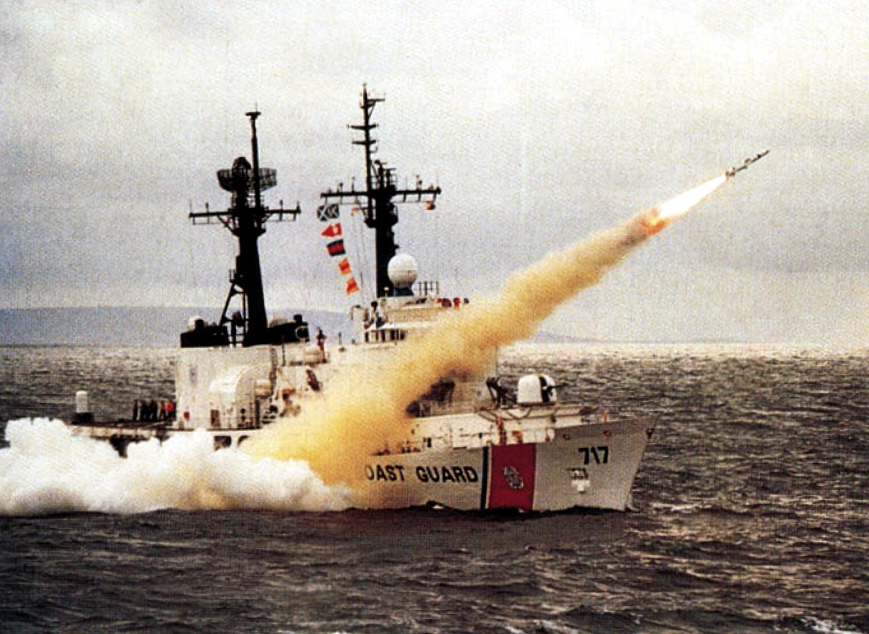
USCGC Mellon seen here launching a Harpoon anti-ship cruise missile in 1990.
In wartime, it is unlikely the Coast Guard would need long ranged anti-ship cruise missiles (ASCM). Cutters are not likely to square off against Chinese surface warships although we are likely to have many interactions with Chinese flag or controlled merchant ships at the start of any conflict with the PRC.
On the other hand, they are one way we might be able to address the potential threat of terrorist controlled merchant ships. The Navy does want to put ASCMs on almost everything, “If it floats it fights.”
ASCMs are an addition that might cause unease in a small country, because in many cases they can be used against targets on shore. There is, however, a simple way to alleviate this anxiety if it proves to be a concern. Using deck mounted launchers, as would be the case on cutters, it can be clear whether missiles are actually on board or not. If our friends have misgivings about a cutter with ASCMs, then simply do no load them, if the cutter is going to be in an area where that is a concern.
Conclusion:
The system upgrades we need to counter terrorists are small and relatively innocuous (like Hellfire and very light weight torpedoes). They are really most needed by vessels that usually don’t venture into foreign waters.
The upgrades our large cutters need are primarily anti-submarine systems and present no threat to small nations.
Even if we did add the capability to have anti-ship cruise missiles, which I see as much less important, it would be easy enough to leave them ashore when going to destinations that might be sensitive to that capability. Empty missile launch cradles would be an obvious signal of lack of aggressive intent.
Naval News reports, Chief of Naval Operations, Adm. Mike Gilday, answers the question, “..if any of the future-built U.S. Navy warships such as the Littoral Combat Ships, Arleigh Burke destroyers, or Littoral Combat Ships will have hardened and strengthened hulls for Arctic and icy-water Polar operations?”
And the answer was,
“I’m not there yet in terms of armored hulls or turning our [war]ships into icebreakers.”
I really don’t think anyone was suggesting we build DDGs on icebreaker hulls for the Navy, but if there is a need for an armed surface naval presence in the Arctic, it would be nice if Navy ships could at least survive there, if escorted by Coast Guard icebreakers. Certainly the icebreakers are to operate in the Arctic in wartime, they are going to need some protection.
The Navy is apparently still not convinced of the need. There are, of course, other assets the US has, that could take the fight into the Arctic, including aircraft and submarines. I still think the Fleet boundaries are poorly drawn to facilitate operations in the Arctic and the Bering Sea. Since it is still seen as primarily under the control of the Air Force (NorthCom), that may explain, to some extent, the lack of Navy interest.
Below is an announcement about the Waterways Commerce Cutter program from the Acquisitions Directorate (CG-9)
Jan. 15, 2021 —
The Coast Guard waterways commerce cutter (WCC) program released two videos today showing layouts, operational footage and crew interviews from the river buoy and inland construction tenders in anticipation of the upcoming request for proposal (RFP) release.
The Coast Guard is recapitalizing its river, construction, and inland buoy tenders, which collectively average more than 55 years in age. The fleet is responsible for maintaining more than 28,200 marine aids throughout 12,000 miles of inland waterways, which move 630 million tons of cargo annually. Replacing the aging fleet is critical to sustaining the overall safety of the U.S. Marine Transportation System, which accounts for $5.4 trillion of economic activity annually and sustains approximately 30.7 million jobs.
The WCC program aims to inform industry members about the current inland tender fleet to help them better understand the mission need. This effort will help industry in creating better quality proposals for the upcoming RFP release for the river buoy and inland construction WCC variants. The RFP release is anticipated during spring 2021. The Coast Guard plans to acquire these two variants on a single contract, as these variants share significant commonalities except for their hull lengths and working deck layout and equipment.
The WCC program is inviting industry questions about these videos at wcc@uscg.mil. The program plans to address these questions and provide additional operational information in a 45-minute presentation during a virtual webinar held in cooperation with WorkBoat, scheduled for 3 p.m. Eastern time Jan. 20, 2021. The final 15 minutes of the webinar will be reserved to answer any additional questions, with operations, engineering, logistics and contracting subject matter experts available to provide additional information.
Webinar registration is free and will be conducted through the WorkBoat site here. The presentation and question-and-answer information will be available on the WCC program webpage following the event.
For more information: Waterways Commerce Cutter program page. Additional resources and previous industry engagement materials can be located under the “Resources” tab at the bottom of the page.








 Chuck Hill's CG Blog