

Based on the Coast Guard Historian’s timeline, https://www.history.uscg.mil/research/chronology/
With inspiration from Mike Kelso
June 22

1818 Boarding parties from the Revenue cutter Dallas seized the privateer Young Spartan, her crew, and the privateer’s prize, the Pastora, off Savannah, Georgia. The crew of the Pastora had been set adrift and their fate remained unknown. The New York Evening Post noted that the crew of the privateer had committed offenses “that can only be expiated by making their exits on the gallows.” (July 3, 1818 issue).
1936 Congress passed an act to define jurisdiction of Coast Guard. In one of the most sweeping grants of police authority ever written into U.S. law, Congress designated the Coast Guard as the federal agency for “enforcement of laws generally on the high seas and navigable waters of the United States.”
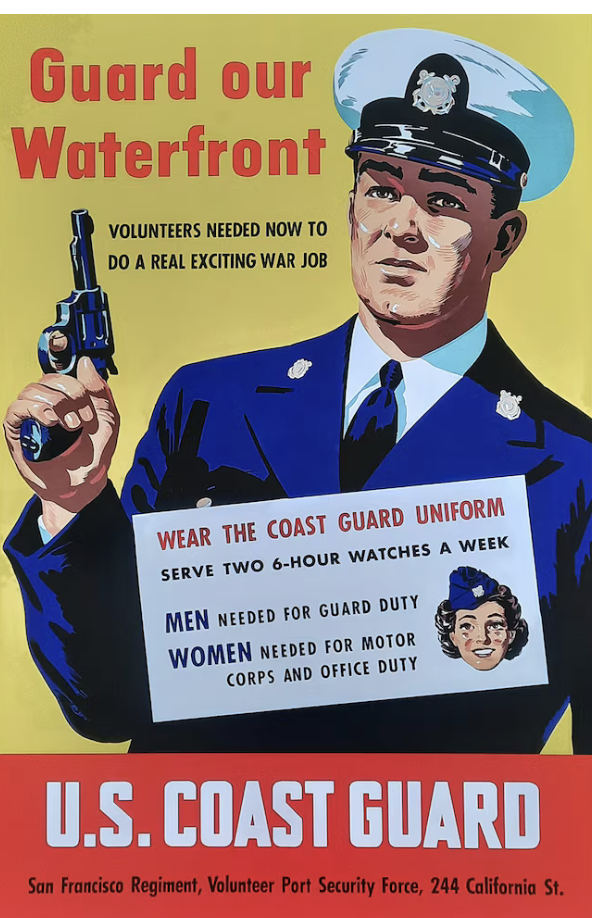
World War II-era Temporary Reserve Recruiting Poster. Photo by Capt. Bob Desh, U.S. Coast Guard retired
1940 Port Security responsibilities were undertaken again for the first time since World War I when President Franklin Roosevelt invoked the Espionage Act of 1917. The Coast Guard was to govern anchorage and movement of all vessels in U.S. waters and to protect vessels, harbors, and inland or coastal waterways of the U.S. The Dangerous Cargo Act gave the Coast Guard jurisdiction over ships with high explosives and dangerous cargoes.
1948 Congress enacted Public Law 738, which authorized the operation of floating ocean stations for the purpose of providing search and rescue communication and air-navigation facilities, and meteorological services in such ocean areas as are regularly traversed by aircraft of the United States.

Commandant’s inspection and where 82-footers tie up at Da Nang, Vietnam. (ADM E. J. Roland, USCG, and Assistant Sec. Reed) 24 July 1965. USCG photo by PH1 Nichols
1965 Coast Guard forces in Vietnam fired their first shot of the war when LT John M. Cece, commanding CGC Point Orient, gave the order to “commence fire” while patrolling the 17th Parallel. The cutter was assigned to Coast Guard Squadron One.
“Point Orient was assigned to Division 12 of Squadron One to be based at Da Nang, along with USCGC Point Arden, USCGC Point Caution, USCGC Point Dume, USCGC Point Ellis, USCGC Point Gammon and USCGC Point Welcome. After sea trials, the Division left Subic Bay for Da Nang on 16 July 1965 in the company of USS Snohomish County, their temporary support ship. After almost two weeks at sea, they arrived at their new duty station on 20 July and began patrolling the coastal waters near Da Nang. Duty consisted of boarding Vietnamese junks to search for contraband weapons and ammunition and check the identification papers of persons on board. Permanent engineering and logistic support of Division 12 was provided by a U.S. Navy non-self-propelled floating workshop, YR-71. Point Orient became the first Coast Guard unit in Vietnam to engage the enemy on 24 July 1965 after being fired on from the shore by machine guns and mortars while attempting to board a junk. She returned fire but the results were unknown. During this time, the WPB’s were directed to paint the hulls and superstructures formula 20 deck gray to cover the stateside white paint. This increased the effectiveness of night patrols.”

Lt. (j.g.) Beverly Kelley, first woman to command a U.S. military vessel, on the bridge of the 95-foot cutter Cape Newagen. (U.S. Coast Guard photo)
1977 Secretary of Transportation Brock Adams introduced Ensign Beverly G. Kelley and Boatswain’s Mate 3/c Debra Lee Wilson during a press conference as two of 12 women who had been assigned to sea duty. “This is the first time in Coast Guard history that women have been sent to sea.” Both women had orders to report to the Morgenthau later that year.

The Coast Guard Cutter Alert (WMEC 630) conducts an engagement coincidental to operations with members of the Guatemalan Navy August 23, 2022, five miles south of Puerto Quetzal, Guatemala. The engagement to strengthen law enforcement and search and rescue capabilities with our partners in Guatemala included joint pursuit training with two Guatemalan small boats, and a search-and-rescue exercise with the Guatemalan vessels Kukulkan and the Kaibil Balam. U.S. Coast Guard courtesy photo.
1982 The first successful hostage rescue at sea occurred when a combined Coast Guard/FBI boarding party deployed from CGC Alert took control of the 890-foot Liberian-flagged motor tanker Ypapanti. The incident began on May 16, 1982 when the Ypapanti anchored off the entrance to Delaware Bay after it was denied entrance to U.S. waters by COTP Philadelphia, due to the lack of required safety equipment aboard. Initially the CGCs Hornbeam, Active, and Point Franklin responded. After the situation stabilized, Active and Point Franklin departed while Hornbeam stood by the tanker to monitor the situation and to act as on scene commander; she was relieved on May 29 by Alert. During the next few days the tanker’s crew mutinied and seized control of the tanker from the master in a wage dispute. After a prolonged period of unsuccessful negotiations and threats by the crew to kill various officers and to set fire to the vessel, the Alert went alongside the tanker on June 22, 1982. A senior Coast Guard negotiating team went aboard to present one last wage/repatriation offer to the crew. When this offer was rejected a combined Coast Guard/FBI boarding team went aboard from the Alert and took control of the Ypapanti without injury. The vessel was then returned to the control of the master and 12 loyal crewmen. Twenty-four mutineers were detained on board the Alert and were transferred to the custody of the INS in Cape May.

The Reliance Class Cutter USCGC Valiant (WMEC-621) underway on a routine fisheries patrol in the Gulf of Mexico.
2020 The crew of Coast Guard Cutter Valiant (WMEC 621) returned home to Naval Station Mayport, Florida, Monday after completing a 9-week patrol conducting operations in the Windward Passage between Haiti and Cuba in support of Coast Guard 7th District and Operation Southeast Watch. Valiant patrolled over 11,000 nautical miles in the Caribbean, working closely with the Navy and Coast Guard Cutters Diligence (WMEC-616), Resolute (WMEC-620), Kathleen Moore (WPC 1109), William Trump (WPC 1111), and Raymond Evans (WPC 1110). Valiant increased Coast Guard presence along the northern coasts of Haiti, Dominican Republic, Cuba, and the Windward Passage, working to prevent an anticipated surge of illegal immigration and human smuggling amidst the COVID-19 global pandemic. Throughout this patrol, Valiant served as the Cutter Tasking Unit, directing all Coast Guard assets supporting Operation Southeast Watch in the Windward Passage. In order to deter an illegal exodus from Haiti, Valiant maintained an overt presence by frequently transiting the Canal de la Tortue, a heavily trafficked, deep-water passage between the Tortuga Island and the Northern Haitian coastline.

The USCGC Bear (WMEC 901) approaches the pier in Portsmouth, Virginia, Monday. Bear returned home following a 74-day deployment to the northern Atlantic Ocean where crew members conducted living marine resources enforcement to ensure federal regulations compliance in U.S. waters, and the crew also took part in the Canadian Armed Forces-led, multinational naval exercise Operation Nanook. (U.S. Coast Guard photo by Petty Officer 2nd Class Brandon Hillard)
2023 CGC Bear (WMEC 910) returned home to Coast Guard Base Portsmouth, VA, on 22 June 2023, following a 65-day Caribbean Sea patrol. While underway in the Seventh Coast Guard District’s area of responsibility and in support of Joint Interagency Task Force–South, Bear conducted six counterdrug interdictions and seized a total of 8,558 pounds of cocaine worth an estimated $97 million. Bear conducted counterdrug operations as part of a multi-faceted approach to combatting illicit narcotics trafficking across maritime borders. Part of this effort included other Coast Guard assets, a Helicopter Interdiction Tactical Squadron aircrew from Jacksonville, Florida, and a deployable specialized forces unit from the Pacific Tactical Law Enforcement Team. Bear also conducted vertical replenishment with the U.S. Navy vessel Little Rock (LCS-9). Little Rock deployed its SH-60 Seahawk helicopter and crew to successfully deliver 5,566 pounds of seized cocaine to Bear’s flight deck. Bear moored in Miami, last Friday, 16 June 2023, and offloaded the combined 14,153 pounds of cocaine worth an estimated $186 million.
 Chuck Hill's CG Blog