“The ICE Pact: One Year Later” –Sixty Degrees North

Canadian Coast Guard Multi-Purpose Icebreaker (MPI). Source: Seaspan
Note: The MPI image does not show the right propulsors; it will use Steerprop’s contra-rotating propulsors (CRP). Additionally according to Seaspan, the design could easily be upgraded to PC3. Confirmation from Seaspan and Aker Arctic. 

To get a realistic view of the potential of the ICE Pact, I recommend a review of the Sixty Degrees North’s review of the state of the agreement after the first year–useful, but perhaps less than we might have hoped.

“Coast Guard announces agreement to construct new polar security cutter shipyard facilities” –CG-9

I am trying to catch up on things, but while this is an August 4 release from the Acquisitions Directorate, I think it is an important step in integrating the PSC’s machinery and providing training.


Coast Guard announces agreement to construct new polar security cutter shipyard facilities

As part of continuing efforts to foster growth within the domestic shipbuilding industry and maintain momentum for acquisition priorities, the Coast Guard on July 23 formalized an agreement with Bollinger Mississippi Shipbuilding (BMS) to construct a production integration facility and land-based test facility at the shipyard in Pascagoula, Mississippi, in support of the Polar Security Cutter (PSC) Program.

This action represents a significant step in the Coast Guard’s continuing investment in the domestic shipbuilding sector and collaboration with industry partners to deliver critical assets to the nation. The construction of both facilities represents a significant capital investment partnership between the Coast Guard and BMS that will support streamlined production and integration of PSC mechanical and communication systems for a simplified installation process.

The Coast Guard modified the construction contract for the first PSC, originally awarded on March 25, 2025, to provide funding for the integration and test facilities via capital expenditure incentives. These incentives benefit the shipyard by providing access to funding for facility upgrades, workforce training and wage increases.

For more information: Polar Security Cutter Program page

“Chinese ships slam into one another during a South China Sea chase, Philippine Coast Guard video shows”

Business Insider Reports,

  • Two Chinese ships collided in the South China Sea on Monday.

  • A China Coast Guard vessel was chasing a Philippine ship when it hit one of Beijing’s destroyers.

The smaller China CG cutters appears to have been one of 22 Type 056 corvettes passed from the Chinese Navy to the China CG.

Thanks to Paul for bringing this to my attention.

Waterways Commerce Cutters to be “Chief Petty Officer” Class

Notional vendor rendering of two Chief Petty Officer class waterways commerce cutter variants: a river buoy tender (left) and an inland construction tender. Image courtesy of Birdon America Inc.

Marine Log reports,

The U.S. Coast Guard is to designate its new fleet of Waterways Commerce Cutters (WCCs) as the “Chief Petty Officer Class.” Each cutter will be named in honor of a Coast Guard Chief Petty Officer, recognizing the profound impact and legacy of these leaders within the service.

Sounds like a good idea.

Thanks to Paul for bringing this to my attention. 


This Day in Coast Guard History, July 18

Based on the Coast Guard Historian’s timeline, https://www.history.uscg.mil/research/chronology/
With inspiration from Mike Kelso

July 18

1818  The Revenue Cutter Active captured the pirate vessel India Libre in the Chesapeake Bay.

1866  Congress authorized officers to search vessels and persons suspected of concealing contraband.

The Long Blue Line: Clarence Samuels—the U.S. military’s Afro-Latino color barrier buster!
A signed photo of Lt. Clarence Samuels commanding a Coast Guard vessel near the end of World War II. (U.S. Coast Guard Collection)

1928  Clarence Samuels assumed command of Coast Guard Patrol Boat AB-15, thereby becoming the second African-American to command a Coast Guard vessel, the first being Revenue Captain Michael Healy.

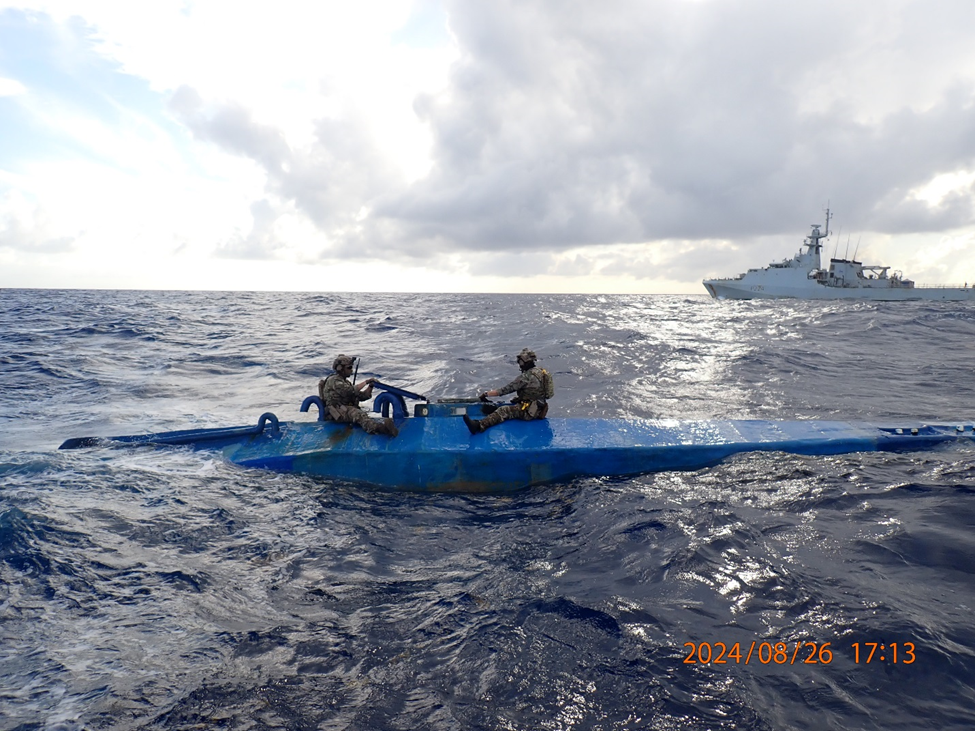
2015  CGC Stratton seized a self-propelled semi-submersible vessel carrying more than 16,000 pounds of cocaine in the Eastern Pacific Ocean.  Stratton‘s crew apprehended four suspected smugglers and seized 275 bales of cocaine worth more than $181 million wholesale from the self-propelled semi-submersible.  A U.S. Navy maritime patrol aircraft detected the 40-foot semi-submersible vessel more than 200-miles south of Mexico.  After removing 12,000 pounds of the narcotics aboard, Stratton attempted to tow the vessel to shore as evidence; however, the semi-submersible began taking on water and sank.  Approximately 4,000 pounds of cocaine left in the SPSS vessel to stabilize it during the towing evolution sank in over 13,000-feet of water and is unrecoverable.  Stratton interdicted or disrupted 15 different drug smuggling attempts since April 2015 including another self-propelled semi-submersible vessel carrying 5,460 pounds of cocaine June 16.  Stratton has seized more than 33,000 pounds of cocaine since May 2015. The July 18 semi-submersible seizure is the largest recorded semi-submersible interdiction in Coast Guard history.  Stratton’s semi-submersible busts are also the first and second by a Legend Class Cutter.  This is the first interdiction of two semi-submersibles in a single patrol at sea where Coast Guardsmen recovered both the narcotics and the vessels.  CGC Mohawk from Key West, Florida, interdicted two semisubmersibles in the Caribbean in 2011; however, both vessels sank during the course of the interdiction.  There have been 25 known semi-submersible interdictions in the Eastern Pacific Ocean since November 2006 when the first documented interdiction occurred.  A semi-submersible is a vessel constructed for illicit trafficking that is mostly submerged with just a cockpit and exhaust pipe visible above water.  These vessels are extremely difficult to detect and interdict because of their low-profile and ability to scuttle.  U.S. Customs and Border Protection Office of Air and Marine also assisted by monitoring the semi-submersible using a maritime patrol aircraft during the course of the interdiction July 18.

This Day in Coast Guard History, July 17

Based on the Coast Guard Historian’s timeline, https://www.history.uscg.mil/research/chronology/
With inspiration from Mike Kelso

July 17

1893  Life-saving Station Keeper H .E. Wilcox of Cape Arago Life-Saving Station rescued 55 of 56 passengers of SS Emily that was capsizing in a raging sea.  Persons were transported from the doomed vessel to the lifeboat via a life raft.

USCGC Polar Sea

1994  CGC Polar Sea departed from Victoria, British Columbia on operation Arctic Ocean Section 1994 and became the first U.S. surface vessel to reach the North Pole.  She then transited the Arctic Ocean back to her homeport in Seattle, Washington.

N93119, a Trans World Airlines Boeing 747-131, pictured at Charles de Gaulle airport in May 1995. On July 17th, 1996, a year after this photo was taken, N93119 was operating as TWA Flight 800 when it exploded in mid-air and crashed off the coast of East Moriches, New York, United States. All 230 people on board were killed in the crash, which remains the third-deadliest aviation accident in American history.

1996  TWA Flight 800 crashed off New York with no survivors.  Numerous Coast Guard units conducted search and rescue operations and then aided in recovery operations.

This Day in Coast Guard History, July 16

Based on the Coast Guard Historian’s timeline, https://www.history.uscg.mil/research/chronology/
With inspiration from Mike Kelso

July 16

1946  Pursuant to Executive Order 9083 and Reorganization Plan No. 3 the Bureau of Marine Inspection was abolished and became a permanent part of the Coast Guard.

The 82-foot patrol boats of Squadron One (RONONE) deploying from Subic Bay in the Philippines to the theater of operations in Vietnam. (U.S. Coast Guard)

1965  Coast Guard 82-foot patrol boats assigned to Division 12 of Coast Guard Squadron One (RONONE) departed Manila Bay on their own, bound for Vietnam and service with the Navy in Operation Market Time.  The cutters had been brought to the Philippines “piggy-backed” on board freighters.

This Day in Coast Guard History, July 15

Based on the Coast Guard Historian’s timeline, https://www.history.uscg.mil/research/chronology/
With inspiration from Mike Kelso

July 15

1870  Congress directed that the revenue cutters on the northern and northwestern lakes, when commissioned, shall be specially charged with aiding vessels in distress on the lakes.

1870  An Act of Congress (l6 Stat. L., 291, 309) directed the Lighthouse Board to mark all pierheads belonging to the United States situated on the northern and northwestern lakes, as soon as it was notified that the construction or repair of pierheads had been completed.

USCGC Point Orient in Vietnam

1967  USCGC Point Orient (WPB 82319) of Coast Guard Squadron One captured a communist trawler in Vietnam.

“…15 July 1967 after three days of tracking by patrol aircraft and the radar picket, USS Wilhoite. After playing a cat-and-mouse game for three days with TF115 units the trawler headed for the mouth of the Sa Ky Riveron the Batangan Peninsula late on 14 July. The trawler was directed by Point Orient to heave to, but the hail was answered with gunfire. The cutter returned fire along with Wilhoite and USS Gallup, USS Walker, and swift boat PCF-79. At 0200 15 July, the trawler was boxed in and ran aground 200 yards (180 m) from shore and the trawler was ablaze. Republic of Korea Marines directed artillery fire from the shore and at 0600 with the trawler apparently abandoned, a Navy demolitions expert from Walker boarded the trawler and defused 2,000 pounds of TNT charges that were designed to scuttle the craft. Found on board were several thousand rounds of rifle and machine gun ammunition, mortar and rocket rounds, anti-personnel mines, grenades, and several thousand pounds of C-4 plastic explosive and TNT. Weapons found included several hundred machine guns, AK-47 rifles, AK-56 rifles, and B-40 rocket launchers.”

USCGC Absecon, Chincoteague, and McCulloch SquadronThree

1972  CGC Absecon was decommissioned and transferred to the South Vietnamese Navy. This was the last of the seven 311-foot Casco-class cutters to be transferred to the South Vietnamese.  She was commissioned as the Tham Ngu Lao (HQ-15) on July 15, 1972.  She was seized by the North Vietnamese when the South fell in 1975.  The North Vietnamese gave her the hull number HQ-1, but did not apparently name her.  She was refitted with two or possibly four SS-N-2 launchers.  Her current status remains unknown.

A port bow view of Kidd (DDG-993) crossing Thimble Shoals, 1 February 1984. (U.S. Navy Photo by PH2 K. Bates, DIMOC #DN-SC-88-09212)

1983 For the first time in history a U.S. Navy warship with a Coast Guard LEDET on board fired on a suspected drug-smuggling vessel to force it to heave to.  On 15 July 1983, U.S. Navy destroyer USS Kidd fired on the “stateless” vessel Ranger with warning shots at first and when the vessel refused compliance the destroyer fired disabling shots, stopping Ranger without causing casualties.  About 35 tons of marijuana were discovered on board and Ranger’s nine crew were arrested and the vessel seized. From “COUNTER-NARCOTERRORISM OPERATIONS IN THE EASTERN PACIFIC AND CARRIBEAN OPERATIONS AREAS FROM 1970 THROUGH 1990.”

“Some smugglers preferred to try their luck and run from the anti-narcotics forces. The smugglers knew that it would take time for the forces to get the necessary permissions to board their vessels, and even if permission was granted there were maneuvers that the smugglers could use in order to prevent the forces from boarding their ships. The only way for the forces to get the smugglers to stop was to disable their engines. The first time that the Navy used this method was in 1983 when the USS Kidd (DDG-993) used her .50 caliber machine guns to stop the M/V Ranger after receiving permission from the Coast Guard Headquarters.

Ranger had refused to stop and allow the search teams onboard after receiving an order to do so from Kidd. Once the Ranger was stopped the LEDET proceeded to search her and after finding over 57,000 pounds of marijuana onboard, they arrested her crew.”