MSN and Washington Examiner report on a new agreement between the US and Taiwanese Coast Guard. Despite the flashy headline the Coast Guard is not going to protect Taiwan from invasion by the PRC. It is really a lot more like the network of working arrangements we have with other countries, but China, of course, objected.
(With the help of Non-Governmental Organizations, we seem to be working toward an internationally shared system for tracking fishing activity and hopefully detecting Illegal, Unregulated, Unreported fishing that would benefit nations like Palau, one of the 15 nations that still recognize Taiwan.)
The Chinese have sought to isolate Taiwan in every way possible way so any kind of contact sets them off.
Meanwhile, China’s claim of sovereignty over most of the South China Sea has its routes in a claim made by the Nationalist Chinese government shortly after WWII, that Taiwan still supports. That puts them at odds with other nations including Japan.
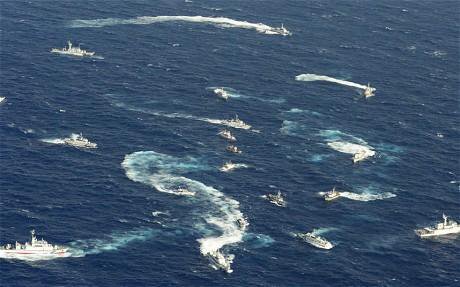
A water cannon battle between Taiwanese and Japanese Coast Guard vessels.
Royal Bahrain Naval Force fast attack craft RBNS Abdul Rahman Al-Fadel (P 22), Bahrain Coast Guard response boats Hawar 5 and Hawar 4, U.S. Navy guided-missile destroyer USS Mahan (DDG 72), patrol coastal ships USS Squall (PC 7) and USS Hurricane (PC 3), U.S. Coast Guard patrol boat USCGC Adak (WBP 1333) and two Mark VI patrol boats operate information during exercise Neon Defender in the Persian Gulf. (Picture source: US Navy)
Navy Recognition reports on a joint US/Bahrain exercise that included USCGC Adak and a Coast Guard Maritime Engagement team
The Coast Guard has long talked about the need for a Medium Altitude, Long Endurance (MALE) land based unmanned aircraft. I have assumed the most likely contender was the MQ-9B, but it looks like there may be another contender, an Optionally Manned aircraft developed by Burt Rutan‘s Scaled Composites. This is the Northrop Grumman Firebird.
“During the flight tests concluded in Florida, the Northrop team conducted a series of ‘manned maritime operational events’.
“These events comprised a four-sensor package that included two high-definition electro-optical/infra-red EO/IR sensors, a maritime configured multi-spectral sensor for small target detection, as well as an automatic identification system (AIS) receiver.”
I don’t think this maritime demonstration would have been for the Navy, since they are already committed to the jet powered MQ-4C Triton.
Apparently the Firebird is already in service with an unspecified Federal Agency. I would guess this is probably a DHS agency.
I was a bit surprised to see that the aircraft is powered by a typical general aviation aircraft engine, the Lycoming TO-540. That means it uses AvGas rather than the fuel typically used by Coast Guard turbine powered aircraft, but it also means that the fuel is available at virtually every airport and its maintenance is familiar to thousands of aircraft mechanics all over the world.
Below is a story from MyCG.Will the surface forces also get this upgrade?
Aviation upgrades night vision goggles
By Lt. Cmdr. Kyle Russell, MyCG Contributor
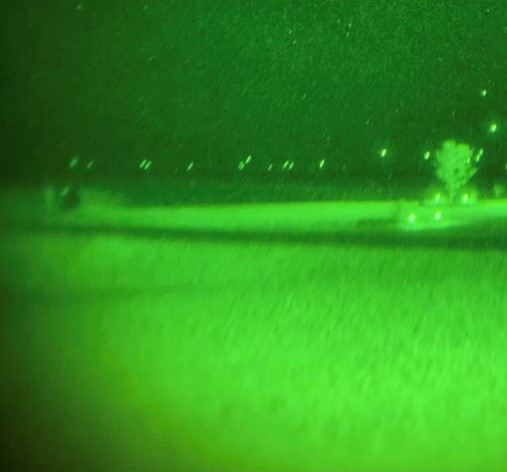
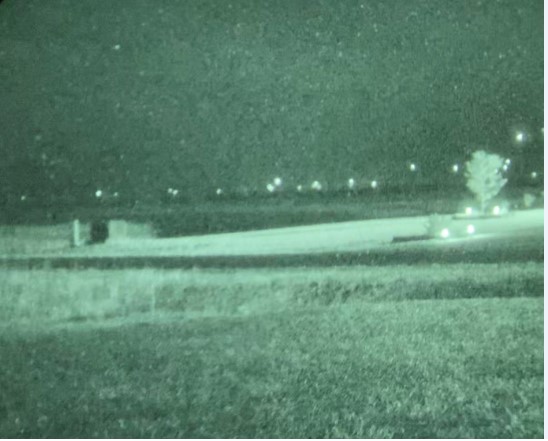
View through current ANVIS-9View through white phosphorus AN/AVS-9
Coast Guard aviation is following the lead of the Department of Defense (DoD), and investing in more capable night vision goggles (NVG) for the fleet. These NVGs will increase the capabilities of our crews as they perform all night missions, especially the aviation use of force mission at HITRON, the rotary wing air intercept mission in Atlantic City, New Jersey, and shipboard deployments.
The AN/AVS-9 white phosphor night vision goggles (WP-NVG) are a recent upgrade to the current generation of the ANVIS-9 NVG platform Coast Guard aircrews currently use. WP-NVG improvements consist of an improved image intensifier tube and is fully interchangeable with the legacy image intensifier tubes in current USCG aviation NVGs. This new technology provides improved resolution and a substantially higher figure of merit (FOM) (line pairs per millimeter x signal-to noise ratio) than the current ANVIS-9 system.
The U.S. Army’s Aviation Research Lab (USAARL) and the U.S. Air Force Special Operations Command Flight Test Squadron conducted extensive testing on WP-NVGs based on demand from special operations aviation communities for improved night vision systems and the overwhelming justification stems from user surveys indicating increased resolution, comfort, and ability to identify objects.
Additional testing conducted by Coast Guard crews agreed with the DoD testers which ultimately led to the recapitalization of the fleet. The Aviation Logistics Center Engineering Services Division is currently managing the rollout efforts for the WP-NVGs and as of mid-March, 11 units have received new intensifier tubes, with a priority being given to rotary wing assets. The fleet transition is estimated to be complete in the fall of 2021.
“French Marine Nationale ships have achieved five seizures of illicit drugs in just six days, whilst participating in a counter-narcotics focused operation under the command of Combined Maritime Forces’ (CMF) Canadian-led Combined Task Force (CTF) 150.”
Drug interdiction in the 5th Fleet Area of Responsibility. PATFORSWA probably had something to do with this. Information about CTF 150 here.
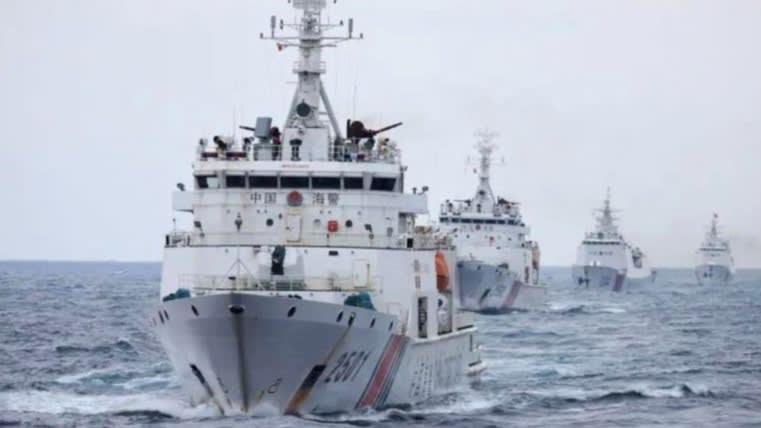
The Asia Transparency Initiative looks at China’s recent changes to their laws regarding use of deadly force by their Coast Guard, comparing it to the US and other regional coast guards.
Really the issue is not the authorities themselves, but rather China’s views of what is theirs and what is illegal, which deviate sharply from those of the international community.
“Articles 20 and 21 are worrying not because they authorize unique powers for the CCG, but because they suggest a readiness to make use of those powers across all waters China claims within its jurisdiction. China makes a vast but purposely ambiguous claim to jurisdiction over almost the entire South and East China Seas. Based on those claims, Article 20 could easily be interpreted as authorizing the CCG to dismantle not only foreign outposts on the Spratlys, but even floating platforms and artificial islands in the reefs and open waters of its neighbors’ EEZs. And Article 21 could likewise authorize the CCG to expel Southeast Asian law enforcement, military, and other government vessels from their own EEZs. These authorities could be used to justify the use of force in the increasingly frequent standoffs between Chinese and Southeast Asian government vessels over oil and gas, fishing, and survey activity across the South China Sea.”
The analysis also suggests that use of force restrictions on the Philippine Coast Guard are unusually tight.
Chinese fishing vessel fleet (Photo: The Maritime Executive)
The Diplomatic Courier reports on incidence of apparent State support for illegal fishing activity. These actions which impact the sustainability of the fisheries resource, are reportedly perpetrated not only by China, but also by some of our friends.
The Congressional Research Service has again updated their report on Coast Guard cutter procurement. (The link will always take you to the most recent edition of the report.) I have reproduced the summary in full below. I have applied emphasis by “bolding” some parts, but first some comments.
As you will see below, the Congress is still keeping the option of NSC#12 open, and, in fact, they are asking the Coast Guard if there isn’t justification for it.
“The Committee is disappointed that the Coast Guard has not officially conveyed to the Committee a determination on whether a twelfth NSC is required…” (Explanatory Statement, p. 25) “The Coast Guard is encouraged to officially convey a determination to the Committees as to whether a 12th vessel is needed.” (Conference, p. 25)
With the expansion of the Coast Guard’s support for distant missions, and the delays in the delivery of the OPCs, looks like we could make a good case for NSC#12.
Congress has asked for a reevaluation of our needs,
SEC. 9422 (re. Elijah E. Cummings Coast Guard Authorization Act of 2020, p. 26). Report on fast response cutters, offshore patrol cutters, and national security cutters. (a) In general.—Not later than 90 days after the date of the enactment of this Act, the Commandant shall submit to the Committee on Commerce, Science, and Transportation of the Senate and the Committee on Transportation and Infrastructure of the House of Representatives a report on the combination of Fast Response Cutters, Offshore Patrol Cutters, and National Security Cutters necessary to carry out Coast Guard missions. (b) Elements.—The report required by subsection (a) shall include— (1) an updated cost estimate for each type of cutter described in such subsection; and (2) a cost estimate for a Sensitive Compartmented Information Facility outfitted to manage data in a manner equivalent to the National Security Cutter Sensitive Compartmented Information Facilities.
So far I have heard nothing to indicate the Coast Guard has complied with this request, which was enacted into law 92 days ago. This report and the determination of the requirement for NSC#12 may be tied up in DHS.
I assume the “…cost estimate for a Sensitive Compartmented Information Facility outfitted to manage data in a manner equivalent to the National Security Cutter Sensitive Compartmented Information Facilities” refers to adding this capability to the Offshore Patrol Cutter.
Summary
The Coast Guard’s program of record (POR), which dates to 2004, calls for procuring 8 National Security Cutters (NSCs), 25 Offshore Patrol Cutters (OPCs), and 58 Fast Response Cutters (FRCs) as replacements for 90 aging Coast Guard high-endurance cutters, medium-endurance cutters, and patrol craft. The Coast Guard’s proposed FY2021 budget requested a total of $597 million in procurement funding for the NSC, OPC, and FRC programs; Congress provided a total of $837 million for FY2021, with the additional $240 million being for the FRC program.
NSCs are the Coast Guard’s largest and most capable general-purpose cutters; they are replacing the Coast Guard’s 12 Hamilton-class high-endurance cutters. NSCs have an estimated average procurement cost of about $670 million per ship. Although the Coast Guard’s POR calls for procuring 8 NSCs to replace the 12 Hamilton-class cutters, Congress through FY2021 has fully funded 11 NSCs, including the 10th and 11th in FY2018. In FY2020, Congress provided $100.5 million for procurement of long lead time materials (LLTM) for a 12th NSC, so as to preserve the option of procuring a 12th NSC while the Coast Guard evaluates its future needs. The Coast Guard’s proposed FY2021 budget requested $31 million in procurement funding for activities within the NSC program; this request did not include further funding for a 12th NSC. The Coast Guard’s proposed FY2021 budget also proposed a rescission of $70 million of the $100.5 million that Congress provided for a 12th NSC, with the intent of reprogramming that funding to the Coast Guard’s Polar Security Cutter (PSC) program; Congress did not approve this request. Nine NSCs have entered service; the ninth was commissioned into service on March 19, 2021.
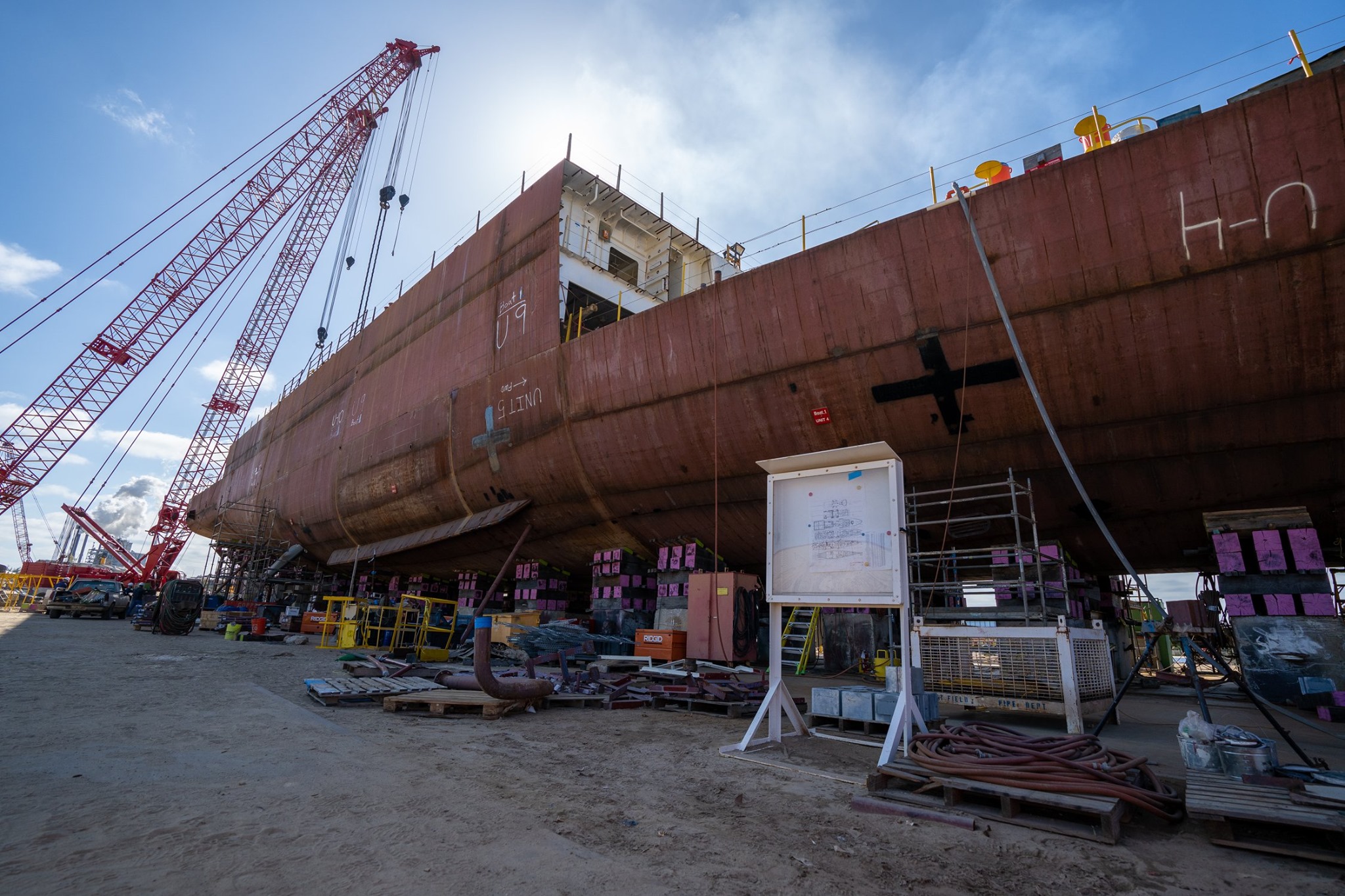
OPCs are to be less expensive and in some respects less capable than NSCs; they are intended to replace the Coast Guard’s 29 aged medium-endurance cutters. Coast Guard officials describe the OPC and PSC programs as the service’s highest acquisition priorities. OPCs have an estimated average procurement cost of about $411 million per ship. The first OPC was funded in FY2018. The Coast Guard’s proposed FY2021 budget requested $546 million in procurement funding for the third OPC, LLTM for the fourth, and other program costs. On October 11, 2019, the Department of Homeland Security (DHS), of which the Coast Guard is a part, announced that DHS had granted extraordinary contractual relief to Eastern Shipbuilding Group (ESG) of Panama City, FL, the builder of the first four OPCs, under P.L. 85-804 as amended (50 U.S.C. 1431-1435), a law that authorizes certain federal agencies to provide certain types of extraordinary relief to contractors who are encountering difficulties in the performance of federal contracts or subcontracts relating to national defense. The Coast Guard is holding a full and open competition for a new contract to build OPCs 5 through 15. On January 29, 2021, the Coast Guard released a Request for Proposals (RFP) for this Stage 2 contract, as it is called. Responses to the RFP are due by May 28, 2021. The Coast Guard plans to award the Stage 2 contract in the second quarter of FY2022.
FRCs are considerably smaller and less expensive than OPCs; they are intended to replace the Coast Guard’s 49 aging Island-class patrol boats. FRCs have an estimated average procurement cost of about $65 million per boat. A total of 64 have been funded through FY2021, including four in FY2021. Six of the 64 are to be used by the Coast Guard in the Persian Gulf and are not counted against the 58-ship POR quantity for the program, which relates to domestic operations. Forty of the 64 have been commissioned into service, and three others have been accepted by the Coast Guard and are awaiting commissioning. The Coast Guard’s proposed FY2021 budget requested $20 million in procurement funding for the FRC program; this request did not include funding for any additional FRCs.
The 41st fast response cutter (FRC), Charles Moulthrope, was delivered to the Coast Guard in Key West, Florida, Oct. 22, 2020. It is the first of six planned FRCs to be stationed in Manama, Bahrain. (U.S. Coast Guard photo)








 Chuck Hill's CG Blog