Offshore Patrol Cutter (OPC) Update, 6 May 2011

Conceptual Rendering of the OPCThe Acquisitions Directorate released their draft specifications for the Offshore Patrol cutter (OPC) Monday, May 2. This is certainly a welcome step, but in some ways it seems the plan ahead has gotten murkier rather than clearer. The description of the ship available to the public has, over time, become more general rather than more specific, and the timing of critical events is now more uncertain.

This release comes five to six months after the previously announced planned release date, as had been published on their website until it was changed this week. Currently the only milestone with a projected date on the Acquisitions Directorate website is “May – June 20, 2011 – Draft Specification Review” everything else is TBD (to be determined). This was the near term plan as it had been previously published: Continue reading

Fleet Mix–Where are the Trade-Offs?

A recent GAO report offers some insight into how the AC&I budget will work for the next few years. The report is accessible here: Coast Guard: Observations on Acquisition Management and Efforts to Reassess the Deepwater Program
GAO-11-535T, Apr 13, 2011
Quick View Quick view toggle Summary (HTML)   Highlights Page (PDF)   Full Report (PDF, 18 pages)   Accessible Text

The thrust of the report seems to be that while the coast Guard has made some progress in managing its own programs since terminating Deepwater there are still a lot of problems and many of them stem from being unrealistic about budget expectations. There also seems to be an underlying frustration because the Coast Guard is not offering real alternatives to the fleet mix proposed by the discredited “Deepwater” program.

“We reported in 2009 that the administration’s budget projections indicated that the DHS annual budget was expected to remain constant or decrease over the next decade. When the Coast Guard submitted its fiscal year 2012 budget request, it also released its fiscal years 2012-2016 acquisition capital investment plan. In reviewing this plan, we found that the Coast Guard’s projected funding levels for fiscal years 2013 through 2016 are significantly higher than budgets previously appropriated or requested and therefore may be unrealistic. This unrealistic acquisition budget planning exacerbates the challenges Coast Guard acquisition programs face. As seen in figure 2, the average annual budget plan from fiscal year 2012-through fiscal year 2016 is about $520 million, or approximately 37 percent, higher than the average Coast Guard acquisition budgets previously appropriated or requested during the past 6 years.”

Continue reading

Lasers vs Small Boats–the Low Cost Solution? Will We Have the Power?

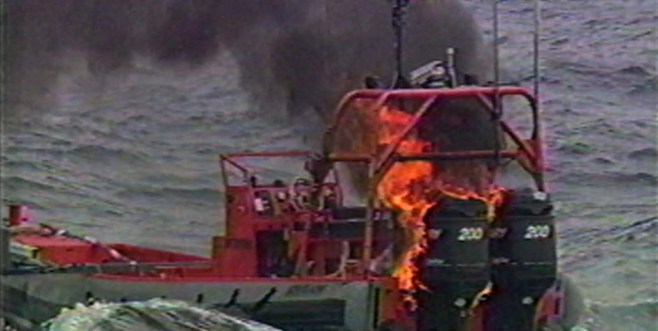
Here is more evidence that laser weapons are on the way, although the video does not look that impressive. We have already seen video of lasers taking out air targets, which has to be more demanding, so the fact that lasers can start a fire on a boat should not be surprising.

What caught my attention was this statement, “Lasers can address a number of emerging threats, enabling the fleet to maintain freedom of operation, yet with a very low cost of operation. Lasers will offset the use of higher cost kinetic defenses for a number of these threats, substantially reducing the total cost of ship defense.” –Lasers are the low cost option?

https://chuckhillscgblog.net/wp-content/uploads/2011/04/10296.jpg?w=300

The press release says that the system, “tracked and damaged moving, remotely piloted, unmanned small boats traveling at representative speeds and ranges.” In the video the boat’s engines appear to be idling, there is no attempt at evasion, and the range is not stated. Also the clip does not appear to be continuous, so the time required is not clear. Even apparently edited, it takes some time before the fire breaks out. Presumably the fire was only as large as it was because the engines were running, bringing gasoline to the fire.

Still, I can see some circumstances where a weapon that can be turned down to less than lethal settings, and be applied very precisely, might be useful.

Lasers do seem to have a future within the lifetime of the ships the Coast Guard is planning now. Perhaps it would be prudent to make sure that they have the electrical generating capacity to use these weapons. This seems another reason to look closely at diesel electric or at least hybrid propulsion for the Offshore Patrol Cutters. As the captain of the Starship Enterprise might say, the command may be, “Divert power to the shields.”

Offshore Patrol Cutter (OPC)–Minor Update

The Acquisition Directorate has given us another illustration of an OPC conceptual design, apparently the same design used earlier.

Conceptual Rendering of the OPC
Acquisition Directorate’s Disclaimer: “The conceptual renderings posted on this website are for artistic display purposes only and do not convey any particular design, Coast Guard design preferences, or other requirements for the OPC.”


We should see a draft “Request for Proposal” (RFP) in the next three months.


Meanwhile the list of companies interested in building the ships has grown to twelve: Austal, BAE, Bath Iron Works, Bollinger, Derecktor, Eastern Ship Building Group, Marinette Marine, General Dynamics NASSCO, Northrop Grumman, Todd Pacific, Signal International, and VT Halter Marine. (Click on “List of Interested Companies” here for more detail).

A previous more detailed update from November 2010 here.

Creative Tension in Ship Construction

As the Coast Guard builds it’s Acquisitions Directorate it may be useful to consider some ship building history. It’s almost two years old now, but Norman Friedman reflected on the “creative tension” that once characterized both American and British naval ship building in the July 2008 issues of USNI proceedings.

“In the past, warship procurement was very much a triangular process, marked by what might be called creative tension. The points of the triangle were the operational navy, the professional in-house designers, and the programmers responsible for paying for the fleet. Typically the operational navy (Office of the Chief of Naval Operations or OPNAV in our Navy) thought of what it would like, without much feeling for the technological (or cost) implications of what it wanted. Its ideas were reflected in tentative (“single-sheet”) ship characteristics. The Preliminary Design section of Naval Sea Systems Command sketched a corresponding ship. In effect it estimated what the stated requirements would cost and whether they were practicable at all. Continue reading

Towed Array Sonar–A Tool for Drug Interdiction

The use of “Self Propelled Semi-Submersibles” (SPSS), semi-submersibles that run with only a snorkel above water, and true submersibles by drug smuggling organizations represents a serious challenge to efforts to interdict drug trafficking. SPSS and snorkels are difficult radar and visual targets. They can be detected, but sweep widths are dramatically reduced. True submersibles are invisible to radar and only rarely visible from the air, when the water is clear and calm, and even then, only at relatively short distances.

Source: “Introduction to Naval Weapons Engineering

There is a way to detect these vessels at ranges greater than typical radar ranges against even normal surface contacts. Passive Acoustic Towed Arrays routinely make detections beyond the radar horizon. Direct path detection ranges vary a lot. They are typically inside the radar horizon, but there are common phenomenon that make detection at extended ranges possible. These include the deep sound channel, bottom bounce, surface ducting and convergence zone (all explained here. You can skip the math and go down to “Propagation Paths” that starts about a third of the way down). These conditions frequently allow detection at well over 60 miles. These conditions are also recognizable and predictable. Passive acoustic detection is not as unambiguous as radar, in that passive sonar does not provide range, but it does give other information radar does not, that can aid in classification. In the past, success with passive systems has been highly dependent on the skill of the operator, but reportedly newer systems like the Multi-Function Towed Array (MFTA), planned for the Littoral Combat Ship, provide computer assistance that makes them much more intuitive. Range can sometimes be inferred from knowledge about the water conditions, and it can also be deduced by target motion analysis. Whatever information can be gleaned from the passive contact can be used to cue a helicopter to search a specific area.

Because this sensor is passive, it permits searches without betraying own ship’s position. It is not too hard to believe that drug runners who can build submarines are sophisticated enough to use Electronic Support Measures (ESM) to detect and identify Law Enforcement units  based on their radar emissions. A towed array gives the commander the option of searching a large area while going passive electronically.

It would be reasonable to expect that the Navy would pay for these systems, just as they did sonar systems in the past, so that they could be available for military operations. The Offshore Patrol Cutters should incorporate provision for this system in their design. (Previous related posts here, here, and here.)

The Commandant Answers–the National Security Cutters: Multiple Crewing, Build Rates, OPC Compared

The Commandant has been good enough to answer three more of our questions, and we expect to hear more in the near future. Today we hear more about the National Security Cutter (NSC).

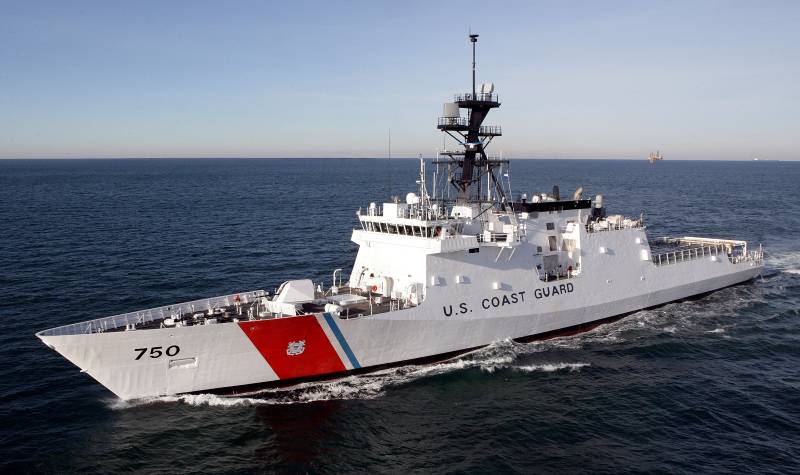
File:USCG National Security Cutter BERTHOLF (WMSL-750).jpeg
USCG National Security Cutter BERTHOLF (WMSL-750)

Will the Coast Guard implement the National Security Cutter multi-crewing plan referred to as the Crew Rotation Concept?  Has the concept been adequately tested?  If the plan is workable, would it be implemented on smaller vessels? Continue reading

Humanitarian Assistance/Disaster Relief (HA/DR) Ship Proposal

The Naval Institute Blog has an interesting proposal for re-purposing Navy ships that are planned to be decommissioned specifically for humanitarian assistance and disaster relief. This would include partnership station and cooperation with NGOs.

There are some issues that come up. The Navy ships, frequently get used, because they are already in the area. How many repurposed NA/DR ships can you have and where will they be stationed? If they are Navy manned won’t their still be suspicions about their purpose? These are really big ships, there are lots of places they can’t go because of their draft.

After Katrina, Haiti, and now Japan, I can’t help but think the CG is part of the solution. If nothing else a container hosting capability on the Offshore Patrol Cutters (OPC) and some “hospital ship” and “disaster command post” modules in storage.


Shipbuilding, Dealing with Reality

The Coast Guard’s fleet of large cutters  is facing a budgetary “perfect storm,” and if it is to survive without a major reduction in numbers, a change in procurement strategy is required.

The NSCs cost as much as an entire year’s AC&I budget for vessels. An analysis of the Coast Guard’s FY 2012 budget request for vessels and the funding history of the National Security Cutters (NSC), funding only about one half the cost of an NSC each year, and with three more NSCs still to be funded, suggest it is unlikely the Coast Guard will see the first Offshore Patrol Cutter in 2019 as has been planned. In fact there is reason to believe the Coast Guard will not be allowed to proceed with the OPC program as currently envisioned.

There are rumblings that some parties want to kill the Offshore Patrol Cutter (OPC) program all together, and many of those who understand the need to replace old ships question why all of our replacements are notably larger than the ships they replace.

  • 378s, 3,050 tons, full load (fl) to be replaced by NSCs, 4,375 tons
  • 210s, 1050 tons (fl) to be replaced by OPCs, 2,500 to 3,000 tons
  • 110s, 165 tons (fl) to be replaced by RFCs, 353 tons

We haven’t generated the “Fleet Mix Study” that might justify these larger and more capable ships. Saying we need larger ships to provide better living conditions for the crew won’t cut it and frankly it does a disservice to our crews who have shown a willingness to accept spartan condition on shipboard, particularly since now most, if not all, will have a place to live ashore as well.

If we want to actually arrest and reverse the aging of the large cutter fleet and have a more capable fleet in the long run, we have to do something different, and we have to do it soon.

Additionally it appears that we may have funded enough NSCs and the Coast Guard needs a different kind of cutter to address the emerging new ways drugs are being smuggled.

Conceptual Rendering of the OPC

Disclaimer by Acquisition Directorate (CG-9): (This) conceptual rendering (is) for artistic display purposes only and do not convey any particular design, Coast Guard design preferences, or other requirements for the OPC.

This is an alternative plan.

  • Stop NSC production at five or at most six ships and put them all in the Pacific.
  • Forget the Crew Rotation Concept (CRC), at least for now.
  • Kick start the OPC program by building the first six or seven as lower cost, smaller replacements for the remaining 378s and give them the sensors needed to find drug running semi-submersibles and true submersibles.
  • To provide “value added,” work with the Navy to make sure they have credible wartime mission capabilities.

NSCs go north, OPCs go south. NSCs will specialize in ALPAT while OPCs will specialize in drug interdiction, with at least some of them being made capable of interdicting true submersibles.

Normally it takes three ships to keep one on station, suggesting six NSCs to keep two on ALPAT at all times, but mixing in an occasional OPC during the summer months, 5 should be enough.

The OPC, at 2,500 tons or more, is a hard sell as a replacement for 1,000 ton 210s, but as a replacement for the 3,000 ton 378s, at what should be close to half the price of an NSC, the Coast Guard is clearly being a team player. This gets the program started and, in quantity, the price should start coming down substantially. After the first six or seven are built as 378s replacements, and they prove their worth, they may not be as hard to sell as MEC replacements as the economy improves.

Earlier posts (here and here) addressed multiple crewing of National Security Cutters and, following the numbers, demonstrated why, even if it works as planned, the current plan could only provide the equivalent of 10 conventionally manned cutters, not 12, and the total operating costs are likely to be higher compared to conventionally manned ships providing the same number of ship-days.

The only example I know of, where multiple crewing of complex ships works is the Fleet Ballistic Missile submarine program and there, the incentives to make it work are huge. Total numbers of submarines are limited by treaty so there is a desire to get maximum use out of an artificially limited supply and the capital cost per crew member is probably an order of magnitude greater than it is for Coast Guard Cutters. The Navy with all their experience does not attempt to multi-crew it’s attack submarines even though this is a closely allied program, again with a far higher ratio of capital cost to crew cost. If we want to try this concept, try it on the Fast Response Cutters first, where it is more likely to work, but kill it as a planning consideration for large ship procurement. Consider it just another hoax perpetrated on the Coast Guard by Integrated Deepwater Systems.

Since we started planning the new fleet of large cutter, our needs have changed. Drug smugglers have begun to change their tactics, using semi-submersibles and even true submersibles (here, here, here, and here). A ship equipped with a towed array and an embarked Navy MH-60R ASW helicopter detachment would substantial improve our chances of intercepting these.

Having a credible wartime capability can also help convince members of congress these ships are a worthwhile investment. Once we have given the ship a towed array and the ability to operate Navy ASW helos, at almost no costs we can add the ability to operate them in a war time role by insuring we have spaces appropriate for storing their weapons and other equipment, spaces that can be used for other purposes until required.  It also should not be difficult, working with the Navy, to insure they can accept at least some of the LCS Mission Modules.

A 2,500 ton OPC, as currently planned, is in many respects an excellent replacement for a 378 and it will have lower operating costs. More importantly, if the OPC program survives and goes on to replace the 210s and 270s, we will have a far more capable fleet overall.

We need to start this change with the FY2013 budget.


Budget Realities Setting In?

The Marine Log is reporting “House Coast Guard and Maritime Transportation Subcommittee Chairman Frank LoBiondo (R-N.J.) set a no-nonsense tone when he opened up a hearing yesterday to review the Administration’s budget requests for the U.S. Coast Guard…’Congress must make extremely difficult decisions in the coming months to bring our spending under control and cut the deficit’…Chairman LoBiondo commended the service for uncovering some savings through efficiencies in operations and the consolidation of services, but wanted to know ‘if more operational savings can be found that will not adversely impact safety, security, and mission success.'”

He called the Coast Guard’s  five year Capital Improvement Plan “fantastic,” (not in a good way, as in, it is a fantasy) referring to a planned 66 percent increase in funding over the next three fiscal years. (Assuming we are talking about a 66% increase in AC&I over the FY2012 request ($1.4B) that is a $924M increase annually, approximately a 9% increase in the total budget.)

He also took the service to task for its failure to complete a “fleet mix analysis” that the Subcommittee requested over 13 months ago.  “I urge the Service, in the strongest possible terms, to satisfy our request for this document in short order…Second, the Service continues to lack the polar missions plan long sought by Congress. To add insult to injury, the Service intends to spend millions of unbudgeted dollars to refurbish the POLAR SEA’s engine and then decommission the icebreaker.  This is a classic example of throwing good money after bad.”

The Coast Guard is still projecting procurement planned under the discredited “Deepwater” program, almost ten years ago, that included replacing 12 WHECs with 8 multi-crewed National Security Cutters (NSC) and replacing 29 WMECs with 25 Offshore Patrol Cutters (OPC), a reduction of 20% in the number of hulls. Meanwhile, there is little evidence to prove multiple crewing of NSCs will work; UAVs, which don’t seem to be working out for reasons beyond Coast Guard control, were supposed to do a lot of the air surveillance work; drug runners are turning to semi-submersibles and true submarines that are increasingly hard to detect; and new responsibilities are coming with the opening of the Arctic to commerce. It is also possible to make a case that the South Pacific EEZ was never adequately policed. Things have changed and they justify more, not fewer assets. Continue reading