
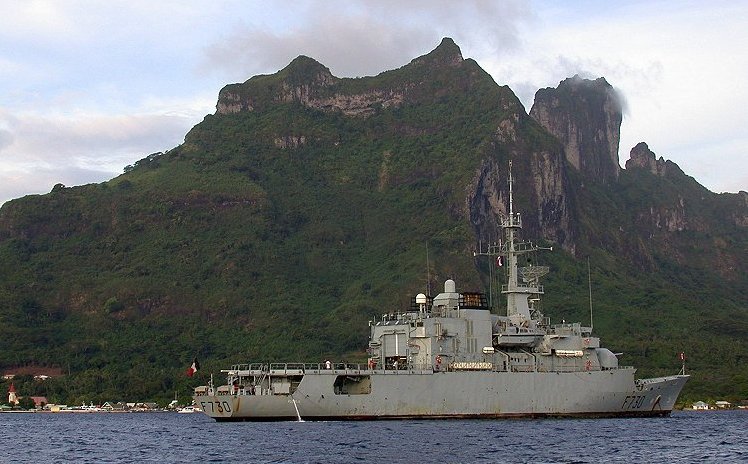
Frigate Floréal, anchored Bora-Bora lagoon (24 Nov. 2002), Jean-Michel Roche photo
–
Following news from the German Navy site Marine Forum, June 20, without additional attribution:
FRANCE: Defence minister indicates plans for long-term replacement of FLOREAL class patrol frigates with a new class of light (3,000 – 4,000 tons) frigates (Frégates de Taille Intermédiaire – FTI) … contract decision by end of decade with first ship arriving around 2025.
The lightly armed Floreal Class Frigates essentially serve as cruising cutters for the French Navy since they do not have an American style Coast Guard. Perhaps DCNS’s participation in the Offshore Patrol Cutter competition will serve them well in developing a contender.
 Chuck Hill's CG Blog
Why not, I think DCNS may push for a variant of the OPC based off the Floréal-class frigate
That might explain why DCNS altered their OPC design away from the initial Adroit clone
“Cruising cutters?” What a novel idea. The RCS and Coast Guard used the same idea from 1895 to 1935. They too were lightly armed.
The Floreals and presumably their replacements are a bit more heavily armed than USCG cutters in that they mount two Exocets, but otherwise they are very close, similar speed (20), armament (one 100mm with only an optronic fire control system and two 20mm), range (10,000 nmi), similar boats (3), and similar aviation facilities (they normally hangar the French Navy’s version of the H-65 but can take larger types).
The first of the six Floreals was completed in 1992 and the last in 1994, so they are newer than the 270s. They apparently will be about 33 years old when replaced.
While the Floreals might be seen as their OPC/WMEC, the LaFeyette Class might be considered their version of an NSC/WHEC, but surprisingly with less range than the Floreals.
http://en.wikipedia.org/wiki/La_Fayette_class_frigate
France has the second largest EEZ in the world, only slightly smaller than that of the US.
Is it a cutter? Is it a frigate? No, it’s a mish-mash!
What’s the point of these half- naval, half-coast guard designs? They make my head spin… NSC, Holland-class, Floreal, now these. Way too much gold-plated naval equipment for a coast guard/anti-piracy role, but not enough to be truly useful in a shooting war, even up against your local third-world rust-bucket navy…
As to what they might do in war time, I have addressed it in some detail here https://chuckhillscgblog.net/2012/02/10/what-might-coast-guard-cutters-do-in-wartime-part-2-coast-guard-roles/
I think your question has two parts
1. Isn’t something like the River class good enough? To which I think the answer is both have a place.
2. If you are going to build something that looks like a frigate, why not build a frigate. Use it for law Enforcement in peacetime and you also have a fully capable frigate in wartime. Here I think the answer is maybe.
Mostly the upgrade relative to something like the River class, http://en.wikipedia.org/wiki/River-class_patrol_vessel, is in its ability to deal with recalcitrant merchant and fishing ships vessels while surviving in a low, but not no threat environment.. Normally a heavy machinegun is enough, but if they were controlled by truly determined terrorists, attempting to smuggle arms to an insurgent group, or acting as a naval auxiliary, the River’s armament might not be enough, in fact it might be out gunned. I’m not convinced that the Coast Guard ships are armed well enough for this task. The French ships are better equipped, having both a larger caliber gun that fires a much heavier shell with greater penetrating power, 32 pounds vs 6 for the 57mm, and Exocet, although I think there is a better and cheaper alternative to cruise missiles. https://chuckhillscgblog.net/2011/03/14/what-does-it-take-to-sink-a-ship/
As for the second question, I have asked this myself, but there are rationale for this decision. Personnel are the greatest cost of operating these ships. By not equipping the ships with sophisticated weapons and sensors, there is both the initial savings of not buying the equipment and there is recurring savings in manning and maintenance costs.
This may be the right decision if you cannot meet both your defense and law enforcement needs with full blown warships.
It was also the right decision if you never go to war.
The value of the ships increases if they are upgradable in the case of either a predictable or long term conflict in that they can be equipped with the latest systems when they are needed. I’m not sure the Coast Guard has planned for this.
The Coast Guard’s reason for avoiding the extra expense of additional weapons and sensors (“to do the Navy’s mission”) is obvious even if it may be sub-optimizing relative to the nation’s needs.
This is a question of balance and the ability to predict the future. Incorporating adaptability is a hedge against making the wrong decision in the near term.
What’s that ship that the Indian Navy has that is a patrol vessel, that can be upgraded to light frigate if need be, it’s the Sukanya-class patrol vessel.
Which is why I think the US Coast Guard should have an OPC that is up to the level of Corvette, where it can capable of being heavily armed if a full-blown shooting war broke out. The future OPC should be at the level of combat Corvette.
Chuck, great point about upgradeability. And you’re right, has the USCG put enough (or any?) thought into making OPC upgradeable?
I think this is a good compromise for most Coast Guards/Navies: build plain vanilla patrol vessels for “no threat” theaters (up to & including anti-piracy deployments & coercive VBSS) , but “fitted for but not with” the stuff that will enable them to operate in “low threat” areas if the need arises. Things like a main caliber gun, CIWS, decoy launchers, maybe even simple modular missile launchers.
Should be very cost effective… just take a look at the French l’Adroit: space reserved for a 76mm gun, Exocet, decoys, and a real CiC… but for current missions a tiny 20mm gun and a few workstations on the bridge do the job. Probably could even fit a towed sonar in one of the stern launch ramps! (I believe they’re designed to accomodate a 20ft container)
The Commandant said the OPCs will have reserves for additional weapons, but I’ve not been privy to what exactly that means. It does appear that they are to be “fitted for but not with” the Phalanx, but that may be all this statement referred to.
My own thoughts about the subject are here: https://chuckhillscgblog.net/2012/06/27/opc-design-for-wartime-build-for-peacetime/
I think I’ve made this point before, but this is a dangerous hedge. We’re not at a pre-WWII technology level any more. With nuclear submarines, ICBMs, jet aircraft, stealth, and the digital age all being significant threat upgrades from 1940 (among others). And at that, the only thing which stopped all the cruisers, destroyers, and yes, CG Cutters from being sunk at Pearl Harbor was the timidness of the IJN TF commander stopping after two attack waves and leaving. 9/11 showed what a non-sophisticated, improvisationally-armed, non-state enemy could do. Do you think a serious threat state with depth and weight to their firepower would give us time to retro-fit the CG Cutters to make them suitable for the war? (The war will be over long before a cutter gets into a dock to start adding on any weapons.) Do you think the Navy would divert weapons capability to arm our fleet of little ships (OPCs and smaller), given the situation?
Better to just walk away from any national defense aspect of the CG mission, except for that which integrates well with the LE mission. In my opinion, that is guarding the ports, approaches, EEZ, fisheries, and maritime border ops. If any cutter has real firepower, it should be limited to surface and subsurface threats (especially since the Navy doesn’t have the resources to cover our nations coasts and still deploy overseas) since, theoretically, the USAF will be there to engage any potential air threat in said environment close to CONUS.
Bill Smith, Lots of people have assumed the next war would be short. That was the thinking before WWI, before WWII, before Korea, before Vietnam, before the last Gulf War, in fact it was the thinking before the Civil War.
It never seems to work out that way. It takes a lot of destruction to disassemble a modern nation and bend it to your will.
By the way, I found this position report for l’Adroit on her current 26,000nm deployment… caught snooping around the contested Spratly Islands just a few weeks ago: http://i83.servimg.com/u/f83/11/36/46/11/03_06_12.png
Nice to see the “cruising cutter” role being done successfully by ship this small (smaller than a 270ft cutter) and she only carries a 20mm gun (for now)!
I would not be surprise if the Future OPC uses technology combined from the l’Adroit and the LCS. The l’Adroit & the Gowind corvette would have been perfect for curtain AOR’s that the US Coast Guard have. I can see the l’Adroit in places such as Guam, Hawaii, and Florida.
Here’s DCNS product page
http://en.dcnsgroup.com/naval/products/opv-gowind/#
http://en.dcnsgroup.com/naval/products/corvettes-gowind-combat/
I see L’Adroit as an improved 210. You can easily see it as a logical evolution of that class.
The L’Adroit is an improvement to the 210 and 270’s I would think that would be an evolution
Not to brag but here is my interview of the commanding officer a couple month ago, for those interested:
Not to brag, here’s the DCNS Corvette design that they may present to the US Coast Guard and the video http://youtu.be/0qLWmf1jMvA
Here’s corvette design that the Royal Navy of Oman has called the Khareef-class corvette. I believe this one would be a good candidate for the Future OPC. Here’s the info http://en.wikipedia.org/wiki/Khareef_Class_Corvettes
It does look about right, but don’t think it is one of the eight designs bid because VT Halter, who as part of VT Group would be the logical one to build it has allied itself with DCNS, so presumably they would not use this design.
The down select to three competing preliminary designs should come by the end of the Fiscal Year, Sept. 30, so we should not have to wait much more than three months to hear.
I would not be surprise if the US Coast Guard picks the variation of the Khareef-class corvette. One thing I like about the Khareef-class corvette is that is has room for ASCM and SAM missiles. It’s something the US Coast Guard can consider for the future role of the OPC as well. It seems like the Royal Navy of Oman pretty much likes their Khareef-class corvette.
It is a nice looking ship, and probably appropriate for the CG, but as I said I don’t think there is much chance. More information on the class including the fact that they have an electric propulsion system here: http://www.navyrecognition.com/index.php?option=com_content&task=view&id=1110
I also note they do not seem to have any ASW equipment. Not a problem for USCG, but a little surprising for a ship equipped with anti-ship and anti-aircraft missiles.
Do you think a design like the Khareef-class corvette would make it as a Future OPC.
First, Nicky and others should remember that DCNS is a subcontractor to VT Halter Marine for the OPC program. DCNS does not get to propose a design to the USCG. VT Halter decides which variant on which DCNS design they will propose to the USCG. And, of course, they already made that decision, because the proposals were submitted in January.
Second, VT Halter is not related to the VT that is now part of BAE. That VT stood for Vosper Thornycroft, a British shipbuilder which was acquired by BAE. VT Halter is owned by VT Systems, which is the holding company for the US subsidiaries of ST Engineering, the leading Singaporean defense contractor, and which is not related to Vosper Thornycroft.
Pingback: Newly as Thailand’s Defense Minister, Yingluck OK US$500 million S.Korea frigate buy | Thai News Break
The French Navy’s three year lease on L’Adroit is due to end Oct. 21. State owned ship builder DCNS and the French Navy are negotiating an extension. DCNS really wants the French Navy to continue to operate and show the ship.
http://www.defensenews.com/article/20140620/DEFREG01/306230011/DCNS-Wants-Navy-Extend-Lease-Adroit
Contrary to the way the post sounds, the ships being purchased by Egypt and Malaysia are larger and more capable than L’Adroit.
More information on the FTI. http://www.navyrecognition.com/index.php?option=com_content&task=view&id=3226
It has been a long time coming, but I think this is the result of the program. Much better armed than any Coast Guard cutter. http://www.dmitryshulgin.com/2019/10/25/surface-combatant-4/
Key figures:
Displacement: 4,500 tons class;
Length: 122 meters/400 feet;
Beam: 18 meters/59 feet;
Maximum speed: 27 knots/31 mph/50 km/h;
Autonomy: 45 days;
Accomodation: 125 + 28 passengers.
There is a unique factor in this design. “The FDI introduces the concept of a dedicated system for asymmetric threats warfare, distinct from the operation room. Located behind the bridge, it will lead asymmetrical warfare against air and surface threats such as mini-UAVs or tricked boats.”
The first of class has been had it keel laid.
http://www.dmitryshulgin.com/2021/12/20/for-defence-and-intervention/
They will be about the same size as the NSC and OPC.