Coast Guard Museum

ncgmaconcept

The team putting together the National Coast Guard Museum in New London is asking for help and they have a new “Plank Owner” program that they hope will provide some extra incentive. If you need more information, they have it available in a couple of forms, a 20 page annual report for 2015 that includes a financial statement or you can take a look at their newsletter.

Perhaps most convincing, they point out that the Coast Guard is the only military service without a National Museum. The Army has 56, the Air Force 13, the Navy 11, and the Marine Corp 5. They also have a web site: www.CoastGuardMuseum.org.


Air Force More Into the Drug War

U.S. Air Force E-3 Sentry AWACS, an RC-135, and KC-135s sit at the CURACAO/ARUBA Cooperative Security Location. Photo via SOUTHCOM.

Photo: U.S. Air Force E-3 Sentry AWACS, an RC-135, and KC-135s sit at the CURACAO/ARUBA Cooperative Security Location. Photo via SOUTHCOM.

While the Navy may be providing less support for the Drug War, since all the Frigates have been decommissioned, DODBUZZ reports increased participation by the Air Force. Seems they see detecting and chasing Drug Smugglers as a training opportunity, with a side benefit.

“The large-scale air operation in the Caribbean included a number of U.S. aircraft, including HC-130s, DH-8s, B-1Bs, B-52s, AWACS, JSTARS, Global Hawks, KC-135s and KC-10s, James said. Space and cyber assets “were also brought into the mix,” she said, but didn’t elaborate.”

Somthing I would have loved to have seen:

“In March, a B-1B Lancer flew a low pass over a drug smuggling boat in the Caribbean Sea, prompting those onboard to dump 500 kilos of cocaine into the deep blue.”

Navy Rethinks the LCS–Manning, Crew Rotation, Homeporting

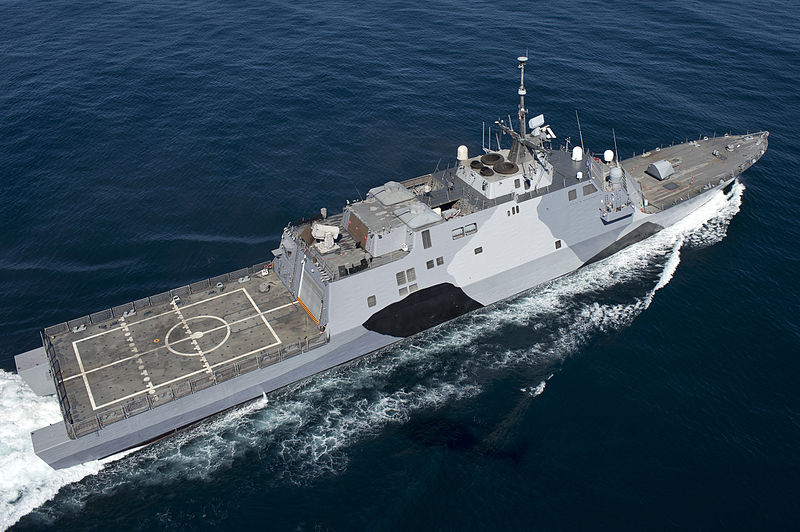
800px-USS-Freedom-rear-130222-N-DR144-367

Photo: USS Freedom (LCS-1)

The US Naval Institute news service reports “Results of New LCS Review is Departure from Original Vision.”

Why should we care?:

For one thing the LCS were planned to be multi-crewed. Their plan was a bit different from our Crew Rotation Concept, but the idea was the same, multiple crews rotating among multiple ships to provide more deployed time. The Coast Guard had planned to apply the Crew Rotation Concept to the National Security Cutters, but I have also seen it referred to with regard to the Offshore Patrol Cutters.

Earlier I called the Offshore Patrol Cutter, the other LCS, and it does look like they will continue to share some systems and training. If the OPCs emerge with space for modular systems, we may see even more cross talk between the programs. The two types (LCS and OPCs) are similar in size, so comparisons are inevitable.

Hopefully we can learn from their experience.

The results: 

The Navy is abandoning their planned rotation of three crews among two ships in favor of a plan that would assign two crews to a single ship, much like the way SSBNs are manned by blue and gold crews. The significant difference is that the crews “own” the ships, they don’t expect to walk away to a different hull and never see it again.

The size of the crews is to be increased. Originally there was to have been a core crew of 40. That was increased to 50, and it is now planned to increase the core crew to 70 plus a 23 person air detachment. Maximum berthing is reportedly 98. Adding a CG LE team should max out the berthing. This pushes the crew much closer to what the Coast Guard was planning for the OPC, (pdf) a crew of 104. That means a full crew for each LCS is really 163, two core crews of 70 and 23 in the air detachment.

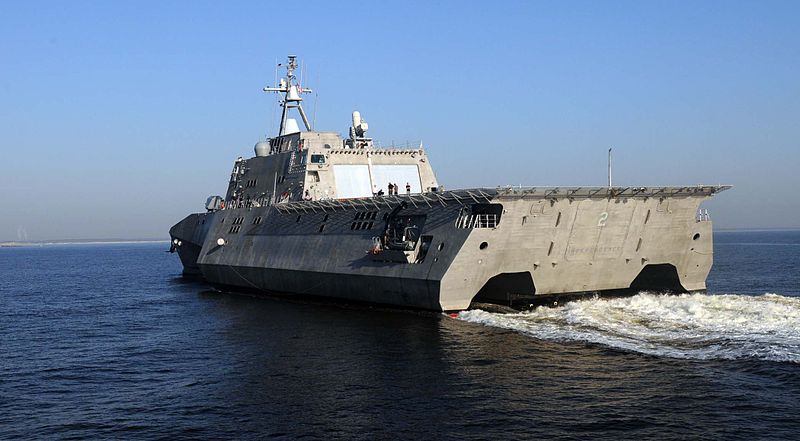
Instead of basing a mix of both types of LCS on each coast, the new plan would put the trimaran Independence class, with its longer range, on the West Coast (San Diego) while the shorter legged, monohull Freedom class will be based on the East Coast (Mayport, FL). That makes a lot of sense.

The ships will be organized into six four ship divisions with each division assigned a single mission (mine countermeasures, anti-surface, or antisubmarine). The four oldest ships will be single crewed, will not be assigned to a division and will instead be used for training and testing. Again this makes sense since subsequent ships are somewhat different, having incorporated lessons learned on the first ships.

That doesn’t necessarily mean there will be one division of each class assigned each of the three missions although that may the result. To me the Independence class appears better suited for ASW and the Freedom class by default better used as minecountermeasures ship.
uss_independence_lcs_2

Photo: USS Independence (LCS-2), U.S. Navy photo by Mass Communication Specialist 2nd Class Justan Williams 

Lessons: 

When the Coast Guard finally decides to abandon the Crew Rotation Concept, as currently envisioned–four crews for three ships. They can point to the LCS experience as justification.

As a means to allow increased time underway, permanently augmenting the NSCs’ crews to allow generous leave and TAD assignments is probably a better solution. After all, if we have a crew of 160 or so assigned to each NSC or OPC, we could probably keep them underway at least as much as the LCS are.

Applying a division staff organization to the NSCs and perhaps the OPCs is probably a good idea. In addition to a post command captain, that could, among other things, provide initial advice to newly arrived COs and possibly a relief CO function; it could provide personnel augmentation for those specialists positions that have little or no redundancy in the typical ship’s organization, allowing them some leave and/or TAD while the ship is underway, with the objective of keeping the crew members underway time at 185 days or less, while the ship is away from homeport for a considerably longer time.


Canada’s Coast Guard, Same Song, Different Accent

CBC reports that the Canadian Coast Guard is in bad shape.

  • Their ships are old.
  • Increased maintenance is eating into their budget and restricting asset availablity.
  • Their new Polar Icebreaker is still a decade away.
  • They have been under funded for decades.

Sounds familiar doesn’t it. In fact, as if to excuse the problems they say, look the USCG has the same problems.

Fatal Incident in Eastern Pacific Drug Interdiction

The Eleventh District has provided a news release which I will quote in full.

A crewmember of a vessel suspected of illicit trafficking activity in the Eastern Pacific Ocean died Tuesday night during the U.S. Coast Guard’s pursuit and interdiction of the boat some 200 miles off the west coast of Isla de Coco, Costa Rica.  The exact cause of death is not known and is under investigation.

A U.S. Coast Guard helicopter, operating from a Coast Guard cutter patrolling the area, pursued the suspicious vessel.  The helicopter signaled the vessel to stop but it failed to do so.  Pursuant to Coast Guard procedures, a precision marksman aboard the helicopter then fired warning shots in front of the vessel, which were ignored by the vessel’s crew.  The marksman then fired rounds into the vessel’s outboard engines, disabling the vessel and bringing the pursuit to a halt.

Once the suspect vessel stopped, a Coast Guard law enforcement team from the cutter boarded the vessel and discovered an injured suspect, who later died.

“Our efforts to stem the flow of illegal drugs are inherently dangerous.  We go to extraordinary lengths to minimize the chance of injury during these operations,” said Rear Adm. Todd Sokalzuk, Commander of the 11th Coast Guard District. “It is regrettable that in this case the crewmembers did not heed multiple orders and warnings to stop their vessel, causing us to employ tactics necessary to disable their engines.  Unfortunately, one of the crewmembers was fatally injured during this interdiction,”  he said.

An investigation is underway to review the details of Tuesday’s interdiction and determine what caused the suspected smuggler’s fatal injuries.

In 2015, a record 109 metric tons of cocaine and 316 suspects were interdicted in the Eastern Pacific by the U.S. Coast Guard and partner agencies.  In fiscal year 2016, the record pace of interdictions continues, with over 132 tons seized, and 410 suspects taken into custody.