
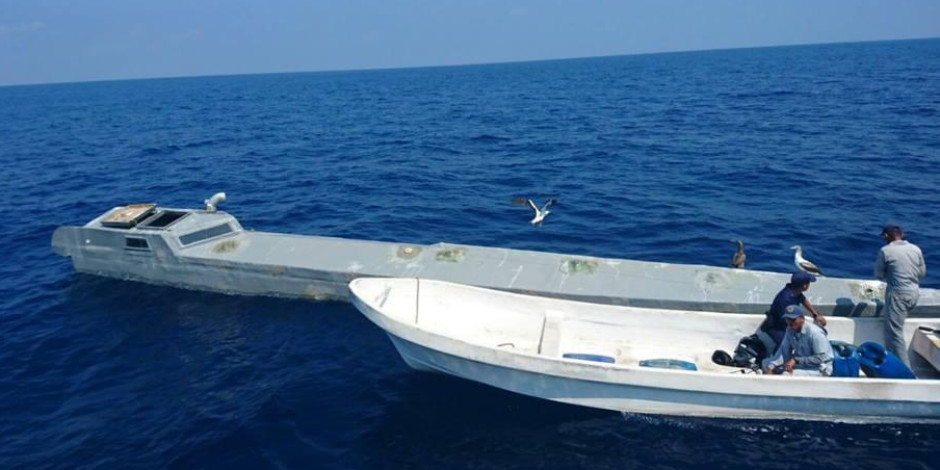
Very Slender Vessel (VSV). Guatemalan Ministry of Defense photo.
Popular Mechanics has a post on the way drug smuggling craft are evolving in an attempt to avoid detection. Specifically they have begun to use very slender hull forms for their self propelled semi-submersibles.
The post also has a link to perhaps the best collection of photos of smuggling craft I have ever seen.
Thanks to Peter O. for bringing this to my attention.
 Chuck Hill's CG Blog
Steve, What are these?
https://navalanalyses.blogspot.co.uk/2016/01/warships-of-past-panagopoulos-class.html
The smugglers’ boat just reminded me of the Panagopoulos class.
Interesting choice of weapons on the panagopoulos class. Reminds me of the ONTOS armored vehicle. https://en.wikipedia.org/wiki/M50_Ontos
I am familiar with Ontos. How a mass of recoilless rifles would work at sea I don’t know………
You don’t want to stand behind it, and rate of fire is not going to be great, but probably a lot more accurate than the rockets the Iranians are using on their Fast Inshore Attack Craft (FIAC).
As you probably know, Royal Marines used a Carl Gustov 84mm recoiless rifle to disable an Argentine Corvette’s gun during the Falklands war.
Recoiless Rifles are among the weapons terrorist might employ to counter the Coast Guard if they attack using a ship.
When the Japan Coast Guard intercepted a N. Korean spy transport in their waters, the N. Korean vessel responded with recoiless rifle and machine gun fire. https://en.wikipedia.org/wiki/Battle_of_Amami-%C5%8Cshima
The Royal Marines were anchored to several million tons of island. 🙂
I have been thinking just lately about a ‘baton round’ for ships. Instead of the shot across the bows shooting something slow and heavy actually at the ship (hull, clear areas of deck without personnel), to make a bit of noise and have a ‘direct’ impact. Though the utility of the system would not be worth the effort I think.