
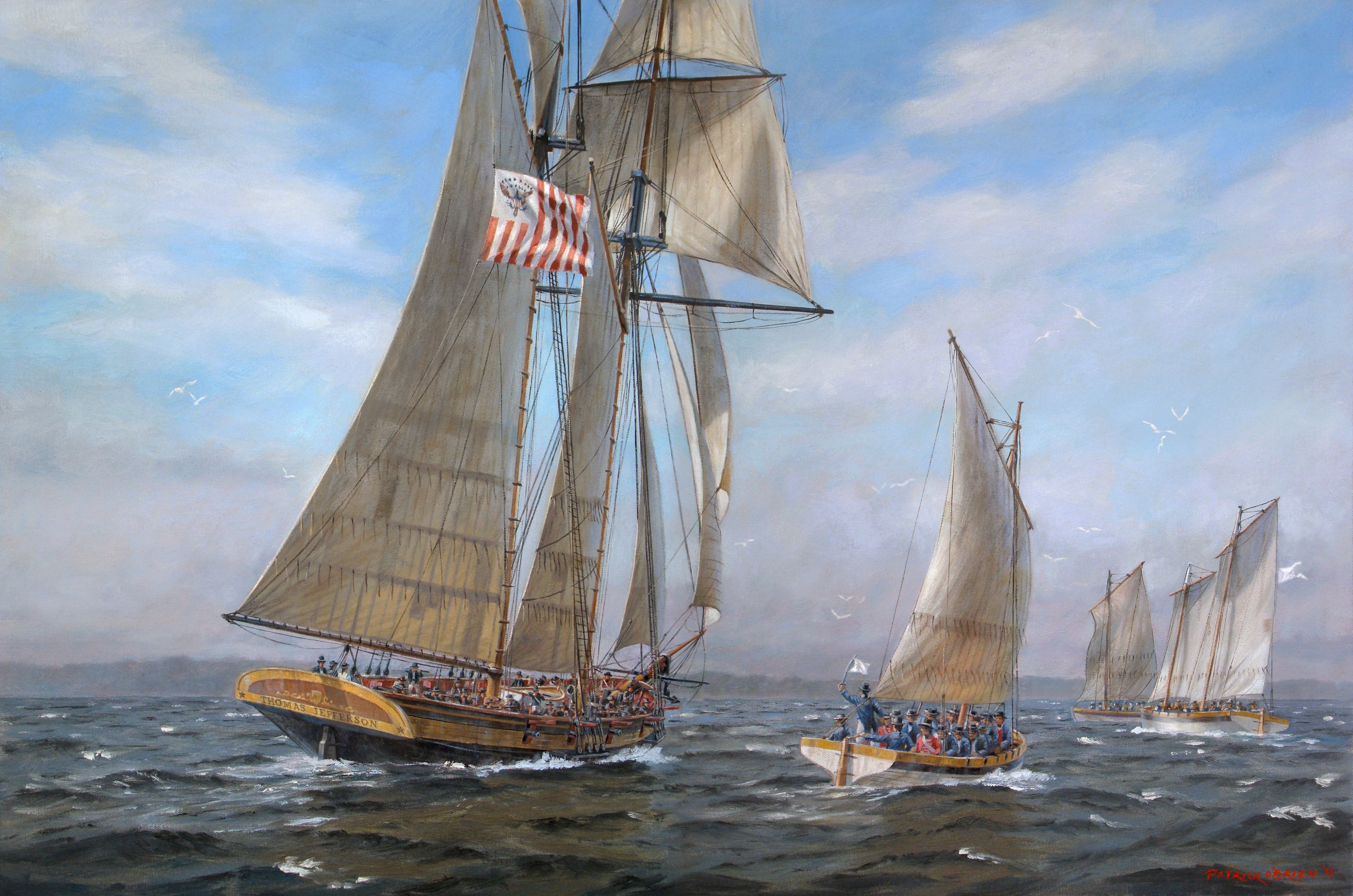
Revenue Cutter Thomas Jefferson captures three Royal Navy barges and personnel in Hampton Roads. US Coast Guard Collection.
Below you will find the text of the Commandant’s ALCOAST regarding the upcoming Aug. 4, “Coast Guard Day.”
I find it curious that it only talks about the Law Enforcement Mission, and almost exclusively drug enforcement, with only a mention of fisheries and no mention of alien migrant interdiction, environmental protection, or marine safety regulation. No mention of SAR, AtoN, Military Readiness (other than “maintaining our national security”), or recreational boating safety. Notably no mention of icebreaking either domestic or polar when we are seeking funding for icebreakers. No mention at all of the other organizations that were folded in to make the modern Coast Guard.
It is almost as if this is written for a specific audience. Makes me curious as to why it was written the way it was.
(Incidentally Bill Wells is sure to point out that Alexander Hamilton did not create the Revenue Marine as a Service, and certainly not as a “military service.”)
ALCOAST 253/19
COMDTNOTE 5700
SUBJ: COAST GUARD’s 229TH BIRTHDAY
1. Sunday, 4 August 2019, marks the Coast Guard’s 229th birthday.
2. The U.S. Coast Guard’s law enforcement mission is its oldest, and sets us
apart from other military services. After the American Revolution, Secretary
of the Treasury Alexander Hamilton was keenly aware of the need to protect
the Nation’s customs revenue, maintain coastal waters, and combat illegal
trade and piracy. On 4 August 1790, Congress, at the urging of Hamilton,
created the Revenue Marine, a military service designed to patrol coastal
waters and regulate the collection of tariffs. The Coast Guard proudly traces
its roots to that date, and for the past 229 years, the Coast Guard has served
the Nation with excellence.
3. The first recorded narcotics seizure by a cutter occurred on 31 August 1890.
A detail of four officers and eighteen men of the Revenue Cutter WOLCOTT boarded
and discovered a quantity of opium on the steamer GEORGE E. STARR. The vessel
and its illegal cargo were seized for violations of U.S. customs law.
4. On 16 January 1920, Prohibition became the law of the land. Given the mission
of preventing liquor smuggling into the United States, the Coast Guard saw a
rapid expansion of both facilities and personnel. By 1924, the “Rum War”
escalated. Smuggling from the sea, particularly along the East Coast, grew into
an immense, highly-coordinated criminal activity. That criminal behavior was met
with intensive and aggressive action by the Coast Guard. When Prohibition ended
on 5 December 1933, Coast Guard Headquarters reported: “The continued pressure
of Coast Guard preventative measures was a potent factor in reducing the volume
of the smugglers’ business and in bringing about a change of smuggling technique.”
5. By the 1970s, the Coast Guard faced an escalation of drug smuggling on the high
seas. This rapid growth of the maritime illegal narcotics trade drove the need for
highly-trained boarding teams and Law Enforcement Detachments (LEDETs), to specialize
in drug interdiction. On 1 November 1984, CGC CLOVER seized 13 tons of marijuana.
Three days later, CGC NORTHWIND became the first icebreaker to make a narcotics
seizure, capturing 20 tons of marijuana. On 8 May 1987, Coast Guard units seized 1.9
tons of cocaine. In 1989, the National Defense Act named the Coast Guard as the lead
agency for maritime drug interdiction.
6. Over the next several years, Coast Guard units continued to interdict drug
traffickers, seizing tons of marijuana and cocaine. CGC DAUNTLESS became the first
cutter in history to seize one million pounds of marijuana. In 2004, Coast Guard teams
intercepted and seized two ships near the Galapagos Islands, resulting in the capture
of more than 56,000 pounds of cocaine. In March 2007, CGCs HAMILTON and SHERMAN seized
42,845 pounds of cocaine aboard a Panamanian-flagged vessel.
7. Today, the mission continues. In July, CGC MUNRO, our newest operational National
Security Cutter, completed its first-ever counter-drug patrol in the Eastern Pacific.
The interdiction of a self-propelled semi-submersible (SPSS) on 18 June resulted in
17,000 pounds of cocaine, the largest single seizure since 2015. Nine total interdictions
resulted in nearly 40,000 pounds of illicit narcotics with a wholesale value of $569
million dollars. During the patrol, MUNRO’s crew worked closely with the Coast Guard’s
Helicopter Interdiction Tactical Squadron (HITRON), which celebrates its 20th anniversary
this year with over $21 billion in seized narcotics from airborne use-of-force interdictions.
8. As we celebrate the 229th birthday of the Coast Guard, it is evident that our first
mission remains one of our most important today. Coast Guard air and surface assets, as
well as our brave men and women, are tasked with enforcing fisheries laws, ensuring secure
ports and waterways, keeping illegal narcotics off our streets, and maintaining our national
security. We remain “Semper Paratus – Always Ready.”
9. ADM Karl Schultz, Commandant, sends.
10. Internet release authorized.
 Chuck Hill's CG Blog