
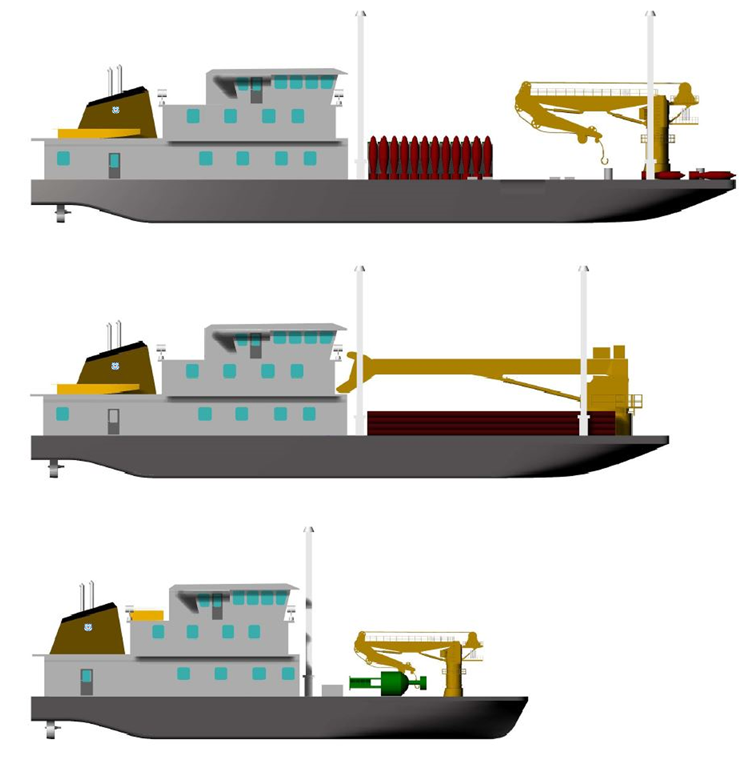
Shown above are Coast Guard indicative designs of a river buoy tender, inland construction tender and inland buoy tender.
The news release is below.
Congressional Research Service has an Aug. 30, 2022, two page explanation of the program.
For background, my most recent previous related posts:
“Ohio River Bomb Spree Shows Need For New Coast Guard Waterways Commerce Cutters” –Forbes Nov. 2021
“Coast Guard releases request for information for boats to support waterways commerce cutters” –CG-9 Oct. 2021
“Waterways Commerce Cutter: It’s Time for an Upgrade” MarineLink June 2021
There are others: https://chuckhillscgblog.net/?s=waterways+commerce+cutter&submit=Search
| News Release |
U.S. Coast Guard Headquarters
|
Coast Guard awards River Buoy, Inland Construction Tender detail design and construction contract
WASHINGTON – On Oct. 5, 2022, the Coast Guard Waterways Commerce Cutter (WCC) Program awarded Birdon America, Inc. of Denver, Colo., an indefinite-delivery, indefinite-quantity firm fixed price contract with economic price adjustments for the detail design and construction of its river buoy and inland construction tenders.
The initial award is worth $28.49 million. The contract includes options for the construction of a total of 16 river buoy tenders and 11 inland construction tenders.
If all contract line items are exercised, the total contract value is estimated at $1.19 billion.
River buoy tenders service short-range aids to navigation (ATON) on the western rivers. They set, relocate and recover buoys to mark the navigable channel in the rivers as the water level changes and also establish and maintain fixed aids, lights and day beacons.
Inland construction tenders construct, repair and maintain fixed ATON within inland waterways along the Eastern Seaboard and Gulf of Mexico. They are the only Coast Guard platform with the capability to drive and remove piles, erect towers and effect major structural changes.
The Coast Guard has a statutory mission to develop, establish and maintain maritime ATON. WCCs will perform a critical part of this mission on the inland waterways and western rivers. The WCCs will replace the legacy inland tender fleet, which has an average vessel age of over 57 years and includes ships still in service at 78 years old. This contract award ensures the Coast Guard will continue to meet its vital missions throughout the Marine Transportation System.
“This contract award is an important milestone for the new inland fleet that will improve our operational capability on the Western Rivers, and Inland Waterways” said Adm. Linda Fagan, Commandant, U.S. Coast Guard.
The new WCCs will have greater endurance, speed and deck load capacity than their predecessors. The ships will also feature improved habitability and will accommodate mixed-gender crews.
More information on the WCC: Waterways Commerce Cutter program page
 Chuck Hill's CG Blog
Interested to see final design. With a crew up to 19 mix gender and hauling two 21’ boats it sounds like it might be bigger than the 195’ combined length of the current 75 WLR/barge. Plus they need to find a shipyard to build it. It looks like Birdon is in Denver and only has a boat yard on each coast.
Bollinger Lockport: https://www.workboat.com/shipbuilding/birdon-america-awarded-1-187-billion-uscg-contract
Perhaps interesting for a direct comparison to the inshore buoy tender part of WCC that is not part of this contract and that the CG now seems to be realizing in a joint project with USACE:
German WSV recently – in July – signed a contract for procurement of five additional “Emmerich” class river buoy tenders for the lower Rhine. These 109ft ships in their specs are largely identical to the USCG WCC WLI requirements – just slightly too slow at 10 knots (11 kn req) and with a too-small crane (2.07t instead of 3.25t) due to the smaller buoys used on German rivers.
Their tasks are primarily in ATON maintenance (buoys, radar beacons) as well as auxiliary tasks (such as removing floating debris, inspections, assisting in emergencies etc). Besides a fairly spacious workdeck they also have a workshop onboard.
The namesake of the class was procured as a prototype in 2020, the current contract replaces all river buoy tenders for that section of the Rhine with identical ships. Design-wise they are a larger version of WSV’s standardized “25m workship” to which e.g. Fassmer’s MPV25 was built for WSV. Cost per ship was 5.1 million Euro – unchanged both for the prototype three years ago and the new 5-ship contract now.
While built as riverine craft they are somewhat capable of coastal travel too, “Emmerich” transferred to the Rhine on a 400-nm trip via the North Sea under her own power.
The Emmerich class differs in a few major points from US requirements though:
– They are operated with a crew of only two men in a single-watch concept. For certain tasks, such as construction, a work crew may additionally be taken aboard. Otherwise it’s one captain for the ship, one boatswain to man the crane and workshop.
– The new ships are diesel-electric with hybrid propulsion, including optional battery propulsion e.g. when passing through cities.
– The ships have a hydraulic bow ramp and are built to transport and land vehicles up to 12 tons weight as landing craft (primarily e.g. small/medium excavators for construction as well as WSV’s Unimog-based 11-ton recovery vehicles).