
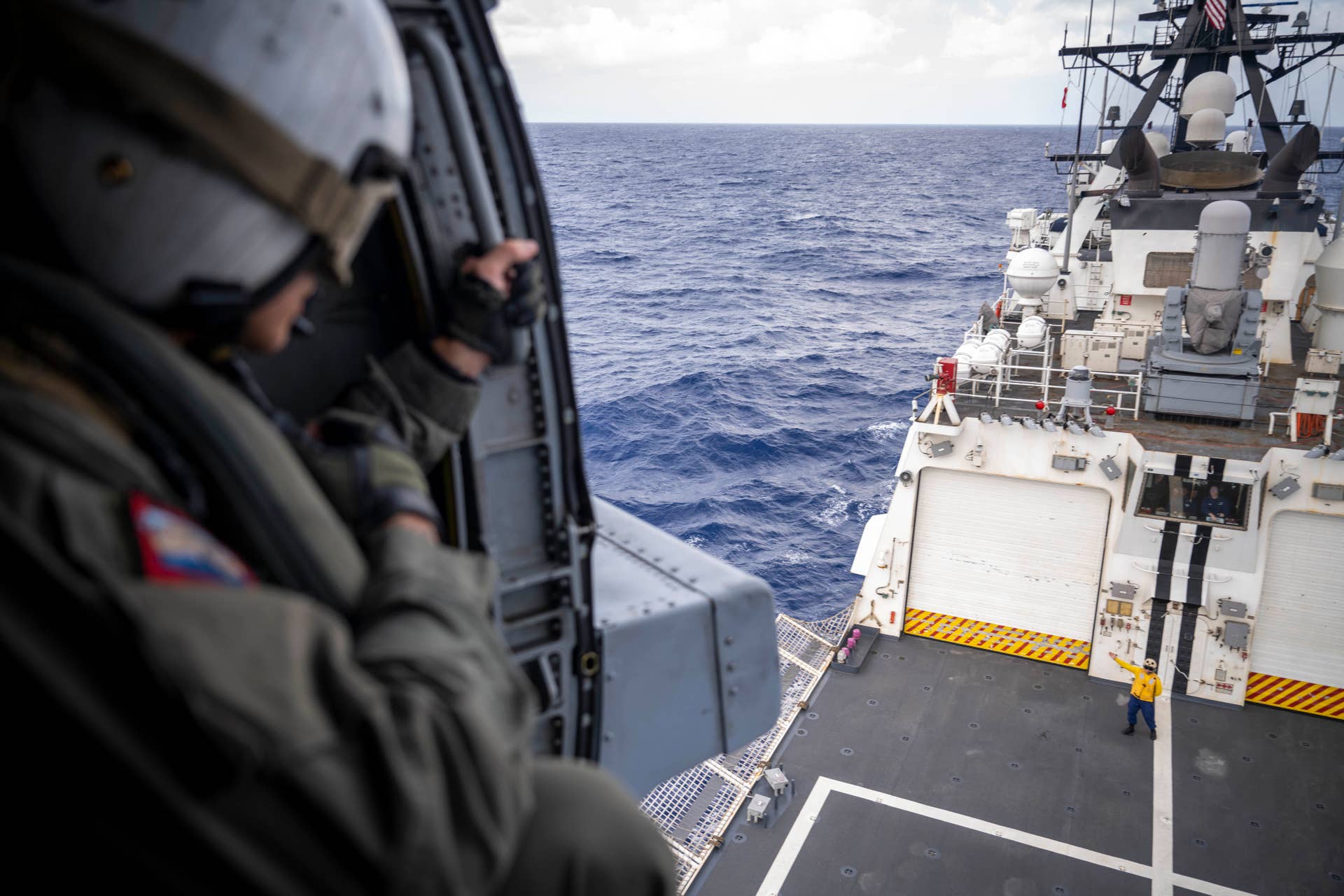
PACIFIC OCEAN (July 30, 2022) U.S. Navy Petty Officer 1st Class Humberto Alba, a naval aircrewman tactical-helicopter, attached to Helicopter Maritime Strike Squadron (HSM) 37, deployed on U.S. Coast Guard Legend-class cutter USCGC Midgett (WMSL 757), looks down at a USCGC crewmember after taking off during flight operations during Rim of the Pacific (RIMPAC) 2022. (U.S. Coast Guard photo by Petty Officer 3rd Class Taylor Bacon)
This essay from the July 2023 issue of Proceedings, is featured on the US Naval Institute Proceedings web site. It won Second Prize in the Midshipmen & Cadets Essay Contest—Sponsored by the U.S. Naval Institute.
This is just one of many such articles that have been published repeatedly over the years. The logic is clear,
If more heavily armed, Coast Guard cutters could better support the Navy and enhance defense readiness.
At small marginal cost, cutters could make a significant contribution to our nation’s naval strength, but it has not happened in the last 30+ years. Why not?
It seems the Leadership of both the Navy and Coast Guard have other priorities, and there is no sponsor in a position of power to push the program.
The Navy is in trouble. The Navy has been shrinking over most of the last 34 years, from down from 592 Sept. 30, 1989, to 299 as of this week. It began with the collapse of the Soviet Union. I’m sure it seemed like good idea at the time, but the “peace dividend” meant there was not much reason to build new ships. Teams that had developed a long string of successful ship designs ceased to exist. Shipyards closed. As a result, they have had difficulty fielding new classes of ships. Their new generation shipbuilding programs have been plagued with problems, while the Chinese navy has been building ships at a furious pace.
The Coast Guard has had its own troubled recapitalization program, beginning with “Deepwater” and while the NSC and FRC programs seem to have been successful, if long delayed, the Offshore Patrol Cutter and Icebreaker programs are still having significant difficulties. But perhaps more importantly, Coast Guard leadership sees the conventional model of a combat ready Coast Guard as counterproductive to other Coast Guard priorities.
Personally, I feel fears that a more heavily armed Coast Guard would not be welcome in many parts of the world is overblown, but the fear does exist and the conventional model of permanently installed weapon systems operated and maintained by Coastguardsmen would require a diversion of assets unless the budget is increased and more assets are provided. There is a cost to the Coast Guard in terms of training and maintenance time for both units and individuals, even if the Navy pays for the systems.
I think there is an alternative that would address the fears of the Coast Guard leadership and create a powerful sponsor in the Navy.
The Navy Reserve could be that sponsor. It is a reservoir of trained talent, but where do they go upon mobilization? There are only so many ships. Their crews, while they may have some shortages, are essentially at war time manning levels. There are only so many helicopter landing spots on Navy ships. Many Navy Reservists have no really appropriate place to serve upon full mobilization.
Coast Guard units can provide a place where they can be used effectively. Navy helicopters and their crews can fly from Coast Guard cutters. Modularized versions of towed array sonar systems could be operated and maintained by Navy reservists on large cutters.
Initially at least, these reinforced cutters would be best used in the board reaches of the Pacific, beyond the effective range of enemy land based and air-launched anti-ship missiles, where the primary threat would be submarines, protecting the logistics ships that are essential for prosecuting a war in the Western Pacific.
In 2012, Admiral Jonathan W. Greenert, U.S. Navy, advocated,
“We need to move from ‘luxury-car’ platforms—with their built-in capabilities—toward dependable ‘trucks’ that can handle a changing payload selection.”
If the Navy can provide payloads, the Coast Guard can provide some trucks.
 Chuck Hill's CG Blog
Chuck, it seems like I can’t get into my ancient WordPress account, so here’s a comment:
As a long-ago retired Sonar Tech, I’ve always thought the CG was a bit shortsighted when it gave up any and all ASW capability. I’ll grant the SQS-38 was best for patrolling on the continental shelf due to its relatively short range, but the Navy had nothing like it at the time. The CG started moving toward a passive towed array, but the “peace dividend” took care of that. I think the fear that we would have to cut the cable on a very expensive piece of equipment in order to quickly adjust to a SAR mission was a red herring. Now there are drug smuggling subs and semi-submersibles, but not much we can do about that. The idea of being able to put a towed array system on board in some modular fashion, particularly manned by reservists (Navy and Coast Guard), seems like a cost-effective, practical enhancement to the sea services’ capabilities.
They might have to widen those hangar doors to fit the next generation Navy MH-XX tilt-wing aircraft that will be replacing the MH-60 (if the MH-60 goes away entirely when the MH-XX comes out). The MX-XX may be the Bell V-280 Valor or something similar.
Perhaps instead of two narrow hangar doors on the NSC, they could change it to one super-wide hangar door (or one wide hangar door and one small door for UAVs).
Or maybe a model with folding wings and/or folding rotors would fit.
This is why I felt it was a huge mistake to put the next-gen helicopter program basically in the hands of the Army. The Army is ultimately going to pick what is best for its missions and to hell with the other services… My feeling is the Bell being selected as the medium-lift/assault platform means the Boing will be chosen as the Scout/attack platform, so as to keep as many manufacturers funded as possible. (This leads to other problems for the Army – vastly different top speeds for the two platforms complicating escort, but that’s another problem…)
I think the only hope (and it will become a necessity) for the Navy and CG is to break away from the joint program and demonstrate the need for the larger Boing helo for the sea services’ roles.
It’s a topic that repeatedly comes up but as you pointed out Chuck, never gets acted upon. More armament never hurt anyone until it needs to be used. Sometimes, looks alone can be effective. Case in point, the 5″ on the 378 vs. the 57mm on the NSC. Which one looks more intimidating?
I would say that most of us here would be in favor of this but unfortunately, we do not make those decisions. At bare minimum, I think our higher end cutters (NSC & OPC) should be outfitted similar to a frigate or be easily able to be upgraded quickly.
The navy got their pick up trucks, the LCS’s now they do not want them. What makes you think the Coast Guard should do the same?
We don’t really have to do anything differently during peacetime. The capacity is dormant. A lot of the problem with LCS was that they wanted to make trucks that performed like Ferraris. They prioritized speed over reliability and range. The push for speed made them choose hull forms that were very weight sensitive and that precluded the towed array they wanted for the ASW capability.
What the USN needed was a mix of Danish Abaslon and Iver Huitfeldt hulls. Simple propulsion systems. American weapons. Long range. Robust.
Unfortunately, what the Navy wants and what the Navy needs are two different things.
Even though it’s what they need, the US Navy doesn’t want simple, reliable, long range, robust, or inexpensive.
The US Navy wants complicated, unreliable, short range, super-expensive, but bleeding-edge high-tech, futuristic, and sexy looking ships!
That’s why the Navy ordered Zumwalt destroyers (floating experiments with non-functional weapons systems, ships that are currently incapable of fulfilling any mission other than being an expensive testbed for experimental future not-ready-for-primetime weapons) and Littoral Combat Ships (Little Crappy Ships) that are so unreliable that they break as soon as you put them in water!
@Bazil Brush: No one realistically ever saw the LCS as a pick-up truck, even though the Navy tried to sell them that way (it was all about Congress and $$).
A pick-up truck should at least be able to carry a 4’x8’ sheet of plywood and a half-ton of cargo. The LCS program was an S-10 step-side which looks cute, but can’t do any real work; maybe a few 4’ 2x4s.
Even with the module systems all working and uncancelled (🤣), they were pretty lightly armed “one-trick ponies.” Anyone serious about naval defense found them laughable.
The Falklands had long previously taught the error of using aluminum in a warship, and now with the LCSes cracking apart and restricted to 20 knots and sea state 4, there’s another reason to avoid aluminum.
They were Corvettes at best, designed with the assumption of a post-cold war world would change the real needs of the Navy into a patrol force. Just utter wastes of money and time, and that is their real legacy: They were counted on for numbers of launch tubes and numbers of hulls, and now with their failures, they have caused the VLS cell gap and the shrinking hull number gap (along with no replacements in the pipeline for the CGs). The BuShips who came up with the concept and the CNO who approved iit should have their retirements garnished to pay back some of the losses here. There’s a saying: If it’s predictable it’s preventable. No one applied that to the LCS program.
Next class of large cutters, have them use STANFLEX? It would at least give options.
This is simple, and I’ve said it before: every major Navy and USCG combatant needs to be suitably armed. The NSCs and OPCs need to have 2-30mm Mk38 Mod4s along with their 57mm AND either a Phalanx or SeaRAM. This fit should be basic. The location of the Mk38 on the OPC is just bizarre. NSCs and OPCs should have space/weight for NSMs.
Every combatant and auxiliary needs at least 2 SeaRAM and/or Phalanx, every one! Hull sonar is needed on the NSC and OPC, in addition to towed arrays on the NSC. It’s not that expensive to make this happen and add the shipboard operators. It’s a lot cheaper than building more $2B hulls for the Navy.
I agree!
Speaking of bizarre positions for the MK38, have you seen the even more bizarre positions of the MK38 guns on the planned Polar Security Cutters? It seems they tried to hide the MK38s next to or behind cranes, perhaps thinking if they hide the guns behind cranes, the cutter would appear unarmed, which is silly because anyone can look on Wikipedia and see the armament, so it’s not going to fool any peace-loving Canadians into thinking US icebreakers are unarmed like Canadian Coast Guard cutters. This hidden position next to cranes gives each gun a field of fire of only (I’m guessing) about 100 degrees, when it would be better to have a 270 degree field of fire (or at least 180 degrees).
@DaSaint – YES! I would add: Ship defense and tactical ability requires a lot more than just weapon systems. (I know you know, but for public reading purposes…)
Every OPC and NSC should have:
•SLQ-32,
•RBOC launchers (which include more than just chaff),
•RPS-42,
•SeaRam (I’ve lost confidence in CIWS),
•2 Mk.38s,
•CEC,
•hull-mounted sonar, and
•Mk.32 TTTs.
These are bare minimums just for self defense, and allows the Cutters to operate in a threat environment but not really project any AAW or ASuW, and very minor ASW ability (against advanced SSNs with heavy torpedoes, it is basically self-defense only and not power projection). (Note in a military-operations situation, I don’t see much use for a big gun – I’ll apologize to Chuck in advance.😉)
Now, for the CG to have Cutters which provide value in a projective way (and by that I mean defending other ships the Cutter may be escorting, not necessarily offensive military operations), another layer of sensors and weapons must be included.
For ASW: a towed sonar array, ASW helo, and data links for the helo and ship to operate in coordination. This would also require magazine space for the helo deployed munitions.
For ASuW: NSM is the “easy button.” Lighter than Harpoon, and easily accommodated on small ships (as demonstrated on LCS).
For AAW: This gets complicated and difficult fast. The Navy has a lot of advanced capability here as well as tons of platforms with sensors. (Remember the days when the Ticos were the only Aegis ships??). To escort a convoy in the future, I’d see putting one or two of the new Constellation class and two NSCs/OPCs together as an escort task unit. The FFGs would handle air defense with their sensors, and the cheap value the NSC or OPC could add in the area of AAW would be one or two 8-cell VLS launchers for additional missiles guided by the FFG through the CEC. I don’t see the value to the country of up-fitting the Cutters to independent AAW mission capability. I believe the NSCs have space specified for adding an 8-cell VLS if needed.