
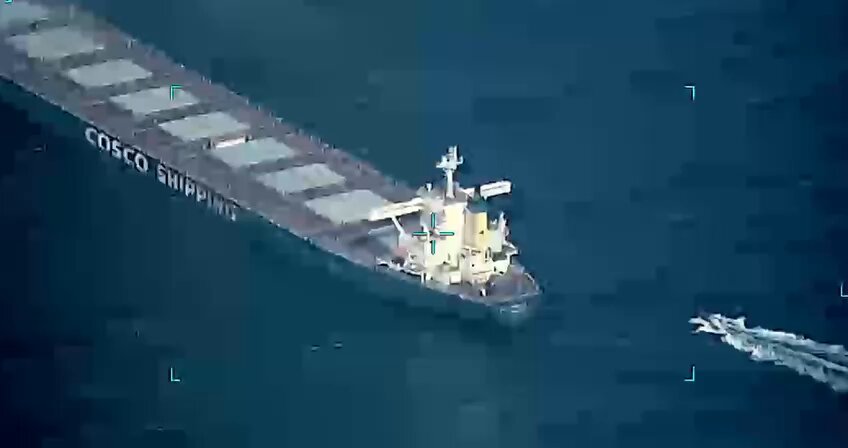
The Indian Navy approaches the M/V Lila Norfolk in the Indian Ocean, January 5, 2024. Photo courtesy Indian Navy
“An Indian Navy warship intercepted the MV Lila Norfolk on Friday afternoon, less than a day after the navy received news that it had been hijacked off Somalia’s coast in the North Arabian Sea.”
The crew of 21 had taken shelter in a citadel. By the time the Indian Navy destroyer, INS Chennai, had arrived, the pirates had fled.
The MV Lila Norfolk “was kept under continuous surveillance using MPA (Maritime Patrol Aircraft–Chuck), Predator MQ9B & integral helos.”
Notably, the Indian Navy is one of several users of the MQ-9B Sea Guardian Medium Altitude Long Endurance UAS including the Japan Coast Guard, the UK, Taiwan, and Greece. The US Coast Guard after years of observation of Customs and Border Protection’s use of earlier model MQ-9 Predators, the USCG has yet to procure or even experiment with a shore based long endurance UAS.
 Chuck Hill's CG Blog
This earlier report provides some background. https://gcaptain.com/ship-boarding-by-armed-persons-in-indian-ocean-sparks-concern/
What is the story behind the U.S. Coast Guard’s not using shore based long endurance UAS? With our extensive coastlines, it would seem an ideal means of ocean surveillance. Do we have adequate surveillance through other means?
I think some of the delay has been because UAS have not had sense and avoid systems to prevent mid-air collisions, but some systems have been developed. There is a version of the MQ-9B that has demonstrated sense and avoid capabilities that goes back to at least 2018. I am not sure if the FAA has accepted this yet, but it has not stopped DOD from operating UAS in US airspace.