
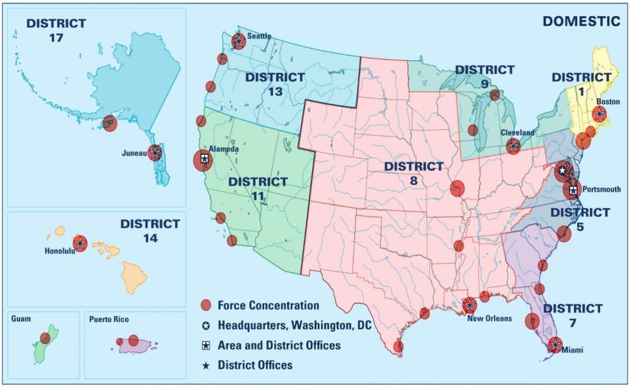
The February edition of US Naval Institute Proceedings has a one page, “No Body Asked Me, But,” article on page 18, by Cdr. Leah Cole, USCG, suggesting that the Coast Guard Districts be given geographic names rather than numbers.
I’ll just list the proposed names without linking them to the existing numbers because, you will find them obvious and intuitive.
- Forces New England
- Forces Mid-Atlantic
- Forces South and Caribbean
- Forces Heartland and Gulf Coast
- Forces California and Southwest Border
- Forces Pacific Northwest
- Forces Pacific Islands
- Forces Alaska and Arctic
I think she pretty much nailed it, though I think Forces Southeast and Caribbean might be more descriptive for D7, and for D11, Forces Pacific Southwest.
Along with these, she would rebrand the Areas Forces Atlantic and Forces Indo-Pacific. There is a potential glitch here, in that PATFORSWA, which frequently operates in the Indian Ocean, is currently under Atlantic Area. (Both the Combatant Commanders and the Navy’s Fleet structure have the Indian Ocean split up three ways.) Just Forces Pacific should suffice.
She goes on to suggest,
“As an additional step, the Coast Guard could time the renaming to align with a new recruiting initiative for both the active-duty and reserve force that offers candidates the opportunity to serve in their home regions or a region in which they would like to live and serve long-term. This could create a sense of purpose, build belonging, and also reduce barriers to accessions.”
She also suggests how district Reserve programs could be tuned for predicable surge operations–it’s a short read.
As I am sometimes told, this makes too much sense to actually happen, but it is definitely worthy of serious consideration.
 Chuck Hill's CG Blog
I would think that when SECTORs became a thing some thing like this would be in play at the same time.
I’m trying to figure out how AtoN, Marine Inspection, and Marine Environmental protection fit neatly into the “Forces” paradigm.
They are a “force for good.” The force terminology is already in use.
I hadn’t heard of “forces for good.” Perhaps I’m a dinosaur, but I’ve always associated “force” with an organization that could actually project “force” (Fleet Marine Force) or support the projection of force (Service Forces). NOAA is a close analog of Coast Guard people engaging AtoN, and certainly an equal “force for good,” but I’ve never heard of the “NOAA Hydrographic Force.” USDA food inspectors have a function similar to the Coast Guard Marine Inspectors, and they are certainly a “force for good”, but I wouldn’t think of having agricultural inspection done by military personnel.
In fact, I’ve often wondered why AtoN, Marine Inspection, and MEP are carried out by a “military” service at all. How can we fit them into the concept of a military officer as an expert in “the controlled application of violence?” When the Coast Guard took over Marine Inspection one rationale was that almost all Coast Guard officers were sea-faring professionals who could apply their experience to inspection. Now we have inspectors who spend most of their careers in inspection. How are they better than civilian inspectors whose life-cycle costs would be much less than the military inspectors they would replace? I think a good case could be made for replacing Coast Guard AtoN with either the Army Corps or NOAA. I believe both have closer ties to AtoN than does the sea-going Coast Guard. Both would have civilian crews (in NOAA’s case with Uniformed Commissioned Officers) that could develop long-term local expertise.
Finally, I think that Coast Guard officers directly involved in military and law enforcement operations find it hard to develop their military professionalism. I think that broadening the definition of “force” will dilute that even more.
@Pete, “A Force for Good” was a Navy recruiting slogan.
Some of the SAR controller positions (maybe all) have been civilianized. Would not be surprised to see some of the Marine Inspection billets going the same way.
I asked the computer for a definition of force and it is something that causes a change in direction or velocity. That is not a bad way to describe what we hope AtoN, Marine Inspection, and MEP will do.
I’ll add that in general, “forces” apply to people without regard to specialties. PATFORSWA, for example (Patrol Forces Southwest Asia) means everyone we have there.
Another useless disruption to a proven system. it will later morph into acronyms such as patforswa that no one has a clue what that is supposed to be. Current system of naming districts is pretty simple and logical if you can count and know the districts start from the NE corner of the United States.
What happens to this dream of being stationed in a certain section of the US when the needs of the Coast Guard comes in to play? What takes precedent, staying close to Mommy and Daddy or the mission requirements of the Coast Guard? Just curious.
The current system lost of lot of its logic when the Naval Districts went away and districts were consolidated. Like she said, where are districts 2, 3, 4, 6, 10, 12, 15, and 16?
Yes, you know the current system, but for people who are just learning, it makes no sense. On the other hand, the geographic names are intuitive.
The author’s comment about a system “…that offers candidates the opportunity to serve in their home regions or a region in which they would like to live and serve long-term” reminds me of work we were doing in 2000 or so as RADM Fred Ames, then CDR Bruce Viekman, and I were launching the Future Force initiative. We published a feature article in Proceedings followed by a series of “Flag Voice” communications called “Voices From the Future.” If I could figure out how to upload some of those to your blog … I’m sure your readers would find them interesting and perhaps controversial. In the meantime, a quarter century later, CG-1 is beginning to move in this direction.
Chuck, can I email some of the “Voices from the Future” I referred to in my last comment? You, I’m sure, would find them interesting.
Steve
[image: sig.jpg]
Always happy to get email from readers. chuckhhill@aol.com
Don’t forget the middle h.
Yes, this definitely makes too much sense to actually happen.
The goal of military designations and acronyms is obfuscation and confusion, as we all know! That’s why they gave the Heritage-Class Offshore Patrol Cutters the designation “MSM” (WMSM), which is the international designation for Minesweeper (I remember you pointed this out in a previous post). That’s why there’s a Seal Team 6 but no Seal Team 1, 2, 3, 4, or 5.
I think those SEAL teams may exist but of course we have the 82nd and 101st Airborne Divisions when the US Army actually has only 11 actual active divisions. We certainly do not have 101 airborne divisions.
Fun fact, Seal Team 6 was created with the name “Seal Team Six” to confuse the Soviets into thinking that America had at least six seal teams back when we only had one. That’s why there are no Seal Teams 1, 2, 3, 4, or 5, there never were, and there never will be because Seal Team Six has been renamed as DEVGRU, but most people still call it “Seal Team Six” (much catchier and easier to pronounce than DEVGRU).
The Wikipedia article says about this, “Marcinko named the unit SEAL Team Six in order to confuse Soviet intelligence as to the number of actual SEAL teams in existence.”
We could also continue to call them districts but give them geographic names, e.g. Coast Guard District New England or Coast Guard District Alaska and Arctic.