

WWII surface torpedo launch
The War Zone reports,
Rapid Acquisition Procurable Torpedo, or RAPTOR…early in the testing stages…could provide the service with quick-delivery and inexpensive submarine munitions that may be transferable to other platforms as well. (Emphasis applied–Chuck) Capt. Chris Polk, the Navy’s program manager for undersea weapons, detailed the effort …The goal…was to have a torpedo that costs $500,000 or less, with all components acquired and produced within a year. For comparison, the current unit cost of a Mk 48 Mod 7 torpedo is approximately $4.2 million…”
Why would the Coast Guard care?:
For quite a while, I have contended that Coast Guard cutters do not have a capability implicit in their mission set, the ability to forcibly stop vessels regardless of size. Simply put, we need a ship stopper.
With the increase in vessel size, it has become extremely unlikely we would be able to stop even a medium sized vessel, manned by a determined crew, in anything like a timely manner, using the guns being installed on cutters.
To stop a ship, the logical targets are rudder, propeller, or engines. All three are mostly or completely below the waterline, making a torpedo the logical weapon of choice. The last time I looked, we had 31 critical ports that needed protecting. Distributing enough of the US Navy’s only, very expensive, Mk48 heavy weight torpedoes to protect 31 ports was a non-starter, so I have suggested that we use lightweight torpedoes (the Navy has a lot more of them) with the idea that cutters would generally just serve as another place to store them since, if we are lucky, they would never be used. Even if an attack occurred, most would go unused. The ones issued to the Coast Guard could come out of the reserve stock until the Navy decides they need them in wartime.
The US Navy has not introduced a totally new heavy weight torpedo in more than 50 years. Some foreign surface combatants still carry heavy weight torpedoes, but the US Navy has not built surface combatants with heavy weight torpedo tubes since the 1960s. (Brooke and Garcia class Destroyer Escorts–later frigates–were the last classes.)
If this new torpedo does cost less than $500,000, it would be less than the reported cost of the Mk54 light weight torpedo ($839,320 in 2014).
It seems, the Navy may have decided they need a way to sink ships, maybe a lot of ships, including large ships, that may not be top of the line combatants, without having to empty their magazines of expensive, exotic munitions.
If that is the case, hopefully they will make enough to allow placing some on cutters, including small cutters like the FRCs or the WPB replacement. FRCs are almost seven times larger than the PTs boats of WWII and the PTs carried four heavy weight torpedoes. I would be happy to see cutters carrying two.
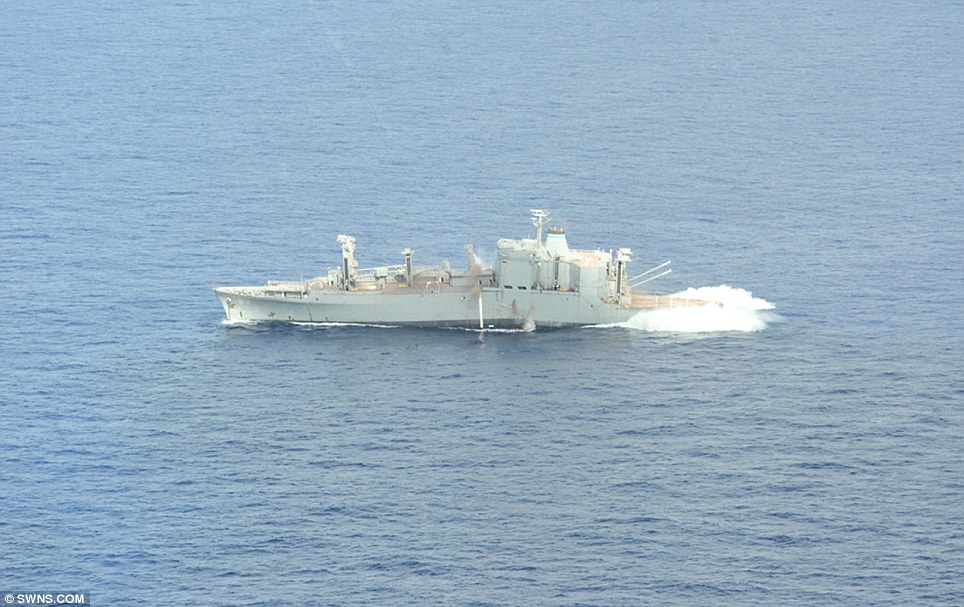
former USNS Kilauea breaks in half after being hit by the torpedo.
 Chuck Hill's CG Blog
I have always been fascinated by the terrestrial torpedo installations that were integrated into pre-WWII era coastal defenses, most notably in Norway. It is interesting to contemplate their utility with modern torpedo technology.
Some modern heavy weight torpedoes can go 60,000 yards. Most are now wire guided with terminal home. Really, they were UUV kamikaze drones before that was a thing.
I can see them as very useful off Taiwan , and the Baltic countries , and the Acandanavian countries. With today’s technology, they could be intelligent, perhaps being fired, then loitering on station. Maybe electric powered. They could be delivered by pipeline, we have great pipeline technology.
More about torpedoes here.
“And finally, Packer said the fourth line of effort is looking at the collective inventory of torpedoes and considering how to create more capability and capacity. Both the U.S. and U.K. stopped building torpedoes decades ago, and the U.S. around 2016 began trying to restart its industrial base manufacturing capability.
“The issue is that none of us have sufficient ordnance-, torpedo-building capability,” Packer said, but the group is looking at options to modernize British torpedoes and share in-development American long-range torpedoes with the allies — potentially through an arrangement that involves a multinational industrial base.”
AUKUS allies developing undersea capabilities they can field this year (defensenews.com)
I guarantee this is going to be 95% ASW oriented, perhaps 100%. The USN has let the ASW capabilities of their surface forces slip drastically since the 1960s. Reliance on Helicopters and lightweight torpedoes just isn’t going to cut it any more. China, NorKo, Russia, and Iran all have credible submarine threats, and they are building bigger and heavier. The lightweight torpedoes have been progressing through a series of failed attempts to update them, plus the recognition of the threats. ASROC carries a lightweight torpedo and has a relatively short range. Helos carry lightweight torpedoes. SVTTs are for lightweight torpedoes. The USN needs to look at a surface-launched heavy ASW torpedo. Right now, advanced opponent’s subs can sit outside detection and counter-attack range, and attack USN surface ships. Not good…
Once in inventory, it wouldn’t take much (software mostly) to give it the capabilities you have kept (rightfully) calling for.
I really think this is being driven by the submarine community. The guy they are quoting is a submariner. Chris Polk – Program Manager, PMS404 (Undersea Weapons) – US Navy | LinkedIn
Right now, submarines have the only large torpedo tubes in the US Navy. That could change, but it will take time.
The problem is that the Mk 48 was designed to take on the most difficult targets, nuclear submarines (like the Alfa, Sierra, and Akula Class) at great depths (like 2000 ft) capable of extremely high speeds (up to perhaps 45 knots) and do it at great distances, but it is now also the only US heavy weight anti-surface torpedo.
That means they are extremely expensive and requires parts that are not exactly COTS.
Meanwhile, most of the targets submarines are likely to engage are not so demanding, slower, on the surface or in shallower water, and not at such great distances.
Subs no longer need to launch spreads of four or six torpedoes. Now it is one or maybe two at a time. So, subs could have both Mk48s and the new much cheaper torpedoes ready to launch and choose the cheaper, hopefully easier to replace, new torpedo against most targets and save the Mk48s for more difficult targets.
The light weight torpedoes do have a problem with those very fast, deep diving submarines, so maybe if heavy weight torpedo tubes are added to surface ships and we no longer have to fill submarines with only Mk48 torpedoes, maybe some Mk48s may find their way onto surface vessels as well.
Probably a lot of money could be saved by reducing the speed, range and depth required of the new torpedoes. It might even be possible to make them half as long as the Mk48s allowing more torpedoes to be carried.
I have long thought that we could make a good torpedo propulsion system from the motors, batteries, and speed controls in the Tesla parts bin. They are powerful enough to be as fast as the fastest WWII torpedoes (about 45 knots).
The MkVIII torpedo that the British used to sink the cruiser Belgrano during the Falklands war entered service in 1927. It was a 21″ 3,452 lbs. (1,566 kg) torpedo with a 750 lb warhead (larger the than the one in the Mk48) and it could do 45 knots using only 322 HP.
https://www.navalnews.com/naval-news/2025/11/u-s-navy-seeks-offers-for-new-heavyweight-torpedo/
U.S Navy Seeks Offers for New Heavyweight Torpedo