
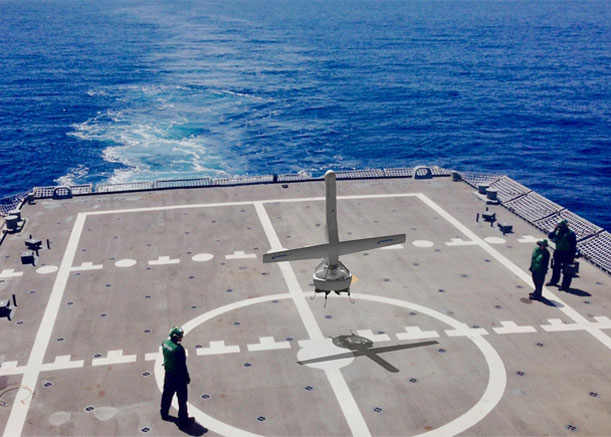
V-Bat from Martin UAV
Below is a news release. The total contract ceiling award amount is $198,106,876.21 over five years.
Compared to Scan Eagle, currently used on Coast Guard National Security Cutters, V-Bat system has a slightly smaller wing span than the ScanEagle (9′ vs 10’3″) and weighs about twice as much (88 lbs (40 kg) vs 44-48.5 lb. (22 kg)), heavier, but still easily handled. Payload can be as much as three times that of Scan Eagle. There is a skid under the nose to allows the V-BAT to be laid on the deck. Cruise speeds are similar. Dash speed is actually a little higher for the V-BAT (90 vs 80 knots).
There are a couple of things worth noting in this release that point toward a broadening of Coast Guard use of cutter based UAS.
While the contract is for “Contractor Owned Contractor Operated (COCO)” services, it includes service pilot and mission training which suggests that Coast Guard personnel will be learning to operate these systems and,
“Initially, the contract will be used to continue UAS capability on the national security cutter class; however, the contract can be used to support additional cutter classes in the future.”
USCGC Harriet Lane, after a change of homeport to Honolulu, completed her first Pacific patrol in April. As I noted, she apparently had no helicopter or UAS on board during a more than 70 day patrol, far from the nearest Coast Guard air station.
In 2020, V-BAT was successfully tested on Harriet Lane. V-BAT requires no catapult or recovery hardware. It should be possible to operate the system from any medium endurance cutter. Bear class 270 foot cutters, like Harriet Lane, could probably deploy with both a helicopter and more than one V-BAT.
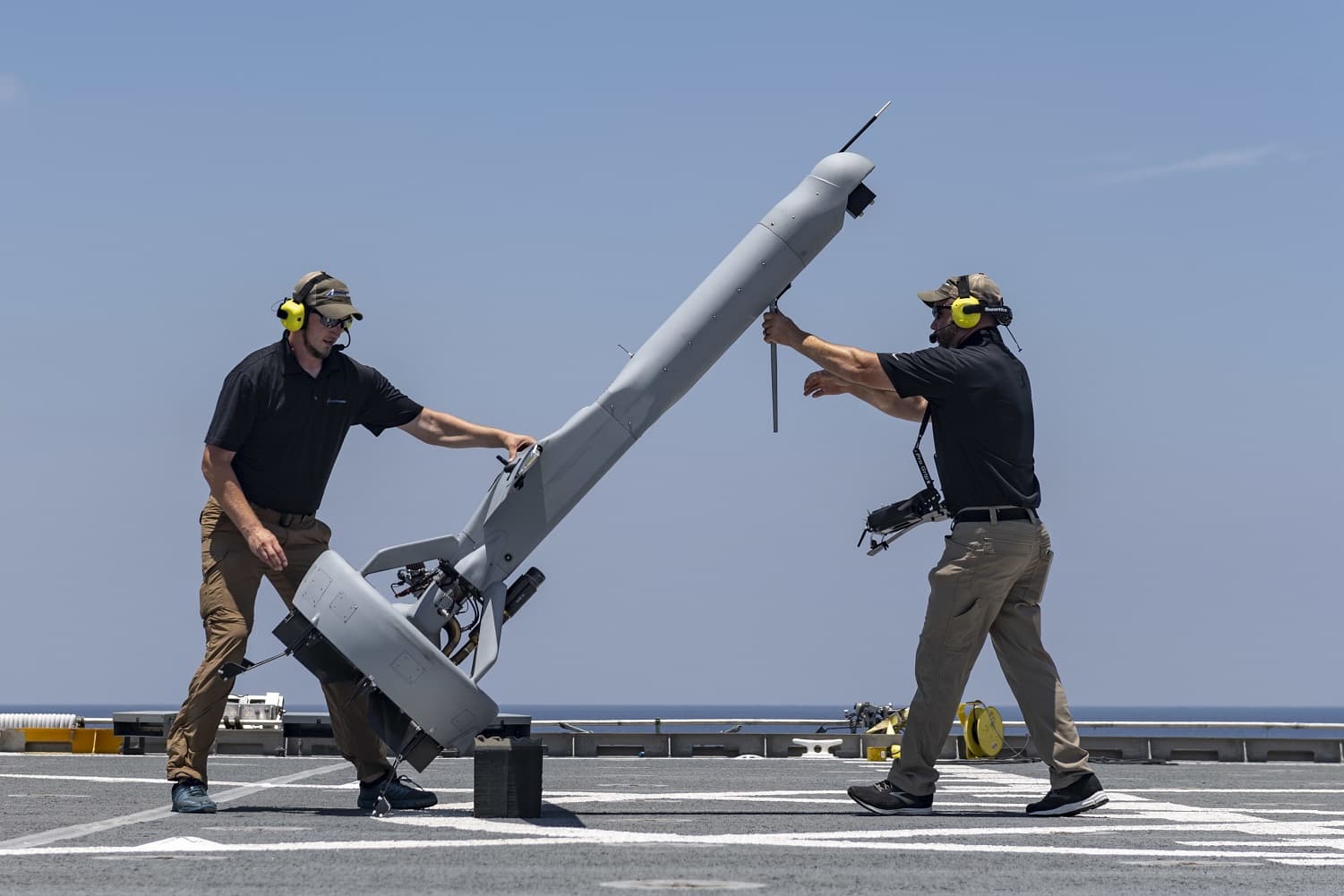
V-BAT Vertical takeoff and landing UAV. Photo by Mass Communication Specialist 2nd Class Anderson W. Branch
Coast Guard awards contract to procure cutter-based unmanned aircraft system capability
This contractor-owned, contractor-operated service will be used for intelligence, surveillance and reconnaissance in support of Coast Guard missions. Requirements for the cutter-based UAS capability – which the Coast Guard will term as maritime UAS or MUAS in the future – included fully automated flight operations, minimum endurance of 12 hours of flight time daily and the ability to provide services 24 hours a day, seven days a week. The payload will include electro-optical and infrared sensors and communications relays and be capable of providing surveillance, detection, classification and identification for all of the host cutter’s operational missions.
The contract has a total potential value of $198.1 million and includes installation and deinstallation of the UAS capability and pilot and mission training. Shield AI will deploy its V-BAT, which is a vertical take-off and landing UAS.
Initially, the contract will be used to continue UAS capability on the national security cutter class; however, the contract can be used to support additional cutter classes in the future.
For more information: Unmanned Aircraft Systems Program page
 Chuck Hill's CG Blog
This is good – Air patrol for a wider SAR area and the ability to patrol a larger area for say fishing enforcement, get a first look at a ship or activity without needing to send a small boat or helicopter. Quick and save money.
Yes good to have CG personnel to operate and maintain the UAV’s
The vendor says these only need a 12×12 foot space. Theoretically these could even operate from FRCs but storing them would be a problem.
US-made V-BAT drone undergoes battlefield testing in Ukraine
V-BAT Drone Has Proven Its Ability To Operate In Heavily-Contested Skies
They can operate in a GPS denied environment and even carry small smart bombs.
“U.S. Special Operations Command (SOCOM) and the U.S. Marine Corps have now been joined by the U.S. Coast Guard as a third domestic V-BAT operator. “We will start flying with the Coast Guard in 2025,” says Harris. “Operators are realizing that V-BAT is quite unique. It can do much of what an MQ-4 or MQ-9 can do, but they can launch it anywhere and carry it around on the back of a truck or on a ship.””
Shield AI V-BAT Selected as Japan Maritime Self-Defense Force’s First Maritime ISR Platform – Seapower