
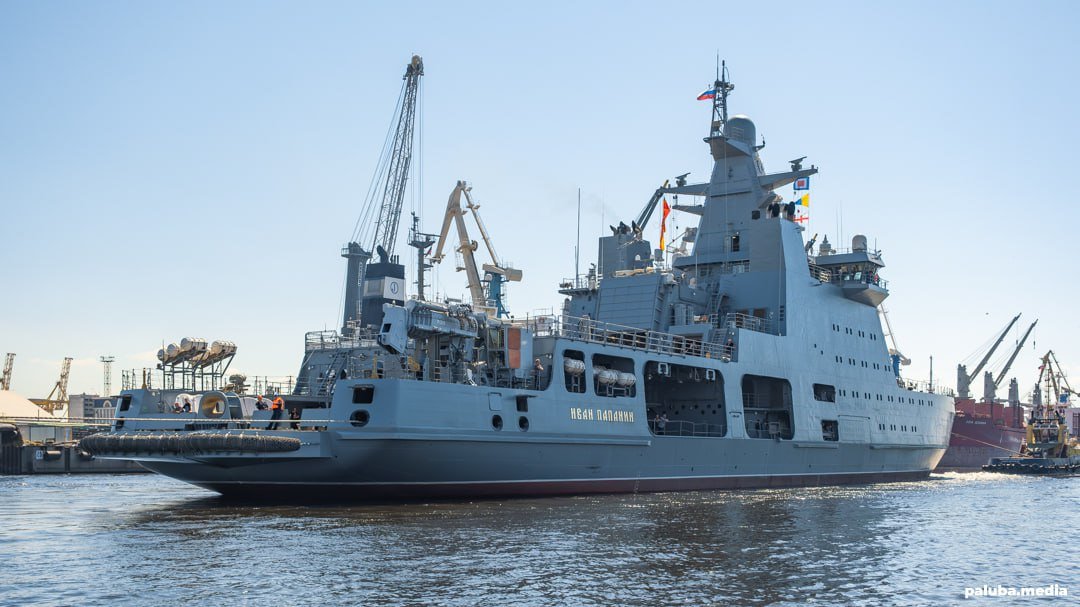
“The Project 23550 Ice-class patrol ship “Ivan Papanin”, built for the Russian Navy at “Admiralty Shipyards”, went to sea for factory sea trials.
https://tass.ru/armiya-i-opk/21229221
We have a couple of reports that the first of four Russian Project 23550 ice class patrol vessels is conducting sea trials. Two are expected to go to the Russian Navy and two to the Russian Coast Guard.
- From The War Zone, “Russia’s New Combat Icebreaker Starts Sea Trials”
- Frome Army Recognition’s Naval News, “Russian Navy’s new Ivan Papanin Project 23550 combat icebreaker begins sea trials with Kalibr missiles”
We have talked about this class many times going back to 2016, most recently in a post, “Arctic Patrol Cutter, State of the Art–Revisited.”
Perhaps too much is made of the fact that these ships can carry two containers that might contain cruise missiles. The real story is that just about anything that can carry containers can also carry a variety of containerized weapon systems, offensive or defensive. The US has fired Tomahawk and Standard missiles from their Mk70 containerized launchers. Even Iran has fired ballistic missiles from shipboard containers.
Russia already has a host of cruise missile launchers in the Arctic, aircraft, submarines, surface ships, and ground launchers. Should these ships receive containerized cruise missiles, they will only marginally improve Russian offensive capability.
Alternately, two containers on the stern might be used to house a towed array and torpedoes to give the ships an ASW capability.
These are probably excellent Arctic Patrol Vessel, but they are not impressive as warships, their defensive capabilities are lacking, having no AAW or anti-surface capability beyond a single medium caliber gun.
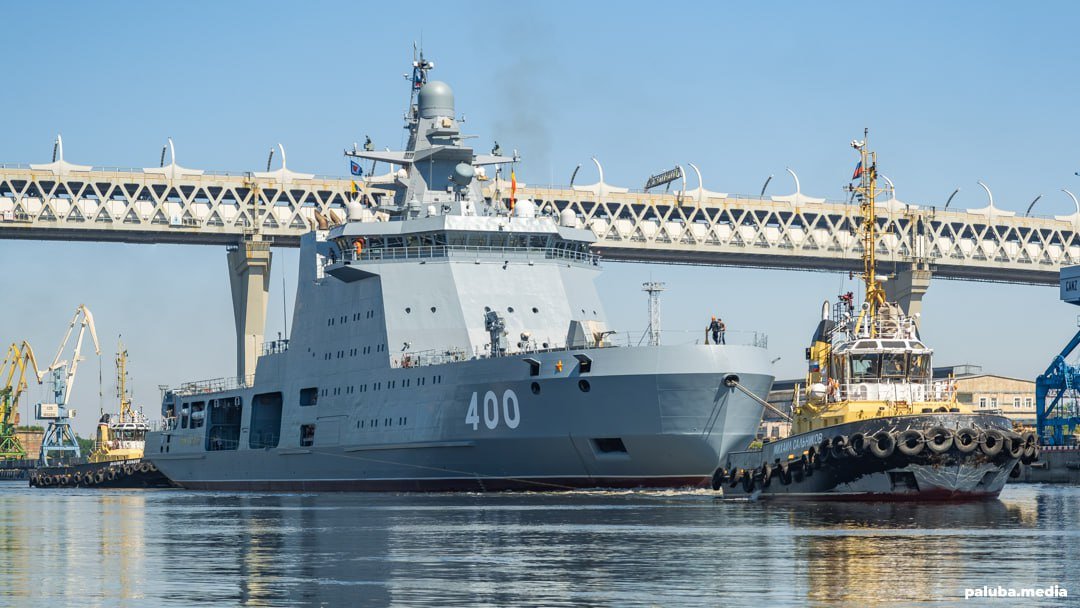
“The Project 23550 Ice-class patrol ship “Ivan Papanin”, built for the Russian Navy at “Admiralty Shipyards”, went to sea for factory sea trials. https://tass.ru/armiya-i-opk/21229221
Any reporting you may see to the contrary, these are not the first “combat icebreakers” in the Russian Navy or Coast Guard. They are just the latest in a long string including eight Ivan Susanin class, three American built Wind class, and the Puga laid down in 1938 but not completed until 1957. Even the icebreaker Krassin, completed in 1917, and now a museum ship, was armed with four 76mm during WWII.
The Russians may take advantage of these ships to more widely distribute their cruise missiles, but that is secondary to their primary purpose as patrol vessels.


Second Project 23550 combat icebreaker Nikolay Zubov set for launch by year-end (armyrecognition.com)
Apparently, this program is four years behind schedule. We are not the only ones with shipbuilding problems.
Another example is the diesel-electric icebreaker Viktor Chernomyrdin which is about the same size (22,000 tonnes) but slightly less powerful (25,000 kW/33,500 hp) than the USCG’s Polar Security Cutters. Although planned since the 1990s as part of a wider fleet renewal, the shipbuilding contract was not awarded until after particularly difficult winter of 2010–2011 with a projected cost of around 8 billion rubles and delivery scheduled for December 2015. The ship was finally delivered in September 2020 at a cost of nearly 15 billion rubles.
Similarly, Russian’s new nuclear-powered icebreaker Arktika was delivered nearly three years behind schedule with severe design errors and a faulty propulsion motor that had to be replaced in a similar fashion as that of USCGC Healy, leaving behind a shipyard that has been complaining in public about how much loss it made with the project.
Following Russian invasion of Ukraine in February 2022, other icebreaker projects have also been delayed. Delivery dates originally set for 2024 have quietly slipped to 2026 or, in case of a medium-sized diesel-electric icebreaker already under construction, even to 2028 as western companies have refused to supply advanced diesel engines and azimuthing propulsion units due to the war in Ukraine.
However, my personal favorite by far is the “world’s oldest icebreaker still under construction”. A small shipyard in the Russian Far East was contracted to build a 5,000-tonne icebreaking salvage vessel. The ship was laid down in 2010 and it is still under construction with plans to deliver it before the end of this year. As a response to the shipyard’s struggles, the Russians contracted two nearly similar ships to a German shipyard which laid them down in 2013 and delivered both in 2015.
Of course Russia has managed to build a number of very advanced icebreaking vessels, including their new fleet of new nuclear-powered icebreakers, but needless to say it has not been as easy as some make it sound…
Russian Navy’s second Project 23550 patrol icebreaker launched (Gallery) – Naval Today