
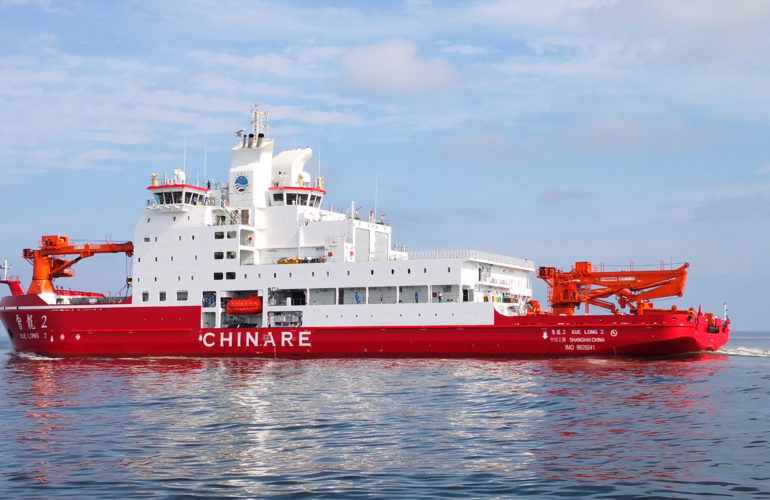
Xue Long 2 on sea trials. Photo by PRIC.
The Sandboxx has a brief look at the problems the US has had in fielding replacement icebreakers.
What I think they leave out of the article is that while the Chinese seem to be planning heavy icebreakers including possibly nuclear-powered ones, the Chinese icebreakers built so far are nowhere near as powerful as Polar Star or the Polar Security Cutter. Mostly they have been ice capable research ships. Their only Chinese built medium ice breaker, Xue long-2, is smaller and a third less powerful than Healy. The three Chinese icebreakers currently in the Arctic include the much smaller 5,600-ton, 8,600 HP (6.4KW) Polar Class 6 Ji Di, smaller than the old Wind class icebreakers.

Aerial view of China’s icebreaker Ji Di berthing at the pier of Qingdao Olympic Sailing Center on July 3 in Qingdao, Shandong Province of China.
© Sun Qimeng/VCG via AP, “China and Russia to Expand Scientific Cooperation in Arctic: Report” –Newsweek
By some counts the US, and most notably Canada, have more icebreakers than China. All of China’s icebreaker construction is not directed at the Arctic. They also have interests in Antarctica (which I find more troubling), and they have ports that ice over requiring domestic icebreaking.
The Sandboxx also describes the 8,500 ton Project 23550 ice class patrol vessels as Russia’s “… first “combat icebreaker,” a small, agile, and armed-to-the-teeth escort ship with launchers installed for anti-ship and cruise missiles.” That is hyperbole. It has provision for placing two containers on the stern. Those containers could contain cruise missiles, but any ship that can mount containers in a position where the space above the container is unobstructed could have a similar capability. Other than being armed with containers, they are armed very much like a Coast Guard cutter. They have a single medium caliber gun, either 76mm or 100mm. They have no surface-to-air missile system other than perhaps man portable air defense systems (MANPADS) and no CIWS of any kind. Furthermore, they are not Russia’s first armed icebreaker. Russia has had armed icebreakers since at least WWII, including the Project 23550’s predecessors, the Ivan Susanin class, eight ships completed 1973 to 1982, four of which are still in service. I went aboard one of them in San Francisco, when they came to help celebrate the 200th anniversary of the beginning of the US Coast Guard.
It would not be too difficult for the US to build counterparts to the Project 23550s for the US Coast Guard or Navy, especially after the recent ICE Pact agreement with Canada and Finland. Ships don’t have to be as capable as the Polar Security Cutters to be useful. The Chinese are proving that.
 Chuck Hill's CG Blog
Some new information about China’s upcoming heavy icebreaker was released last week. The reporting is light on technical details and mainly consists of marketing talk, but it includes the Chinese definition of light, medium and heavy icebreakers; the latter should be capable of breaking up to 2 m (6½ ft) thick ice. According to the article, the construction would begin next year. There’s no information about possible delivery date, but I’d estimate it earliest in 2028. The article makes no reference to the power plant but I don’t think this will be the nuclear-powered icebreaker China has been planning; however, the next heavy icebreaker could be it.
https://www.globaltimes.cn/page/202408/1318507.shtml