

Based on the Coast Guard Historian’s timeline, https://www.history.uscg.mil/research/chronology/
With inspiration from Mike Kelso
1837 Two early complainants on the efficiency of the American lighthouses, E. and G.W. Blunt, publishers of the famous Blunt’s “Coast Pilot,” submitted a statement to the Secretary of the Treasury. They argued that the whole lighthouse system “needs revision, a strict superintendence and an entirely different plan of operation.”
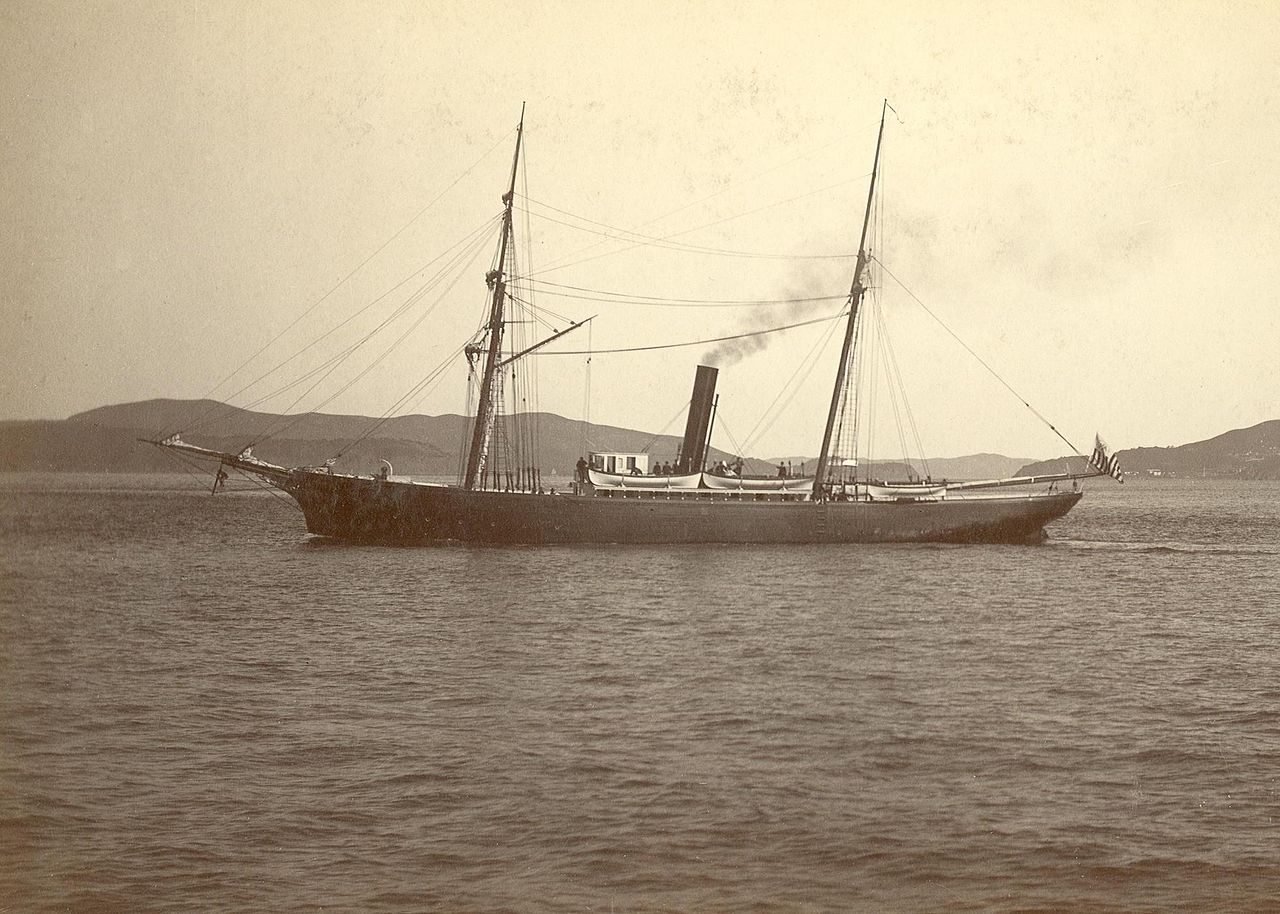
U.S.R.C. “Richard Rush,” on her departure Jan. 2d, 1886, in search of the “Amethyst.” Photo credit: Isaiah West Taber (1830–1912)
1886 USRC Rush made the service’s first drug seizure at sea, confiscating 350 lbs of opium from SS City of Rio De Janeiro near the entrance to San Francisco Bay. Only the opium was seized, as no connections to the ship’s owners, captain, or officers could be established. [The Nautical Beginnings of America’s War on Drugs, American History, November 17, 2019. https://www.historynet.com/online-exclusive-the-nautical-beginnings-of-americas-war-on-drugs/]

4 May 1943
Mare Island, CA
Starboard bow view during inclining experiment
U.S. Navy photo 2558-43. Source: Jon Burdett
1920 The Navy minesweeper USS Swan (AM-34, later AVP-7) ran aground on Duxbury Beach, Massachusetts. Coast Guardsmen from three nearby stations rescued the minesweeper’s crew with a breeches buoy. CGC Androscoggin assisted in the rescue. USS Swan was refloated 22 Feb. 1921 and went on to assist in the search for Amelia Earhart and was present during the Attack on Pearl Harbor Dec. 7, 1941 and claimed to have shot down a enemy aircraft. She was decommissioned 1946 but was still in existence in 1988. Fate unknown.
 Chuck Hill's CG Blog