
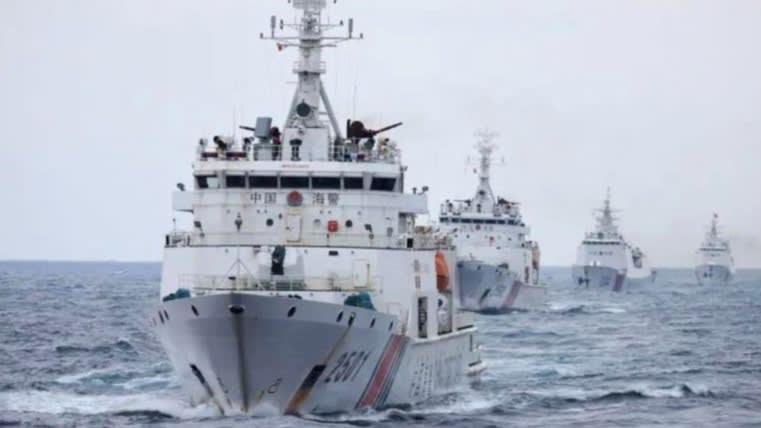
This Chinese coast guard ship 2501 is equipped with weapons believed to be 76-millimeter guns. © Kyodo
A recent large-scale transit of the Miyako Strait by three PLAN frigates and three China Coast Guard frigates has caused some alarm in Japan and raised questions about the armament on Japan Coast Guard cutters. (“China tests maritime blockade strategy in Miyako Strait“}
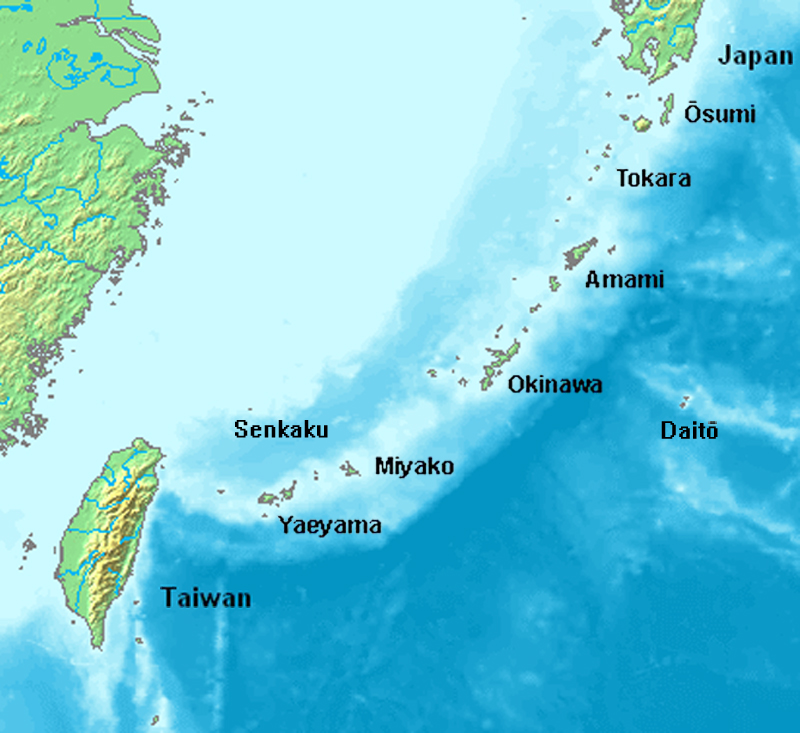
Ryukyu Islands. The Miyako Strait is located between Miyako and Okinawa
Meanwhile we see increasingly aggressive deployment of heavily armed China Coast Guard vessels in the Philippine EEZ. (“Chinese Warships, Aircraft Deploy in Strength to Scarborough Shoal“)
The Chinese, Japanese, and Philippine Coast Guard have each taken different paths in their choice of how to arm their large coast guard vessels.
Changing with the Geopolitical Situation:
China: China Coast Guard (CCG) was formed in 2013 by the consolidation of four existing agencies. At that time none of their vessels were armed with anything larger than crew served machineguns 14.5mm or smaller. July 1, 2018, the China Coast Guard was transferred from the civilian control to the People’s Armed Police. The Coast Guard Law of 1 February 2021 allows CCG ships to use lethal force on foreign ships that do not obey orders to leave Chinese waters. In parallel with this increased militarization, the China Coast Guard expanded dramatically growing into the largest fleet of cutters in the world, with several times more ships than the US Coast Guard. Four frigates or 22 corvettes that have been transferred from the PLA Navy to the CCG have retained much of their gun armament. Their newer cutters are relatively well armed. Typical armament for cutters now includes a 76mm and two 30mm guns. While this armament is typical of many Offshore Patrol Vessels world-wide, it offers significantly greater range and lethality that that of the Japan CG and particularly the Philippine Coast Guard.

Chinese H/PJ-17 30mm
Japan: Prior to the December 2001 “Battle of Amami-Ōshima” in which the Japan CG engaged and ultimately sank a North Korean spy ship disguised as a fishing vessel, most Japanese CG cutters were typically armed with 20mm Gatling guns, the same gun used in the Phalanx Close In Weapon System (CIWS), but with a much simpler fire control system. Though they significantly outnumbered the N. Korea vessel they had considerable trouble dealing with the improvised armaments on the N. Korean Vessel that included at least one recoilless rifle and heavy machine guns. This led Japan to recognize a need for more powerful, longer ranged weapons. Even so, even the largest Japanese Coast Guard cutters, and some are very large, carry no weapons larger than 40mm. The 20mm Gatling guns still seem to be the base armament for their smaller cutters and is the secondary armament for large cutters.
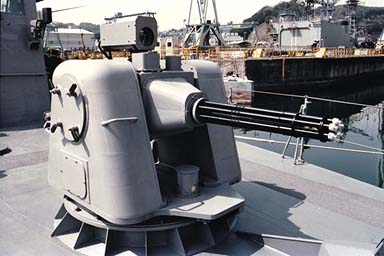
Japanese 20 mm/76 Gatling Gun. Note the camera for remote targeting. JMSDF Photograph.
Philippines: The Philippine Coast Guard is in the unique position of being, in terms of personnel, larger than the Philippine Navy even including Philippine Marine Corps, and in terms of personnel, larger than the China CG. The Philippine Coast Guard was born out of the Philippine Navy in 1967 and it was completely separated in 1998. Despite this military background the Philippine CG is a police and public service organization rather than a military service. Like the Philippine military, much of its history involved suppression of internal unrest. Until 2020 their largest ships were two buoy tenders and still none of their vessels carry weapons larger than .50 caliber machine guns. More large cutters are building, but currently they have only three. The Philippines seems to be determined to show that they are the innocent party being bullied.
Why Arm Cutters?:
No existing cutters were built with the threat of Unmanned Air Systems in mind. This is likely to have an effect on future cutters.
Weapon choices are determined on the basis of expectations of who or what the cutters will have to deal with:
- fishermen, smugglers–small arms will serve
- domestic terrorists that might employ small vessels–something a bit heavier, with a premium on accuracy and limited danger of collateral damage, putting guns in remote weapon stations helps, but something that has a very high probability of hit on the first round like APKWS would be better.
- state sponsored terrorists, revolutionary groups, hostile maritime militia that can employ even large ships–how they will be armed is unpredictable, but opposing cutters need to be at least equal to the most dangerous widely available weapons that are easily tacked on.
- coast guard of other states in disputed waters–the cutters need to be armed with weapons of equal effective range so that they cannot be intimidated.
- armed aggression by the military of another state–cutters needed to be armed or at least rapidly upgradeable for the missions they are expected to perform.
For some states the coast guard is the only navy they have, and the coast guard needs to be prepared to assume that role. In other countries, notably the UK and France, their navy also does coast guard type missions that require larger vessels. For other states, like the US, the coast guard is a significant naval auxiliary.
Why Not to Arm Cutters?:
First of course, weapons may incur costs to various degrees–procurement, maintenance, man-days of training, ship-days of training, increased cost to build a ship that can support armaments.
Weapons change how the organization views itself. Is it a military service or a law enforcement agency or exclusively a service provider like Canada’s Coast Guard?
Weapons change how others, including other nations, see the service. International law enforcement cooperation is much easier to achieve than military cooperation. It is easier for a country to trust a Coast Guard cutter in their waters than a haze gray “battleship.” I do think this presumption of trust worthiness has more to do with reputation than the actual armament and that some types of weapons look aggressive while others do not.
Is there an optimum level of weapons for Japan and Philippine Coast Guard cutters?:
The concern in Japan seems to be that with weapons that have greater range, the China Coast Guard can strike with impunity. That seems unlikely to happen as a result of a decision by higher-ups unless they want to provoke a major conflict. That is not an advantageous way to willfully initiate a war, but wars frequently result because one side underestimates the resolve of their counterparts on the other side. An overzealous midgrade CCG officer might see an opportunity to strike a blow that his Japanese or Philippine counterpart could not answer, or China’s national command authority might see using the possibility of just a few shots to inflict some damage on a Japanese or Philippine cutter as just a small step up from ramming.
In any case, leaving the impression that the opposition can inflict significant and lethal damage on your ship, with impunity, does not seem like a good idea.
The one thing guns can do that missiles cannot, is fire warning shots. Larger guns can fire more impressive warning shots at greater ranges than smaller guns. That is a consideration, but once weapons are fired it becomes a smaller step to fire for effect. Even so, a weapon that can fire an impressive warning shot at a range outside the effective range of most improvised armament seems essential. That seems to point to at least a 40mm gun.
The most obvious answer is that Japan and the Philippines should arm their cutters the way most similar vessels are armed, with one 57 or 76mm caliber gun and one or two 20 to 40mm autocannon. This has become almost a worldwide standard for Offshore Patrol Vessels.
There is another alternative that might serve them better, that is to create ambiguity or doubt in the mind of the opposition by installing VLS that could support different types of munitions or have none at all. Are they armed with loitering munitions, Hellfire, Spike ER, Spike NLOS, Sidewinders, short range anti-drone (UAS) weapons, or anti-ship cruise missiles or is a bluff? What is their range? How lethal are their weapons? No way of knowing.
 Chuck Hill's CG Blog
Other options might provide scalable deterence. 30x113mm is nice and small. But mount a Javelin to it when you need to. Many ways to be more incognito and more lethal.
I am definitely in favor of 30mm guns with airburst ammunition that is effective against drones and low flying aircraft, with missile systems hung on the side.
Those are light weight alternatives that can be mounted on small vessels, but I would not expect that the type of missiles would be a secret.
For man portable systems like Javelin you don’t even need an installed mount, just a couple of guys on deck, but their range is short relative to a 76mm at about 2,500 meters vs close to 16,000. Effective range for the 76mm is about 8,000 meters. Hellfire is good for about 8,000 and it looks like longer range similar weapons are in the works.
If Mk41 VLS or a similar system are used, what is in the cells can be changed easily as threat changes and budgets allow. Just a few of the more capable weapons in the inventory would put the adversary in the unenviable position of not knowing how deadly his adversary might be.
Chuck,
I’m in favor of the Philippine Coast Guard getting the same 30 MM that the Philippine Navy has on the Acero-class gunboat. It saves the Philippines on commonality and using the same Ammo
Spike NLOS as used on the Acero class would actually give a 10,000 yard range advantage over the 76mm gun, and would allow selective targeting of particular points on the opposing ship, like specifically the 76mm or the bridge.
I’m surprised the PCG doesn’t have Spike NLOS
There is a current PCG project to acquire a few 30mm RCWS. Hoping this be a minumum for all Parola, Magbanua classes and the incoming 40 OCEA FPB98/FPB110 boats.
Not clear if its Aselsan Smash as with Jose Rizal class or the Typhoon Mk30c of the PN Acero class.
It should be a standard for the PCG to carry the 30MM and share the same commonality, maintenance and training with the Philippine navy. All the PCG ships should have at least a 30mm cannon
Agreed. 30mm should be the standard minimum.
For their OPVs and large MRRVs, 40mm should be the minimum. But I like the idea it to be at least 76mm and 40mm as the secondary.
The sad reality is that the PCG needs a minimum of a 30mm on all their ships. For them to face China unarmed is just asking for trouble and begging the US to bail them out.
Paging Chuck hill, your wanted in the wardroom
USA sought to transfer to the Uruguayan National Navy a Reliance class ocean patrol car
https://www.zona-militar.com/2025/01/09/ee-uu-procura-transferir-a-la-armada-nacional-de-uruguay-un-patrullero-oceanico-de-la-clase-reliance/
The Coast Guard has at least four WMEC210s that could be transferred. As reported Uruguay already has some WPB87s Marine Protector class patrol boats.
This seems to be based entirely on a December 2022 report and nothing since then.
I think Uruguay can use two or four of the 210’s and that can form their OPV navy. I also think as for the 270’s, once the OPC comes online, they can be given Lebanon, Dominica Republic, Uruguay and even Argentina.
I also think and here’s a thought, maybe we can push Argentina to buy some NSC’s and FRC’s to keep the production lines going