
In 2012, in one of my first posts, I explained a “Case for the Five Inch Gun.” All the reasons I outlined at that time have only become more salient over the last twelve years, but if the Hypervelocity Projectile (HVP–video above) becomes a real option, we will have even more reason to choose the 5″.
We could get many of the same benefits, and perhaps even more capability, by adding missiles to the USCG’s vessels and in some cases, we could put the capability on much smaller platforms, but the Coast Guard seems to be allergic to the idea of adding missiles, however small and innocuous, to their ships. The rationale seems to be we don’t want to appear threatening. I would argue that sometimes you just want to look capable.
If the Coast Guard is going to persist down this single gun/no missiles path, then the gun should be the best available in the US Navy inventory, the 5″/62 Mk45 Mod4 HVP or no HVP, assuming it would not look out of place, and it would not. Originally the 5″ Mk45 was designed as a direct drop in replacement for the 5″/38 single mount.
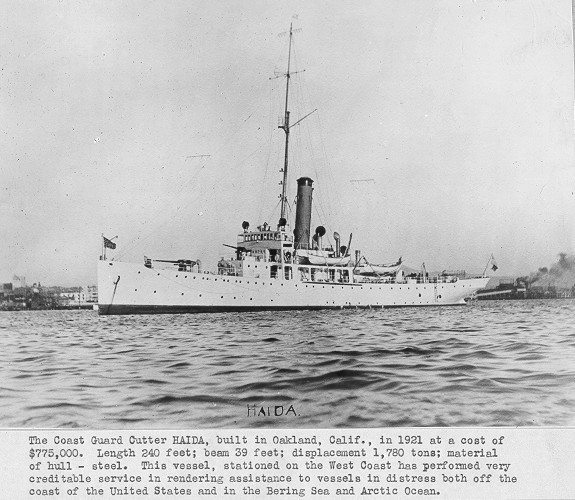
A modern 5″ gun would not be a radical change from the way Coast Guard Cutters have been armed in the past. The first Coast Guard cutters armed with 5″ guns goes back to at least USCGC Haida commissioned in 1921, which was armed with not one but two five inch guns.
Five inch guns remained a standard fit on large cutters until completion of the WHEC378 FRAM program in 1992. Over the intervening 71 years, at least 64 US Coast Guard cutters have been armed with 5″ guns.
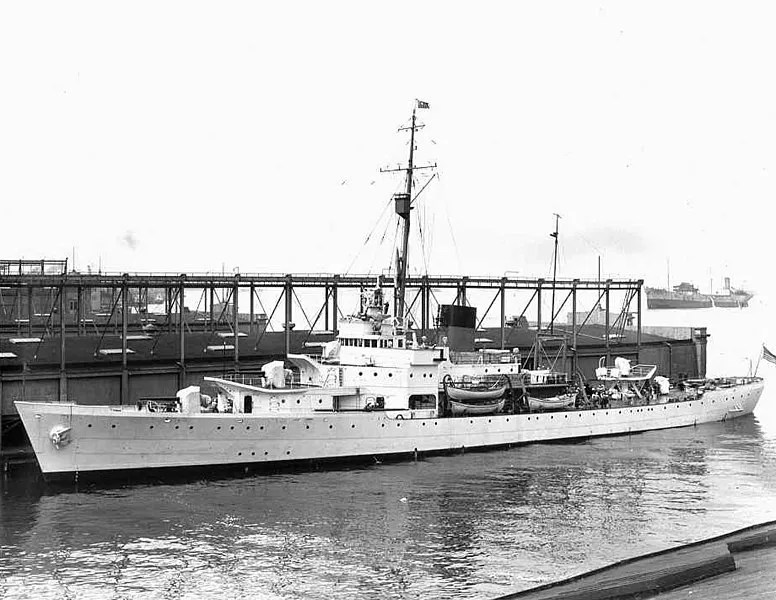
Several classes had multiple three and five inch guns.

An aerial port view of the U.S. Coast Guard high endurance cutter RUSH (WHEC-723) underway during Exercise Brim Frost ’85.
A modern 5″/62 MK45 Mod4 on an OPC would not much look different from the 5″/38 on a 378, but it would provide much greater capability than the 57mm Mk110 which alone is not enough to meet the needs of an increasingly hostile geopolitical environment.
 Chuck Hill's CG Blog
Makes sense to me…greater range, packs significantly more punch, more useful for NGS. From my understanding, the five inch guns on Squadron Three cutters were very useful during the Vietnam War to soften up enemy positions.
Maybe the NSCs and OPCs will swap out with this platform if a conflict becomes imminent? For now, leadership does appear quite content with the 57mm.
Come to think of it, ironically a set of VLS cells would “appear” less threatening than a five inch gun on deck.
not very likely! The Mk.45 Mod.4 5”/62 is lethargically slow 20-rpm (16-rpm sustained) compared to the Mk.110 57/70 220-rpm (110-rpm sustained)! The “Hamilton’s” carried -350-rounds of ammunition for its Mk.12 5”/38 gun! If using the Mk.45 Mod.4 maximum ammunition load would have been ~270-rounds! The Mk.110 57/70 carry’s ~1,190-rounds!
And, no they can’t bring back the Mk.12 5”/38, simply because no one uses it anymore or the propellant which the US Navy and USCG stopped producing ammunition for in 1954 and the newer EX-99 propellant is far to powerful to be used with the WW2 vintage Mk.12 gun…
A cutter’s primary missions mean AAW is not its primary mission. That would be engaging surface vessels. The 5″/62 is much better at that than the 57mm because of its greater range and greater projectile weight.
It is also a better Naval Gun Fire Support Weapon.
If the HVP fulfills its promise, it would also be a better AAW weapon.
Not even considering the HVP which is effectively a guided missile, the 5″/62 shoots a shell that is twelve times larger than the 57mm. About 70 pounds vs 5.3 to 6.2.
It also shoots much further.
Max Range with conventional ammunition: 25,880 yards (23,660 m). With unconventional projectiles up to 63 miles. 50 miles with the HVP.
The 57 mm using its longest range projectile has a range of 18,600 yards (17,000 m).
20 rounds per minute is a round every 3 seconds. Thats not slow each round has a larger kill radius. A 600 knot target requires 60 seconds to cover 20,000 yards.
Even the 57mm does not shoot continuously at max rate of fire, it fires a burst, checks the results, and if not successful fire another burst.
the coast guard has no need for a 5” gun.
what role would they use it for?
The Navy has been using the 5 inch in my the Red Sea recently with success.
idk.
mk110 is way better for self defense.
the Japanese coast guard upgraded to 40mm after the battle for umami-o shima or whatever because based on their experience there 40mm was sufficient to stop relatively large ships effectively.
no gun in our inventory will effectively stop or hinder a super tanker so that’s not really an argument.
@Travis,
“the Japanese coast guard upgraded to 40mm after the battle for umami-o shima or whatever because based on their experience there 40mm was sufficient to stop relatively large ships effectively.”
I think you misunderstood or made a typo. What the Japanese learned was that their 20mm Gatling guns in spite of their high rate of fire, they were not adequate to stop the 97 foot (30 meter) long spy ship masquerading as a F/V.
They certainly did not learn that “40mm was sufficient to stop relatively large ships effectively.”
The only way any currently available gun is going to forcible stop or at least divert a very large merchant ship is to disable its engine or steering.
A 70 pound 5″ projectile is more likely to be able to do that than a 6 pound 57mm projectile, but there are no guarantees.
Battle of Amami-Ōshima | Chuck Hill’s CG Blog
a 70lb 5” shell doesn’t have a better chance of that.
how many 57mm rounds do you think a merchant engine is capable of absorbing before it breaks down? Even if it’s 10 rounds a mk110 can put that many rounds into the engine in a second or two.
please provide an example of a 5” gun effectively disabling any vessel over 3k tons.
so, if the Japanese didn’t learn that 40mm was sufficient for the job, then why did they choose 40mm guns?
“how many 57mm rounds do you think a merchant engine is capable of absorbing before it breaks down?”
Well, if the target is beyond 6-7 nmi, then probably zero. With the Mk 45, it can reach out well beyond that distance (potentially even more with HVP).
Sure, the 57mm might be effective against soft targets within a limited range, but the point is that the Mk 45 can deliver far more punch against more well-protected targets further out. And if need be, CIWS/.50 can engage targets closer in depending on the situation.
If CG is going to steer clear of missiles, then the Mk 45 is a good alternative in comparison to the 57mm. Higher rate of fire doesn’t mean much if the rounds themselves won’t penetrate or disable.
lmao. it would be easier to take your opinions seriously if you actually had any idea what you’re talking about.
the unclass range on paper is over 10 miles, not 6-7 you claim.
so the range is difference is less than 5 miles.
not sure why you think that 57mm would have any problems penetrating a merchant’s hull and a few interior bulkheads to damage the engine…
@ Travis, for the Japanese they learned that they needed a larger gun to stop even a 30 meter vessel. The 40mm is a good choice for that.
As for stopping a large vessel, it is simple physics that a large shell of the same type is going to do more damage than a small projectile.
There were dozens of incidents of submarines sinking merchant ships over 3,000 with guns during WWII. The Germans typically used 88 and 105 mm guns. The US used 4″, and ultimately 5″ guns on their most numerous classes of fleet submarines. There were also a few US subs with 6″ guns.
Guns are really not the best way to sink a ship, but they are capable of damaging a ship and the larger the projectiles the more damage.
sure, bigger round might do more damage per shot…but 57mm has roughly double the throw weight than the 5in has, so again, you’re doing more damage for the same amount of time spent shooting.
if you can guarantee a first round hit on the engine your argument might be sound, but you cant, so quick follow up shots are whats needed until you can get those hits and stop it.
please share a link to an example of a 5″ gun stopping a vessel above 3k tons with a single shot, because that’s the only way you can remotely claim that 5″ would do it better.
Five inch would be just fine!
I think Commander Salamander just proved my point.
Red Sea Experience: Don’t Let Others Ignore It
“Look at those numbers again. What weapon system was used more than any other?
“The 5” gun.
“What I would like to see is a list of what was shot down by what list…but probably not on this net.
“Never forget—you’ve heard me say it 1,000 times over a couple of decades—when war at sea starts one thing becomes very clear, very fast: you don’t have enough guns, and those you have are a size smaller than you really need.”
Below is a conversation I had on Facebook with a knowledgeable commentator, an associate professor at the US Naval War College and naval aviator about Commander Salamander’s article. I am reproducing his comments here with permission.
Keith E Patton:… he’s hinging his comment on weapons expended. If all 160 5” killed, say, one drone.. not a great argument. Talking to crews involved they wanted to use guns more (cost!) but geometry and time usually prevented it. Couldn’t get ship into effective 5” range of crossing targets. Now.. May mean it’s time for guided 5” (still cheaper than missiles)
Charles Hill: I have to believe HVP or something similar is going to happen. The interesting thing about Cdr. S statistics is that there were 400 engagements and about 400 rounds expended which seems to indicate a one for one even for the 5″ that is hard to believe. I questioned this in comments on his post.
Charles Hill : Would really like to see some more detailed data.
Keith E Patton: I’ve been to briefings on engagements given by crews involved. For deck guns it was no where near 1 shot 1 kill (except with missiles, and even then not 1 for 1).
Charles Hill: then the statistics are seriously misrepresentative. I have been trying to get the Coast Guard to put at least Hellfire or APKWS on their ships for a long time, but any missiles however small seem to be anathema.
Keep in mind, the difficulty reported with the 5″ was largely that they were not useful for protecting other ships, not problems in the self defense role.
To provide some context 5″/38 guns using variable time (V/T) fuses (radar fuses) required 340 rounds per kill. The 3″/50 for which there was also a VT fuse required 338. The 40mm required 1,713 per kill.
Some of those 5″ rounds were barrage fire for protection of other ships.
Firecontrol systems now are better, but some targets may also be more difficult as well.
The amazing thing about what has been happening in the Red Sea is that the Houthi have failed to make a single hit on any warship, US or allied.
Meanwhile the Russian Fleet can’t seem to defend itself against 45 knot unmanned surface vessels that can only move in two dimensions.
Great info here on effectiveness of gun AAW during WWII.
AAA Umbrella vs Rain of Bombs – Naval Anti-Aircraft vs Aircraft in World War II
The U.S. Navy’s Most Popular Gun System Is Getting an Upgrade
That article “The U.S. Navy’s Most Popular Gun System Is Getting an Upgrade” is apparently from today, 1/29/2025, but the article says that between now and 2028, they’re going to upgrade the Mk 45 to Mod 4, even though the Mod 4 has been out for 25 years now (since 2000). Is this an error in the article? Is there now a Mod 5 that the article neglected to mention? The article says, “The contract calls for the work to be completed by the end of 2028,” but why would it take 28 years (from 2000 to 2028) to upgrade the Arleigh Burkes to the Mod 4, which has been out since 2000? I know the Navy (and Coast Guard) are extremely slow at building new ships (don’t get me started on the Constellation Class Frigate or the Polar Security Cutter), but I didn’t think it took decades to upgrade one gun on the existing ships.
What they are doing is upgrading the ships that still have the Mk45 Mod2 5″/54 to the Mk45 Mod4. Presumable this will happen as the ships go in for their regular yard availabilities.
It will take about three years for the ships that still have the earlier mount to cycle through their yard periods.
If the Coast Guard wanted to upgrade our ships, they would probably go through a similar cycle so as to minimize loss of operational days.
https://news.usni.org/2025/01/30/crew-of-uss-stockdale-shot-down-houthi-drones-with-5-inch-gun-says-admiral
Guided Hyper Velocity Round for the 5″
https://read.nxtbook.com/kiva_communications/seapower/seapower_mon_2025/bae.html?utm_campaign=7241395-SAS%202025&utm_medium=email&_hsenc=p2ANqtz–91Pq8JCKQrR95uNVuHlGc-gyWwA-I05fJyshWQ-4vuIXEsPk_y_p8yss7AQcw6A5VkX8qUlCwyHDFd4NsTFwEqgMEcg&_hsmi=355705475&utm_source=hs_email
Hey Chuck
Can you imagine this on a USCG cutter
Also a potential replacement for the CIWS but not as good as the BAE 57mm we already have. 76mm would be better than the 57 or the 40. 40mm is probably not as good as the SeaRAM for most scenarios.
Where we need this kind of thing is on the Military Sea Lift Command ships which are essentially defenseless.
I could see the 40mm on the FRCs, but weight might be a problem.
Of course the Coast Guard gets their weapons from the Navy so unless the Navy adopts it, the Coast Guard will definitely not get it.
Maybe on the FRC, Polar security cutter. What about the bouy tenders