
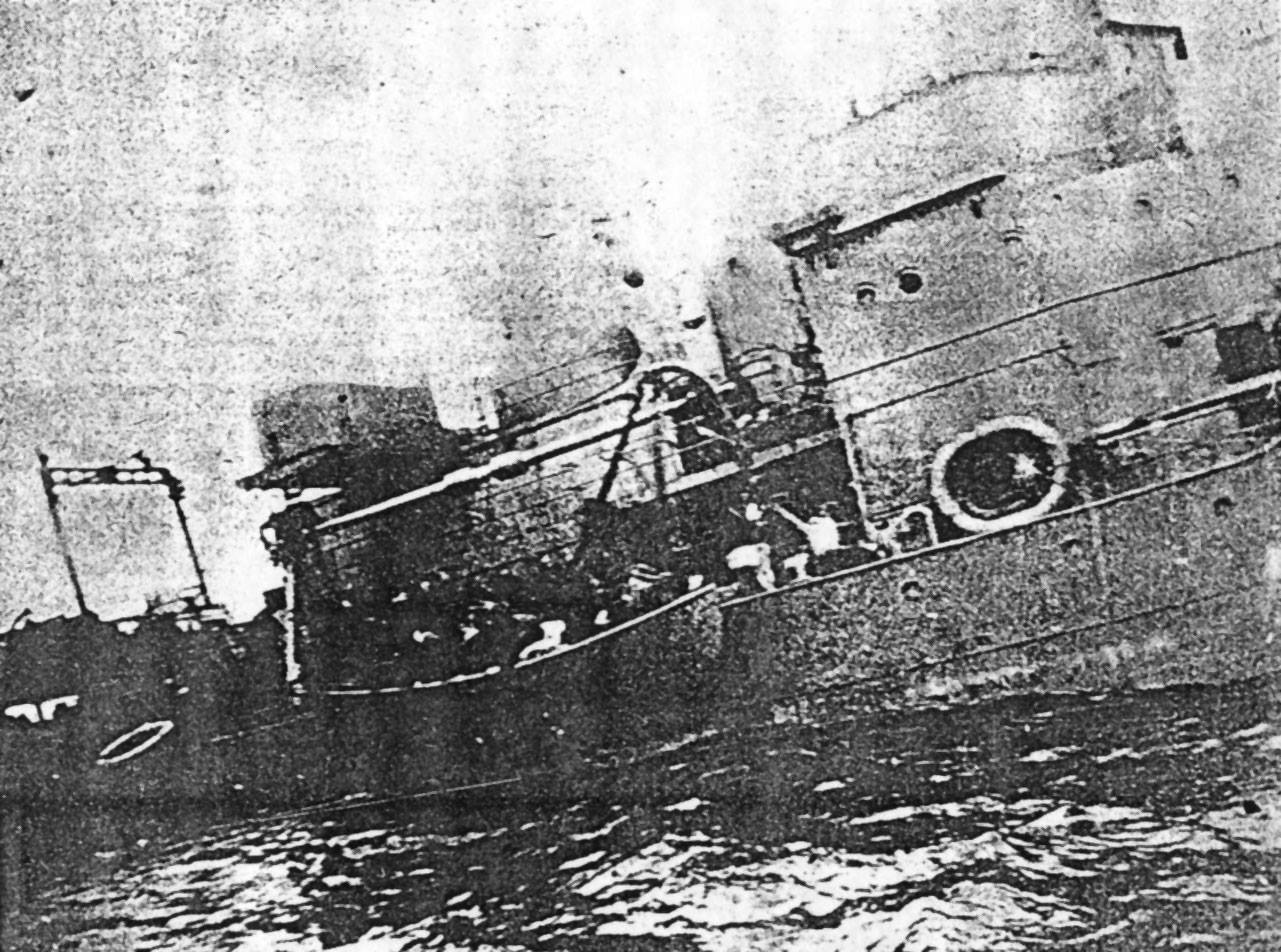
Today is the 83rd anniversary of the sinking of USCGC Alexander Hamilton (WPG-34), January 30, 1942. She was the Coast Guard’s first loss of World War II and the first US warship sunk in the Atlantic after the US entered the War.
USCGC Hamilton (WMSL-753)’s web site has the story of her sinking which I have reproduced below.
There is a “Booklet of General Plans” as originally built here, and contract plans here.
U-132, which torpedoed Alexander Hamilton, also sank ten other ships but was “Sunk on 4 November 1942 in the North Atlantic south-east of Cape Farewell, in approx. position 55.38N, 39.52W, when the British ammunition ship Hatimura blew up in a huge explosion. U-132 had torpedoed this ship earlier and was probably waiting nearby for her to sink when caught in the lethal radius of the explosion. 47 dead (all hands lost). (FDS/NHB, January 1985).”
Found some photos of Cutter Alexander Hamilton on Facebook that were taken only five weeks before she was sunk. She is much better armed then when she was built, with three 5″/51s and three 3″/50s, but does not have some of the equipment seen on other ships of her class in pictures taken in 1942/43, no radar, no High Frequency Direction Finder (HF/DF), a Y-gun in the photo immediately but no K-Gun depth charge launchers.
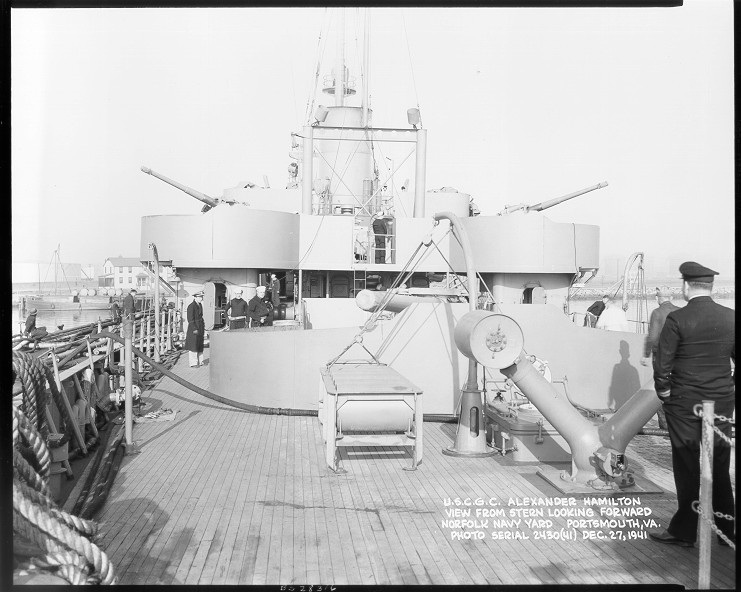
U.S.C.G.C. Alexander Hamilton view from stern looking forward, Norfolk Navy Yard Portsmouth, VA. Photo Serial 2430(41) Dec. 27, 1941.

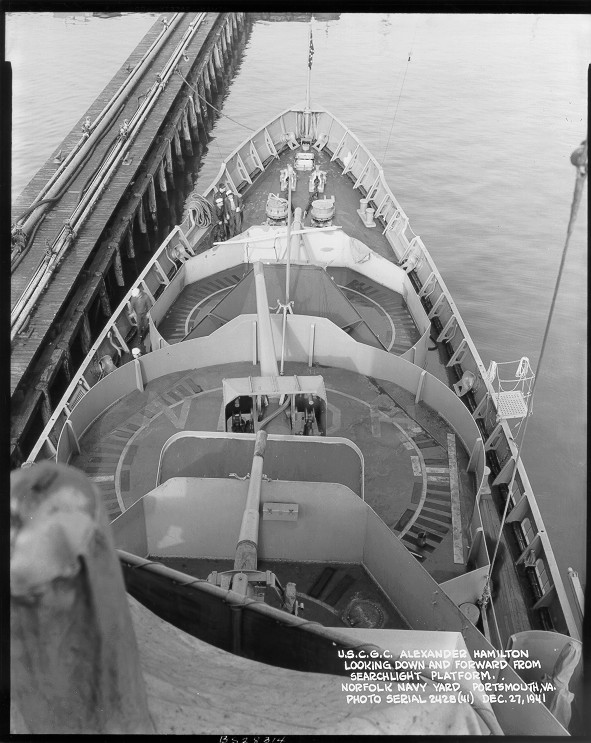
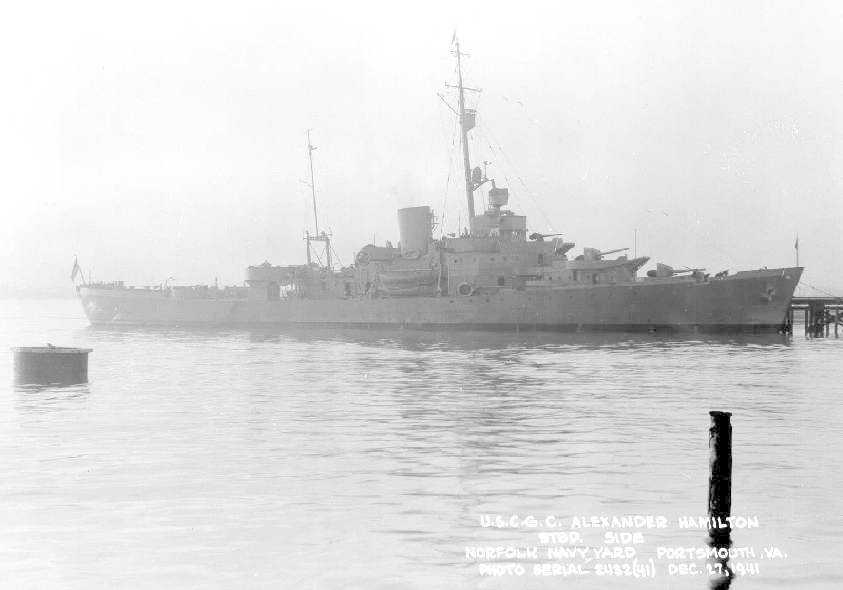
U.S.C.G.C Alexander Hamilton STBD. Side Norfolk Navy Yard Portsmouth, VA Photo Serial 8482(41) Dec 27, 1941″
THE FIRST LOSS; THE SINKING OF THE ALEXANDER HAMILTON
by Dr. Robert M. Browning Jr.
When the United States entered World War II, the Coast Guard had already demonstrated its value in this country’s national defense. For over a year the Coast Guard, with its large cutters and experienced seamen, had protected American interest in the North Atlantic. They had maintained patrols in Greenland and took a prominent role in the protection of America’s seaborne commerce in this area. The 327 foot cutters in particular were well-suited for convoy duty in the North Atlantic. Because of their long-range and good sea-keeping qualities along with their speed and armament, the Navy Department put the entire class into naval service before the war began. The Alexander Hamilton, participating with the ocean escorts in the icy North Atlantic, became the Coast Guard’s first loss of the war.
The Alexander Hamilton was one of the newest ships in the service. Built at the New York Navy Yard, this twin-screw, geared-steam-turbine-propelled cutter was commissioned in March 1937. The Alexander Hamilton was initially stationed in Oakland, California and performed patrols to the Bering Sea. All the vessels in the class carried their full names when commissioned, but these were shortened in 1937 to their surnames only. The Navy requested that the Hamilton use its full name so as not to be confused with the Navy’s U.S.S. Hamilton. In January 1942, the cutter resumed its full name once again.
When war began in Europe the cutter was ordered to Norfolk Virginia to perform Neutrality Patrol duties. The Alexander Hamilton also operated with the Grand Banks Patrol and made ten cruises on weather observation patrol. On 27 December, just three weeks after Pearl Harbor, the Alexander Hamilton reported for special naval duty in the North Atlantic. Mixed groups of U.S. Navy, Coast Guard and Royal Canadian Navy escorts had begun to escort fast and slow convoys between rendezvous points off the coast of Newfoundland and mid-ocean meeting points (MOMP). At this point British escort groups protected the merchantmen eastward. The 327 foot Campbell was the first cutter to perform this duty, followed by the Ingham and on January 15th 1942, the Alexander Hamilton.
After helping to screen convoy HX 170 to the MOMP, the Alexander Hamilton was tasked to tow the disabled storeship Yukon to Iceland. A destroyer, USS Gwinn, steamed ahead to act as an escort. The British rescue tug Frisky arrived later to take over the tow. At about 1:00 pm, the Alexander Hamilton handed off the tow to Frisky and steamed ahead to screen the other ships.
Unknown to all the allied ships, the German submarine U-132 had detected these ships at a vulnerable moment and maneuvered to a favorable position to attack. Instead of singling out the crippled and near motionless 12,546 ton storeship Yukon, the U-132 fired a spread of torpedoes at the Alexander Hamilton. The cutter had meanwhile worked up to 15 knots and passed the Yukon as the torpedoes sped past the storeship. One torpedo passed ahead of the Yukon and struck the Alexander Hamilton on the starboard side between the fireroom and the engine room.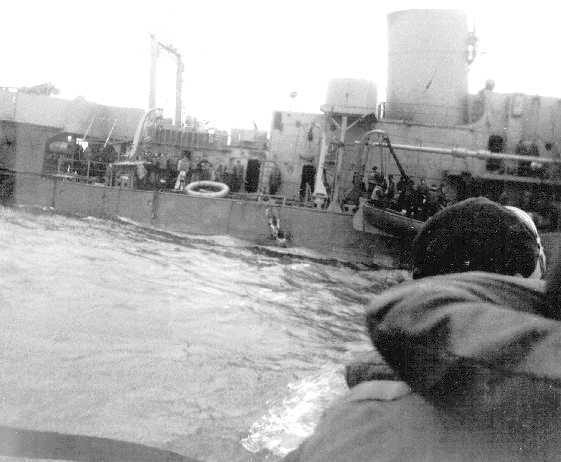
Crew of the Alexander Hamilton abandons ship after being torpedoed.
The Alexander Hamilton was fatally wounded. The explosion wrecked both the engine room and the fire room, initially killing seven men and burning and injuring many others. The cutter immediately lost way and settled 4 feet in the water but was counter-flooded to trim the vessel. Afraid that the submarine might fire another torpedo, the crew began to abandon ship. Thirty minutes after the attack, four boats began transferring the injured and some of the crew to the Gwin. Three Icelandic fishing trawlers, responding to the distress signals, also came to help remove the “Hamiltons”. The torpedo claimed 26 lives, including 6 who later died of burns. While attempting to rescue the damaged cutter, as many as 14 destroyers from the nearby base at Hvalfjordur searched unsuccessfully for the U-132.
The cutter remained afloat. That evening the British tug Restive tried for two hours to take the Alexander Hamilton in tow. The Frisky returned from Reykjavik after towing the Yukon and joined the ex-Coast Guard tug Redwing and the Restive in the attempt to save the cutter.
Darkness and rough seas, however, prevented salvage throughout the night. Just after 10:00 am on the morning of 30 January, the weather moderated enough for the Frisky to take the Alexander Hamilton in tow. The cutter’s list had increased to nearly 20 degrees as seas broke over the starboard side aft while the bow rode out of the water. The Frisky towed the Alexander Hamilton about 18 miles when the cutter suddenly capsized and floated bottom up. The life of the gallant cutter ended at 7:57 pm when gunfire from the U.S.S. Ericksson sent it to its final resting place in forty fathoms of water, 28 miles off the coast of Iceland.
 Chuck Hill's CG Blog