
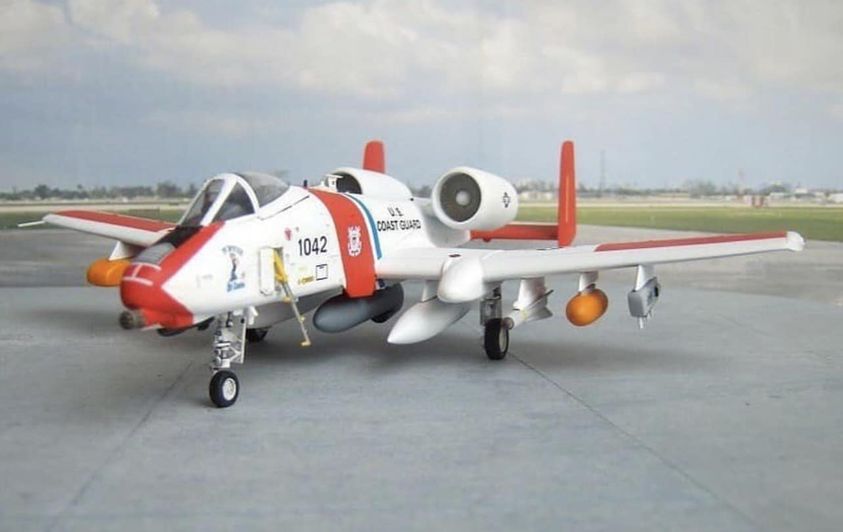
I am not really suggesting this, but having some Air National Guard on call would be comforting.
There is a hole in US defenses and the Coast Guard is likely to be the first to see the threat, “Who yah gone call?”
- MSN reports on the growing maritime role of Air Force A-10s.
- A bit more on how A-10s have been used in a maritime role here and here
- I also seem to remember seeing that A-10s based in S. Korea have also trained to counter N. Korean small boats. A-10s can be a powerful anti-shipping weapon system.
If a threat, in the form of a merchant ship with containers that may be filled with missiles, mines, terrorists, a dirty bomb, a nuclear bomb, or whatever horror the mind of man can imagine, should be headed for the US, the Coast Guard is the most likely agency to detect the threat. But then what?
Can your local sector commander or even district commander call for air support from a DOD unit poised to strike a target at sea in a timely manner? I don’t think so.
NORAD, the North American Aerospace Defense Command, does have a modest number of aircraft on standby, prepared to intercept air threats, mostly air national guard, but they are not trained, equipped, or prepared to take out maritime targets.
I have (several times) suggested that the Coast Guard needed at least the ability to forcibly stop any vessel, regardless of size. That would presumably allow DOD forces sufficient time to organize a response because we don’t have one pre-packaged.
I would feel a lot more comfortable if DOD units, assigned an anti-shipping role, were on standby, practiced and exercised, ready to respond to a Coast Guard call for help.
They might be Marine cruise missiles, Army attack helicopters, or Navy maritime patrol aircraft, but Air Guard A-10s look promising. This could also prepare these units for an anti-shipping role in wartime.
Target designation is always a problem in multiunit operations. Every Coast Guard unit should have at least a hand held laser target designator to allow them to mark a target for DOD units.
I know an attack using a merchant ship seems unlikely, at least in peacetime, but 9/11 was unlikely and look at the fallout from our failure to respond appropriately to the hijackings in progress, not just those killed on the ground on that day, but also two fruitless wars.
 Chuck Hill's CG Blog
That’s why I am all for the USCG getting the A-29 Super Tucano. It could play several roles in CONUS Homeland defense. Can you imagine each Sector having a wing of A-29 Super Tucano for CONUS defense and maritime defense. Manned ISR and provide a Forward air control presence. It can be used against Maritime terrorism, and slow flying aircraft, helicopters and UAV drones.
There was a drill in D13 last year that involved A-10s escorting a sub transit out of Bangor in conjunction with surface assets.
Nelis and Whitman AFB are obviously not located to provide a rapid contingency response in the PNW but there’s obviously other assets in Portland (air guard with an alert posture), in garrison at JBLM (likely without an alert posture), and NAS Whidbey.
https://www.dvidshub.net/image/8388543/uss-nebraska-escorted-usaf-10s-uscg
https://www.twz.com/news-features/a-10-warthogs-escorting-a-ballistic-missile-submarine-is-certainly-different
This is something I’ve looked at as well. Air National Guard A-10s could easily cover ports with a pair pre-loaded with a variety of weapons for different roles thanks to the A-10’s excellent capacity, pylon count, and low cost. On the low end, the 30mm gun and APKWS are ideal for low-collateral or warning shots, and on the high end a 2,000 pound bomb fitted with the new quicksink kit should be able to send even the biggest commercial ship to the bottom.
Furthermore, while port security may be the primary mission of these A-10s, they can obviously support a variety of secondary missions further afield. They already perform combat search and rescue, so they could obviously support the Coast Guard there, and their maritime interdiction capabilities are well proven. Throw in the benefit to the DOD of maintaining A-10 units which could be deployed overseas if needed, and you get a clear win any way you look at it.
Pingback: After China invades Taiwan | Chuck Hill's CG Blog
This might work, at least in some places. https://www.flightglobal.com/fixed-wing/us-air-force-dubs-new-oa-1k-armed-crop-duster-skyraider-ii-ahead-of-first-delivery/162009.article