
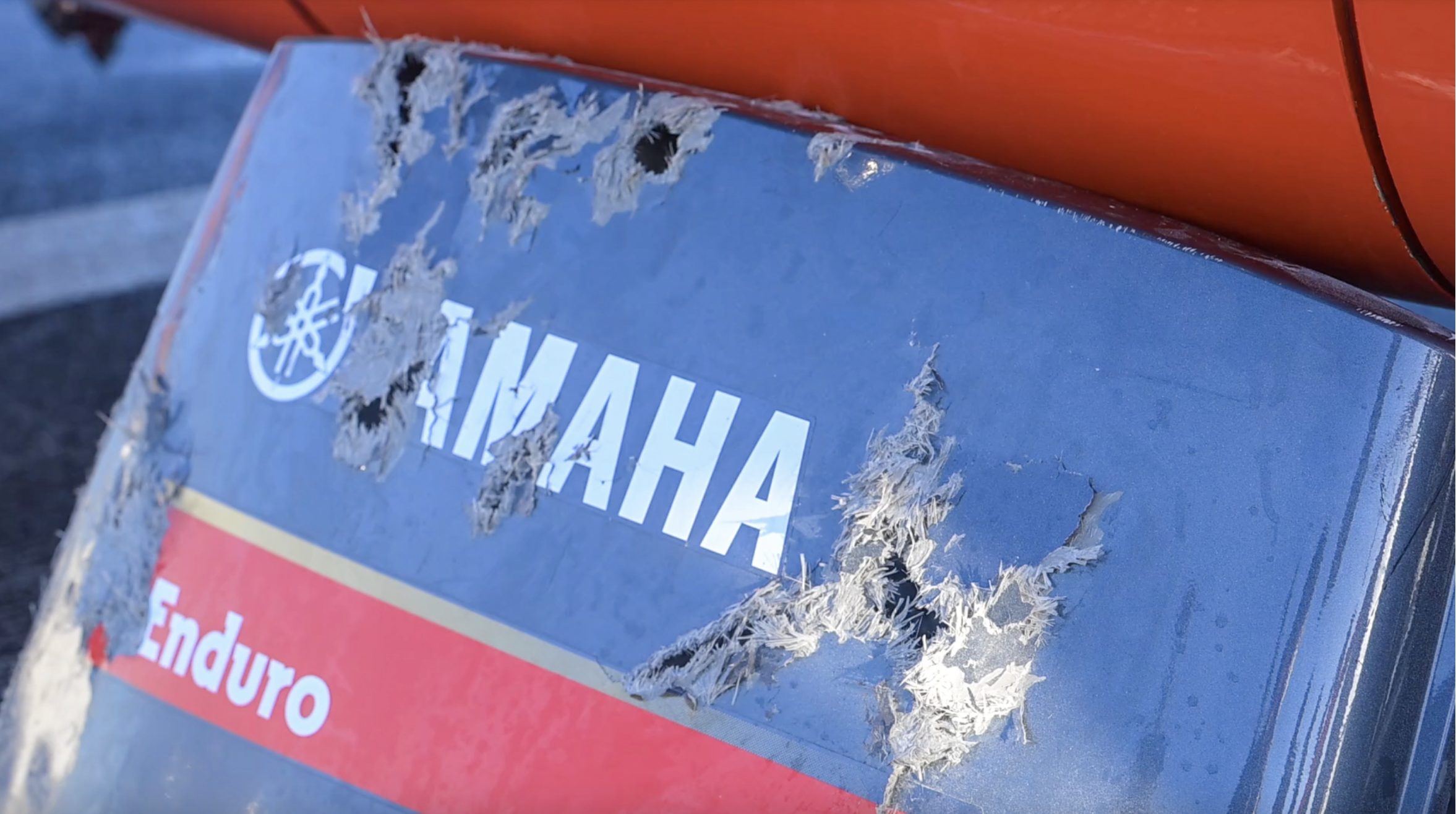
An engine cowling rests against an MH-65 dolphin helicopter at Port Everglades, on March 20, 2025. After attempts to stop a non-complaint vessel failed, the Coast Guard’s Helicopter Interdiction Tactical Squadron was authorized to use force, including disabling fire. (Coast Guard photo by Petty Officer 3rd Class Nicholas Strasburg)
Below is a news release from District Seven. I don’t pass along every ship’s off load of drugs because they have gotten to be routine, but this patrol was anything but routine.
- For one ship to interdict 12 drug smugglers in a single patrol is unusual.
- This interdiction of four go-fast vessels operating in company moving almost as if in formation was unusual.
“On Feb. 19, Stone’s embarked UAS crew detected multiple suspicious vessels approximately 110 miles south of the Galapagos Islands, Ecuador. Stone’s embarked HITRON aircrew employed airborne use of force tactics to compel the non-compliant vessels to stop, and their boarding teams interdicted four go-fast vessels, apprehending eight suspected smugglers and seizing approximately 10,885 pounds of cocaine.”
- Success of the UAS was notable.
- The location of that interdiction is unusual in that it is probably at least 500 nautical miles west of Ecuador and well South of Colombia, the country we normally think of as the source for cocaine.
(Could the four vessels intercepted Feb. 19 have been on the way to meet a larger vessel offshore? –either to transfer the load or to refuel?)
The photo above, at the head of this post, was the first thing that really got my attention, but apparently, that cowling was not unique.
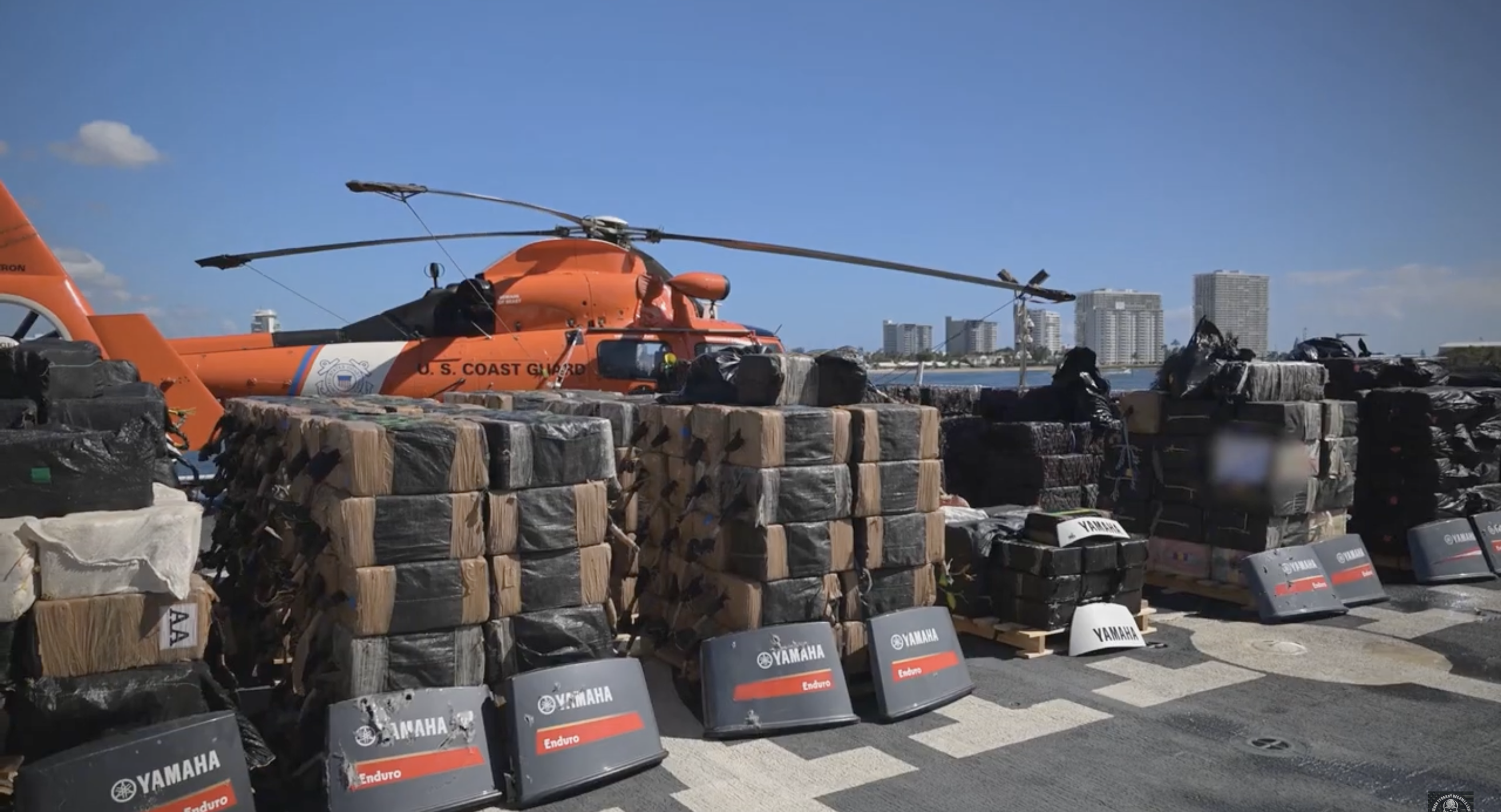
USCGC Stone (WMSL-758) delivers $517.5 million in illicit drugs interdicted in Eastern Pacific Ocean. Along side are displayed cowlings of outboard motor disabled by the Airborne Use of Force crew from the Coast Guard’s Helicopter Interdiction Tactical Squadron (HITRON) based in Jacksonville, FL.
Coast Guard offloads over $517.5 million in illicit drugs interdicted in Eastern Pacific Ocean
MIAMI – The crew of U.S. Coast Guard Cutter Stone offloaded approximately 45,600 pounds of illicit narcotics worth more than $517.5 million at Port Everglades, Thursday.
The seized contraband was the result of 14 interdictions in international waters of the Eastern Pacific Ocean, and 35 suspected smugglers were transferred ashore to face federal prosecution in U.S. courts.
“You heard it said before that the Coast Guard’s national security cutters are game changers in the counter-drug mission, but they still require a crew of men and women willing to serve on or over the sea, and place themselves in harm’s way,” said Capt. Jonathan Carter, commanding officer of Stone. “I’m incredibly proud of our crew’s performance and their efforts to combat narco-terrorism this deployment. In one exceptional case, the crew interdicted four go-fast vessels in 15 minutes, seizing nearly 11,000 pounds of cocaine that will never be mixed with deadly fentanyl to threaten American lives here at home.”
On Dec. 21, Stone’s embarked aircrew from Coast Guard Helicopter Interdiction Tactical Squadron detected a suspicious vessel in international waters approximately 321 miles west of Ecuador. Stone’s boarding team interdicted the go-fast vessel, apprehended three suspected smugglers and seized over 1,630 pounds of cocaine.
On Dec. 22, a maritime patrol Dash-8 aircrew detected a suspicious vessel in international waters approximately 180 miles southeast of the Galapagos Islands, Ecuador. Stone’s embarked HITRON aircrew and boarding team interdicted the low-profile go-fast vessel, apprehended three suspected smugglers and seized approximately 12,220 pounds of cocaine.
On Jan. 9, a maritime patrol Dash-8 aircrew detected a suspicious vessel in international waters approximately 148 miles west of Salinas, Ecuador. Stone’s embarked HITRON aircrew and boarding team interdicted the go-fast vessel, apprehended three suspected smugglers and seized approximately 2,370 pounds of cocaine.
On Jan. 28, Stone’s embarked unmanned aircraft system (drone) crew detected a suspicious vessel in international waters approximately 459 miles south of Manzanillo, Mexico. Stone’s boarding team interdicted the vessel, apprehended five suspected smugglers and seized approximately 3,885 pounds of cocaine.
On Jan. 30, Stone’s embarked UAS crew detected a suspicious vessel in international waters approximately 715 miles off Mexico. Stone’s boarding team interdicted the vessel, apprehended two suspected smugglers and seized approximately 3,800 pounds of cocaine.
On Jan. 31, Stone’s embarked UAS crew detected a suspicious vessel in international waters approximately 630 miles off Mexico. Stone’s embarked HITRON aircrew employed airborne use of force tactics to compel the non-compliant vessel to stop, and the boarding team apprehended three suspected smugglers and seized more than 2,565 pounds of cocaine.
On Feb. 12, Stone’s embarked UAS crew detected a suspicious vessel in international waters approximately 655 miles south of Mexico. Stone’s embarked HITRON aircrew employed airborne use of force tactics to compel the non-compliant vessel to stop, and the boarding team apprehended three suspected smugglers and seized more than 3,640 pounds of cocaine.
On Feb. 18, Coast Guard Cutter Mohawk’s crew detected and boarded a sailing vessel approximately 70 miles northwest of Isla Malpelo, Colombia. Mohawk’s boarding team apprehended three suspected smugglers and seized approximately 635 pounds of cocaine.
On Feb. 19, Stone’s embarked UAS crew detected multiple suspicious vessels approximately 110 miles south of the Galapagos Islands, Ecuador. Stone’s embarked HITRON aircrew employed airborne use of force tactics to compel the non-compliant vessels to stop, and their boarding teams interdicted four go-fast vessels, apprehending eight suspected smugglers and seizing approximately 10,885 pounds of cocaine.
On Feb. 25, Mohawk’s crew detected and interdicted a suspicious vessel approximately 230 miles south of Costa Rica. Mohawk’s boarding team apprehended three suspected smugglers and seized approximately 1,600 pounds of cocaine and 330 pounds of marijuana. Costa Rican authorities took custody of the fishing vessel, suspects and bulk contraband for prosecution.
On March 10, Stone’s embarked HITRON aircrew detected a suspicious vessel in international waters approximately 270 miles southeast of the Galapagos Islands, Ecuador. The HITRON aircrew employed airborne use of force tactics to compel the vessel to stop, and Stone’s boarding team interdicted the go-fast vessel, apprehending two suspected smugglers and seizing approximately 3,980 pounds of cocaine. The transfer of custody from this case will occur at a later date.
“The fight against drug trafficking and transnational criminal organizations doesn’t begin at our U.S. maritime borders,” said Cmdr. David Ratner, commanding officer of Mohawk. “Our efforts to defend Americans at home begins with denying drug traffickers access to maritime routes and disrupting the flow far out at sea where we operate alongside interagency and strategic regional partners like Costa Rica.”
The following assets and crews were involved in the interdiction operations:
- U.S. Coast Guard Cutter Stone (WMSL 758)
- U.S. Coast Guard Cutter Mohawk (WMEC 913)
- U.S. Coast Guard Helicopter Interdiction Tactical Squadron (HITRON) Jacksonville
- U.S. Coast Guard Tactical Law Enforcement Team-Pacific (PAC-TACLET)
- Joint Interagency Task Force-South (JIATFS)
- Eleventh Coast Guard District
Detecting and interdicting illicit drug traffickers on the high seas involves significant interagency and international coordination. Joint Interagency Task Force-South, in Key West, conducts the detection and monitoring of aerial and maritime transit of illegal drugs. Once an interdiction becomes imminent, the law enforcement phase of the operation begins, and control of the operation shifts to the U.S. Coast Guard for the interdiction and apprehension phases. Interdictions in the Eastern Pacific Ocean are performed by members of the U.S. Coast Guard under the authority and control of the Eleventh Coast Guard District, headquartered in Alameda, California.
The Coast Guard continues increased operations to interdict, seize and disrupt transshipments of cocaine and other bulk illicit drugs by sea. These drugs fuel and enable cartels and transnational criminal organizations to produce and traffic illegal fentanyl, threatening the United States.
Each of these interdictions initiate criminal investigations by federal law enforcement partners. Several were tied to the transnational criminal organizations responsible. Drug evidence from these cases is linked to cartels recently designated as foreign terrorist organizations by the U.S. government, including Sinaloa and Cartel Jalisco Nueva Generaciόn. These interdictions denied those criminal organizations more than half a billion dollars and provide critical evidence for their total elimination.
USCGC Stone is one of four 418-foot Legend-class national security cutters homeported in Charleston, South Carolina under U.S. Coast Guard Atlantic Area Command. The U.S. Coast Guard Maritime Law Enforcement Academy where Coast Guard boarding officers train to conduct these missions, in Charleston, celebrated its 20th anniversary on March 14.
For breaking news, follow us on X (formerly Twitter). For additional information, find us on Facebook and follow us on Instagram.
Make a difference on land, at sea or in the air with the Coast Guard. Visit GoCoastGuard.com to learn more about active duty and reserve, officer and enlisted opportunities. Information on how to apply to the U.S. Coast Guard Academy can be found here.
 Chuck Hill's CG Blog
Mr. Hill,
Kinda shocked at the sporadic shots these engine cowlings took, was part of the Agusta team after retiring out of CGAS Miami in 2005. Would have to look back at my orders but would say I did at least 10 patrols during my time as part of HITRON from 7/05-2/08 when I flew as FLT Mech with the last group of Agusta Hitron birds up to Delaware to hand the Heloâs back over to Agusta.
During the interdictions that I witnessed as a helo mechanic aboard various cutters, saw that all the cowlings that had been shot through had one shot through the center of the H. Same held true for the engine cowlings kept at the Airstation as trophies.
It is quite shocking to see the damage to these cowlings, which gives the impression that perhaps the marksmanship is not what it once was!
Did see that you had an article talking about a drug runner that passed away during an interdiction in 2016, there was no confirmation of what caused this. Was the result of this interdiction and fatal injury ever released?
Just curious to hear your opinion of where HITRON is at these days?
Sincerely,
Russ Jones
Me on right side, enjoying down time with the crew!
[cid:image001.jpg@01DB9C90.5F5F8200]
I read a related article about the seizure here:
https://www.marineinsight.com/shipping-news/u-s-coast-guard-seizes-around-45600-pounds-of-illegal-drugs-worth-517-5-million/
That article claims “USCGC Stone is one of the four 418-foot Legend-Class cutters homeported in Charleston, South California [sic] under the U.S. Coast Guard Cutter Atlantic Area Command.”
I tried to post a comment on that article asking, “Where is this fictional city called ‘Charleston, South California,’ and when did ‘South California’ become a U.S. state?” but that article is currently blocking comments!
-David Watson
Must be taking advantage of “Artificial Intelligence.”