
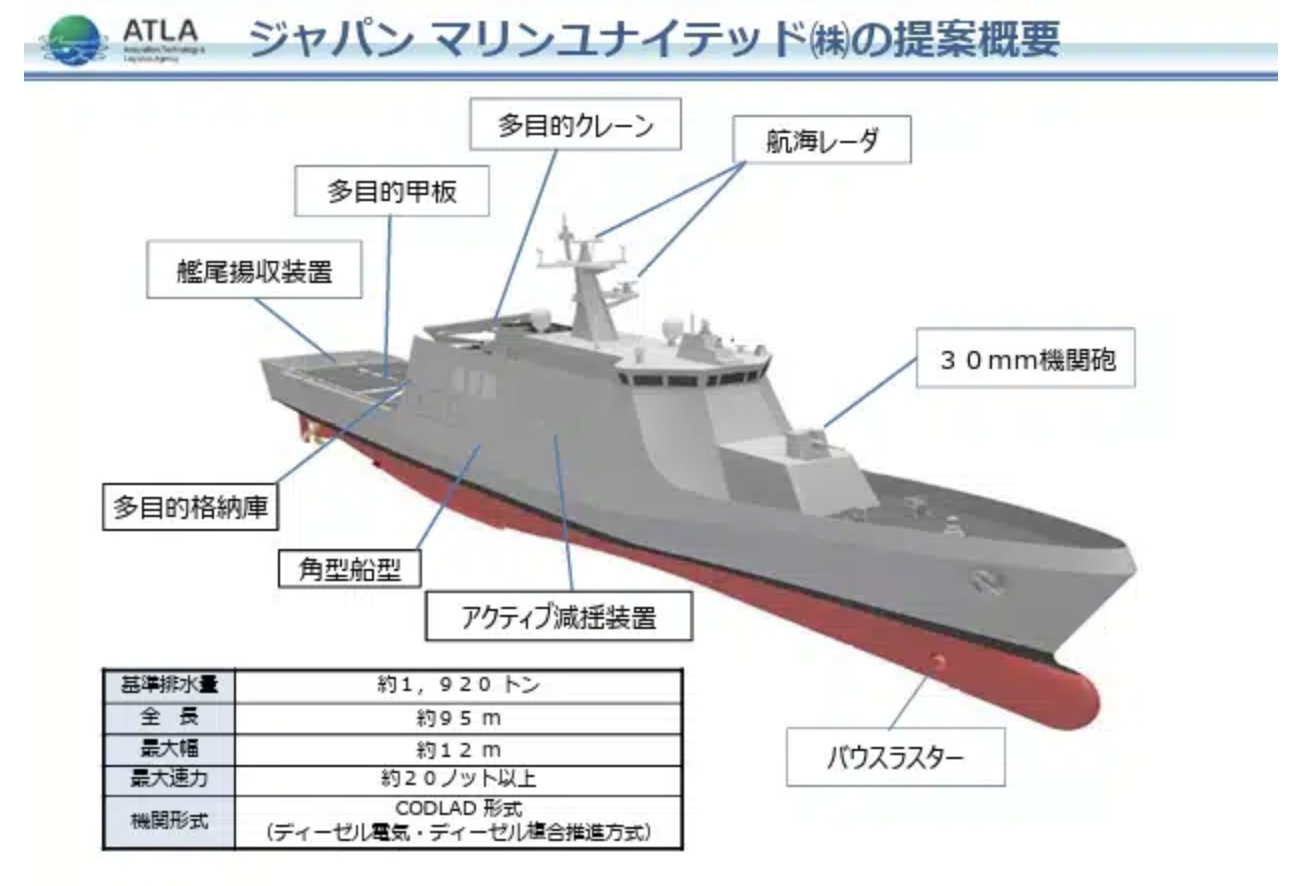
A concept image of a next-generation offshore patrol vessel (OPV) for the Japan Maritime Self-Defense Force (JMSDF) made by JMU. Image courtesy of Japan’s Acquisition, Technology, and Logistics Agency (ATLA).
“The Japanese Ministry of Defense has announced that it has started building a planned fleet of 12 OPV for the Japan Maritime Self-Defense Force (JMSDF). It is the first time ever for the service to introduce any OPV… the first and second vessels are scheduled to be launched in November this year, with the third and fourth vessels being scheduled to be launched in March 2026, according to the magazine. All four vessels will be commissioned in March 2027.”
Notably these are not for the Japan Coast Guard which does have a number of OPVs,
We have discussed these ships before. Earlier posts offer some good discussion in both the post and the comments.
- Japan’s New Offshore Patrol Vessel–July, 2021
- “MAST Asia: Mitsui Unveils OPV Design Proposal for JMSDF OPV Requirement” –Naval News –June, 2019
Cost of the first four vessels is reportedly 35.7 billion yen ($250 million). While it is difficult to draw comparisons, that is about what the US Coast Guard would pay for four Webber class FRCs.
These are very true to my original Cutter X concept, e.g. take the crew, equipment, and capabilities of a Webber class FRC and put them in a more seaworthy hull with greater endurance.
These are not small OPVs:
- Displacement: 1920 tons, standard, which probably means about 2500 tons full load
- Length: 95 meters or about 312 feet.
- Beam: 12 meters, or about 39’4″
They are very similar in statistical description to the WHECs that preceded the Hamilton class, very much the same size as the class we called 311s. They had a range of 20,000 nautical miles at 12 knots.
Their reported speed of 20 knots would suggest they have less horsepower than the Webber class, but the true maximum may be understated. Asian nations frequently understate the capability of their ships. Earlier reports indicated a maximum speed of 25+.
An earlier conceptual drawing showed both a helicopter hangar and stern launch for two RHIBs.
Japan has had great difficulty in manning their ships so they have attempted to trim crew size. The reported crew size is only 30, but they will probably have accommodations for additional mission specific personnel.
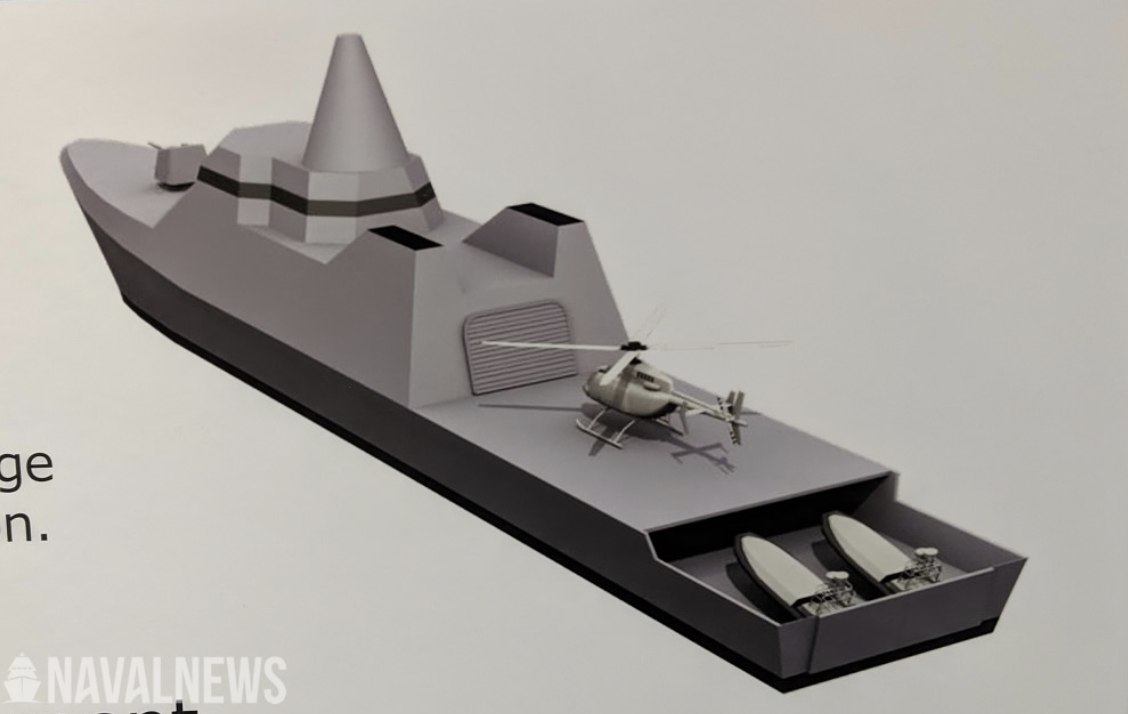
Earlier conceptual design, Japanese Navy OPV stern quarter, Note significantly different mast.
From an earlier Naval News post,
“…the aft deck can carry multiple containers, making it useful for a wide range of missions, from transporting supplies in peacetime to providing humanitarian aid in times of disaster. These functions can be used to address Japan’s most pressing issues, such as remote island defense and disaster relief. On the other hand, multi-purpose hangers and modularization of equipment have the advantage of being able to change the ship’s equipment to suit different missions, as well as being able to propose a form that meets the requirements of other countries when exporting to them.”
What will these be used for? I suspect they will provide presence near critical coastal ports and infrastructure to prevent unconventional attacks launched from merchant or fishing vessels from either North Korea or China. The 30mm gun pictured may be adequate only for dealing with fishing vessels. Japan may have supporting forces they can call on.
More discussion of the class and its purpose here.
According to a video release in July 2021 by the MOD’s Acquisition, Technology & Logistics Agency (ATLA), the purpose of this OPV program is to provide enhanced maritime security, particularly around the southwestern Ryukyu Islands, including the disputed Senkaku/Diaoyu Islands in the East China Sea, by boosting JMSDF patrol activities in the region. The OPV will take over the patrol missions of the Abukuma-class destroyer escorts and Hayabusa-class patrol boats currently operated by JMSDF, including monitoring of other countries’ military vessels in the Sea of Japan, East China Sea, and Pacific Ocean. While the OPV’s primary mission is patrol, and its armament is very limited, it will be very well equipped for intelligence, surveillance, and reconnaissance (ISR).
 Chuck Hill's CG Blog