

Based on the Coast Guard Historian’s timeline, https://www.history.uscg.mil/research/chronology/
With inspiration from Mike Kelso
May 10
1800 Congress forbade citizens to own an interest in vessels engaged in the slave trade or to serve on such vessels.
1956 President Dwight D. Eisenhower signed Public Law 519, which brought all previously uninspected vessels on navigable waters carrying more than six passengers for hire under inspection laws. These were chiefly party-fishing motorboats, excursion sailboats, and ferry barges. Public attention had been focused on the inadequacy of existing inspection laws by the hundreds of lives lost on uninspected vessels.
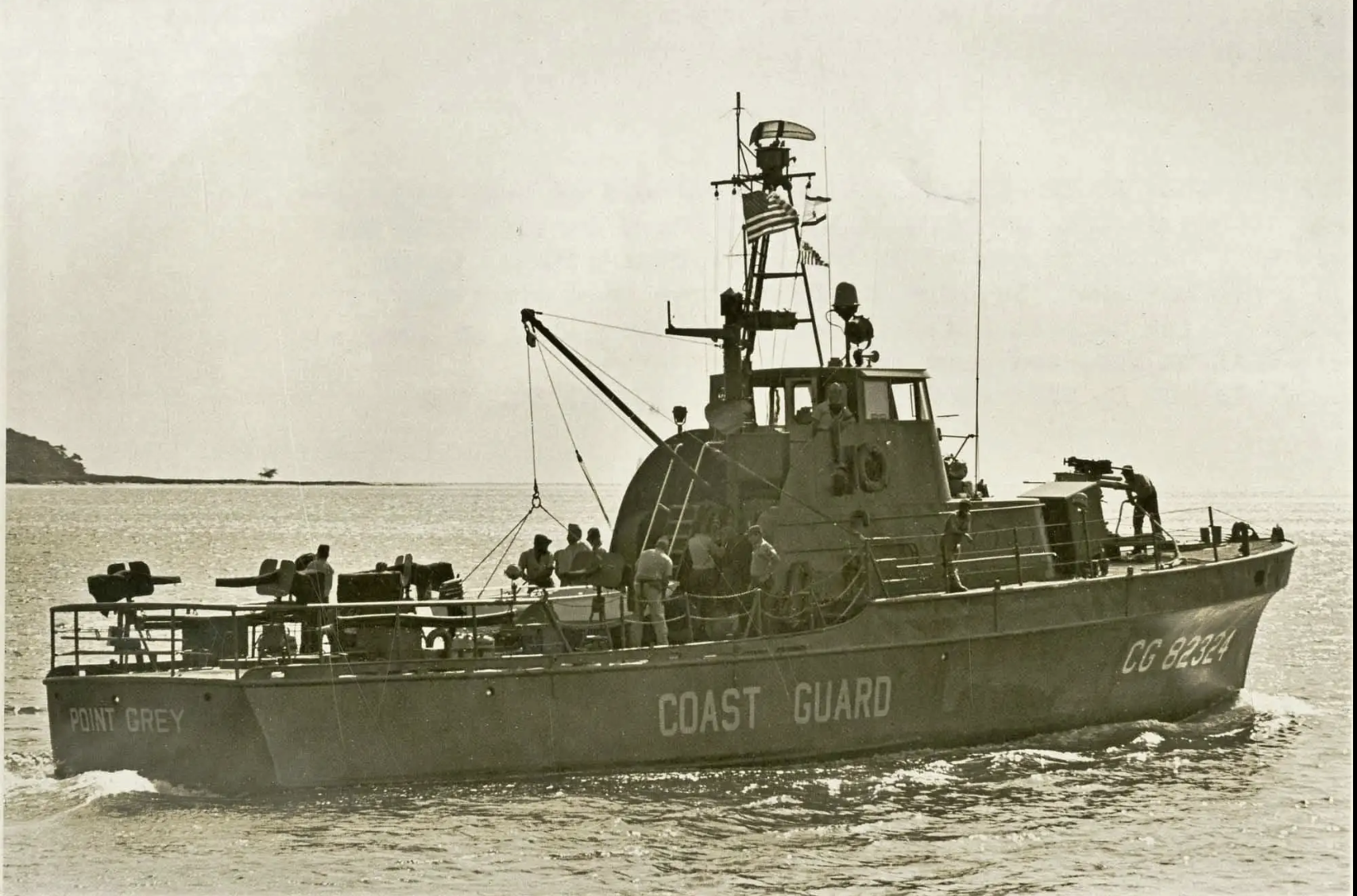
USCGC Point Grey (WPB-82324) note her M2/81mm piggyback forward, at least three M2s over the stern, and nearly a dozen Coasties on deck preparing the away boat
1966 CGC Point Grey was on patrol near South Vietnam’s Ca Mau peninsula when her crew sighted a 110-foot trawler heading on various courses and speeds. Suspicions aroused, Point Grey commenced shadowing the trawler. After observing what appeared to be signal fires on the beach, the cutter hailed the vessel, but received no response. The trawler ran aground and Point Grey personnel attempted to board it. Heavy automatic weapons fire from the beach prevented the boarding and two crew and one Army passenger were wounded aboard Point Grey. USCGC Point Cypress, USS Brister (DER-327) and USS Vireo (MSC-205) came to assist. During the encounter the trawler exploded. U.S. Navy salvage teams recovered a substantial amount of war material from the sunken vessel. This incident was the largest, single known infiltration attempt since the Vung Ro Bay incident of February 1965 and was the first “suspicious trawler interdicted by a Market Time unit.”
At about 04:30, Point Grey encountered a steel-hulled trawler trying to make a landfall near the mouth of the Cua Bo De River. The Coast Guard cutter received heavy .50-caliber gunfire when she tried to force the trawler to heave to for inspection but, while requesting assistance in the form of Brister and Vireo, succeeded in forcing the enemy ship aground. At a hasty conference on board Brister, it was decided to attempt to salvage the grounded gun runner. While Point Grey approached the trawler with a towline from Vireo, Brister launched her motor whaleboat to assist. The Coast Guard cutter received a withering machine gun fire from insurgents ashore as she neared the enemy. She answered that fire promptly, and Vireo joined in with 150 rounds of 20-millimetre (0.79 in). Brister, her battery masked by the cutter, could not bring her 3-inch (76 mm)/50 caliber guns to bear on the enemy. Ultimately, the Coast Guard cutter had to break contact and move off in order to get her wounded crewmen medical assistance. Vireo covered her retirement with more 20-millimeter fire and provided a haven for Brister‘s motor whaleboat while air strikes were called in to silence the enemy machine gun emplacements. Further air strikes eventually destroyed the trawler,
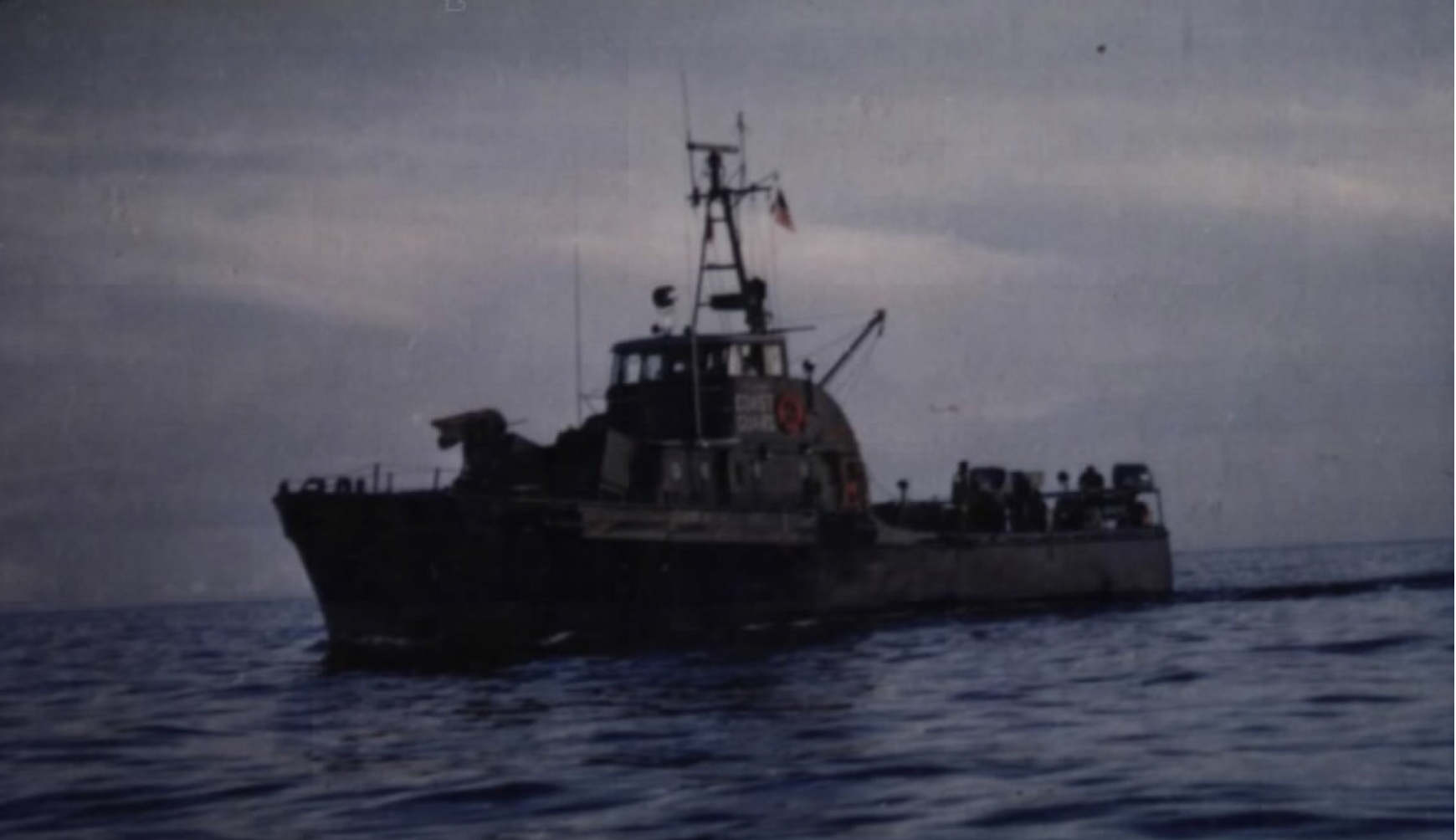
USCGC Point Cypress (WPB-82326) off An Thoi, 1 November 1968. US Navy photo K60600
 Chuck Hill's CG Blog
It is time for a new U.S. Navy Motor Torpedo Boat/Missile Boat. Fast hull with common Diesel engines for all applications in a package <100), low displacement (<100 tons), RADA MHR sensor with four (4) array faces, lightweight ESM, SensorXP Continuous 360 Optronic System, two guns with one fore and aft at 30-50mm with smart rounds, guided rockets fore and aft for point defense and main armament would be HellHound/RoadRunner drones. It will need a small flight deck for RoadRunner recovery. We could give them countermeasures (chaff/flares).
They should have an operational characteristic near that of an USCG FRC. Build a grunch of them, and give them a Mother Ship like the USNS John Glenn, and off you go.
I think the trick is that if you could fit all that on 100 ton you won’t have speed or endurance. I take my inspiration from the GRC43. Base a design on an upgraded Westport 50m and use an ESB as a mothership for them. They have plenty of endurance on their own, but can hitch a ride into theater. http://www.tmgico.com/images/GRC43_BROCH_EMAIL.pdf
Well . . . 100′ is probably a little long, and 100 tons probably more like 200-300 tons with a turbine for speed. However, I do like the Swedish Patrol Boat HSwMS Malmö (P12). We could Americanize it . . . just don’t let NAVSEA do it!
The 82 foot cutters were successful in this role not because they were fast, but because they were seaworthy and had good endurance.
PTs were never really giant killers, but they found their niche countering coastal traffic.
Coastal traffic is still important in lots of areas of the world.
I see a need for the Coast Guard to have a true “Fast Response Cutter” as a WPB replacement in important ports.
https://chuckhillscgblog.net/2019/04/06/the-87-foot-wpb-replacement-an-addendum/
The nearest thing to what I was thinking about is the Shaldag V.
https://chuckhillscgblog.net/2025/04/27/spike-nlos-missile-system-photos-and-video/
https://chuckhillscgblog.net/2023/12/03/shaldag-mk-v-what-a-true-fast-response-cutter-might-look-like/
“Coastal traffic is still important in lots of areas of the world.” . . . you mean like the Greater Western Pacific Archipelagic AOR? What ever we built it should probably be able to make the trip from the 2nd Island Chain to the 1st on its own. Probably a range of at least 2,000 miles.
“The nearest thing to what I was thinking about is the Shaldag V.” . . . The Philippines agrees with you!