
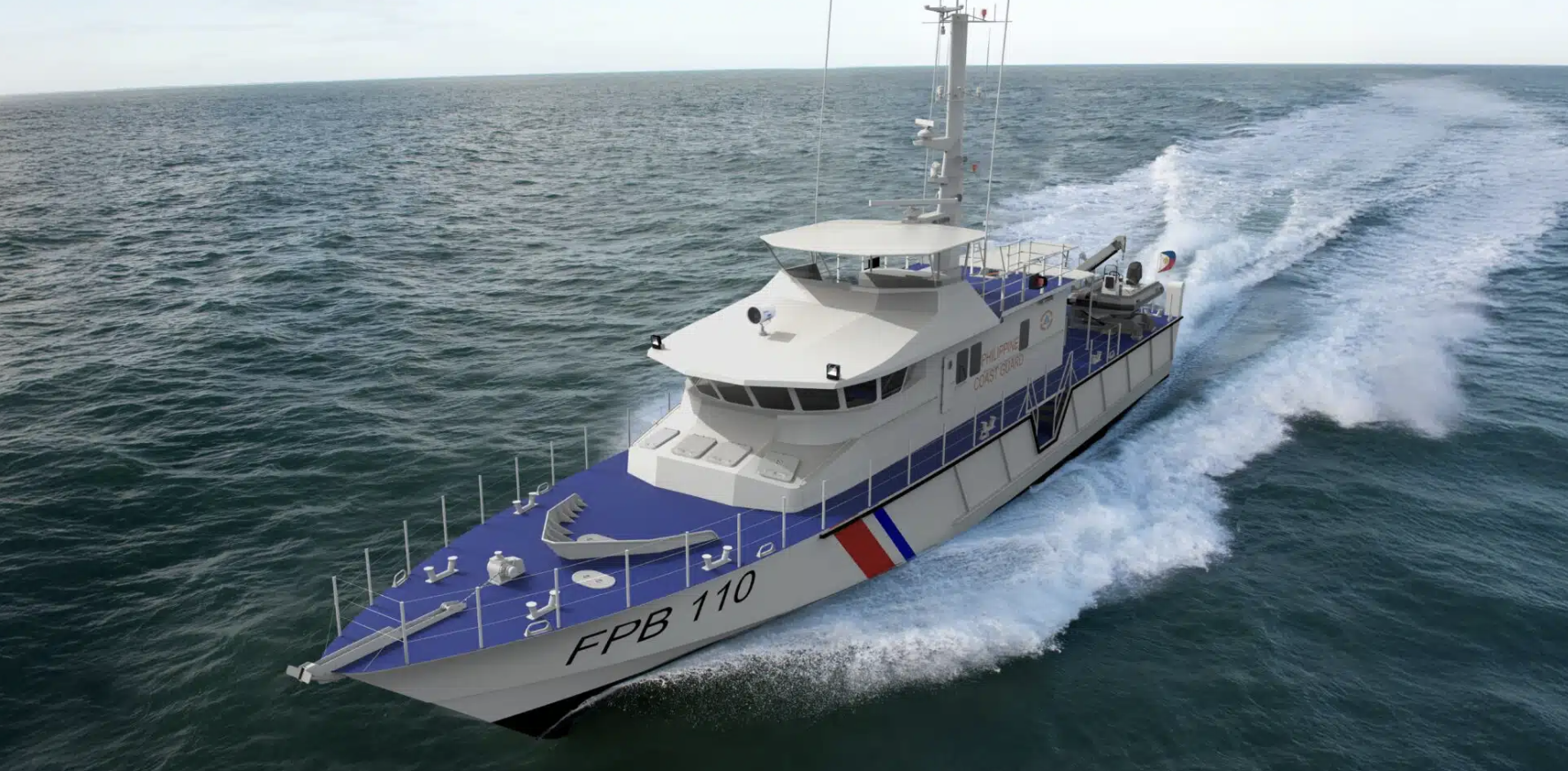
A 3D rendering of the Philippine Coast Guard’s future FPB 110 MKII. OCEA photo
“French shipbuilder OCEA signed a contract for the construction and basing support of 40 fast patrol boats for the Philippine Coast Guard on Thursday, marking the largest investment by Paris into Manila’s maritime security efforts to date.
“These fast patrol craft will be based on OCEA’s FPB 110 MKII design, which comes in at 35 meters long and weighs 110 tons. The vessels are more capable than the existing four OCEA FPB 72s in service, which are used for littoral patrol and rarely operate into the South China Sea. According to company infographics, the FPB can reach speeds up to 28-35 knots. The vessels can also operate out to 700 nautical miles at 12 knots. OCEA claims that the vessels can conduct missions relating to territorial and deep sea surveillance operations, control of vessels at sea, and “sovereignty.” It should be noted that while there is a space for a deck gun, this is not depicted in 3D graphics of the vessels.”
These will be a bit larger than the Island class WPBs at about 115 feet and will have an Aluminum hull providing greater fuel economy.
That they would have no permanently installed gun mount should not be a surprise since no Philippine Coast Guard vessels have any weapon larger than a .50 caliber machine gun.
The illustration above suggests that the Philippine OCEA’s FPB 110 will have a single arm davit for a launching their RHIB on the port side.
This contract was not unexpected, but the boats are large than originally expected “Philippine Coast Guard to Receive 40 Patrol Boats from France in $438 Million ODA Project” –USNI
OCEA is an experienced patrol boat builder. Some previous projects:
- “OCEA Launched Largest Aluminum OPV in the World for Philippine Coast Guard” –Naval News
- “Two OCEA FPB 72 MKII Delivered to the Philippine Coast Guard” –NavyRecognition
- “French Customs order OCEA FPB 100 MKII patrol boats” –Naval News
- Ukraine’s new FPB 98 MKI boats pass Istanbul Strait onboard Cargo Vessel
- Ocean Dispatches Two More FPB Mk1s For Ukraine
 Chuck Hill's CG Blog
The Philippines being the 4th largest ship builder on the planet should be building their own Surface Combatants, patrol boats, and logistics ships. That fact that they are not already is a huge indictment in my book. It demonstrates just how competent and resolute they are. Time to catch up.
@Torch, I tend to agree, that they should be building their own. Some ship builders like Damen are willing to transfer technology. The problem is, if you only need a few, then you build up the industry for a few years and then it dies. It needs to be scaled for sustainability.
Even if it costs more to build locally some money is recycled thru the economy so the nation usually comes out ahead.
The Philippines shares geographic similarities with the UK and Japan that made them great maritime powers.
The Philippines has a large number of skilled mariners.
I don’t understand why they have not been building at least their own small cutters and warships even if they have to get the designs from more experienced nations.
“The Philippines has a large number of skilled mariners…” . . . Philippine Mariners track all the way back to ancient times. The Philippines is a volcanic archipelago full of minerals, and has been recognized as such since Biblical times (the land of “Ophir”). Gold and pirates go way back. Investigate Ancient Filipino knife fighting, primarily known as Kali, Escrima, or Arnis. Even back in the day many Philippino Pirates would be hired to protect things of value.
It does appear that France is paying some of the cost.
Each 35m FPC also includes spare parts/ILS for NINE YEARS.
Project price also includes FPC dockside equipment for SIX PCG bases.
With a required cabin for 21 crew(versus 17 from base variant), the PCG needs to train around 840 crew for all 40 vessels.
The PCG has time to train crew as the 40 units are required to be delivered over a maximum period of 7 years.
Around Dec 2026 would be the expected first French made unit delivery.
Around August 2027 would be the expected delivery of the PH made unit.
Around June 2032 would be the expected delivery of the 40th unit.
The sad thing is that the PCG is still unarmed and they don’t stand a chance against China.