
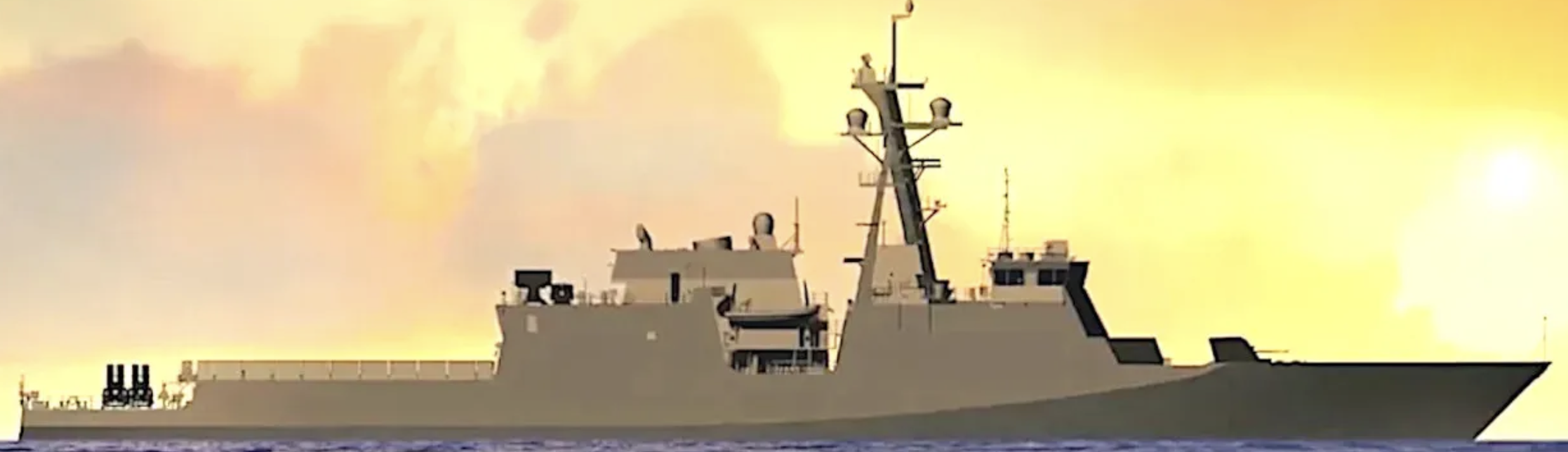
The War Zone reports what seemed obvious from the artists’ renderings, that the FF(x) derived from the National Security Cutter will not have any permanently installed vertical launch missile tubes,
“The initial flight of FF(X) will have a 57mm gun, 2 x 30mm guns, a Mk 49 Rolling Airframe Missile [launcher], various countermeasures, and a flight deck from which to launch helicopters and unmanned systems. Aft of the flight deck, there will be a flexible weapons system, which can accommodate containerized payloads (Counter-UAS, other missiles),” a Navy spokesperson told TWZ today. “Much like the successful DDG-51 [Arleigh Burke class destroyer] program, we are building this in flights. The frigate will be upgraded over successive flights to evolve and has the space reservations needed to improve capability over time.”
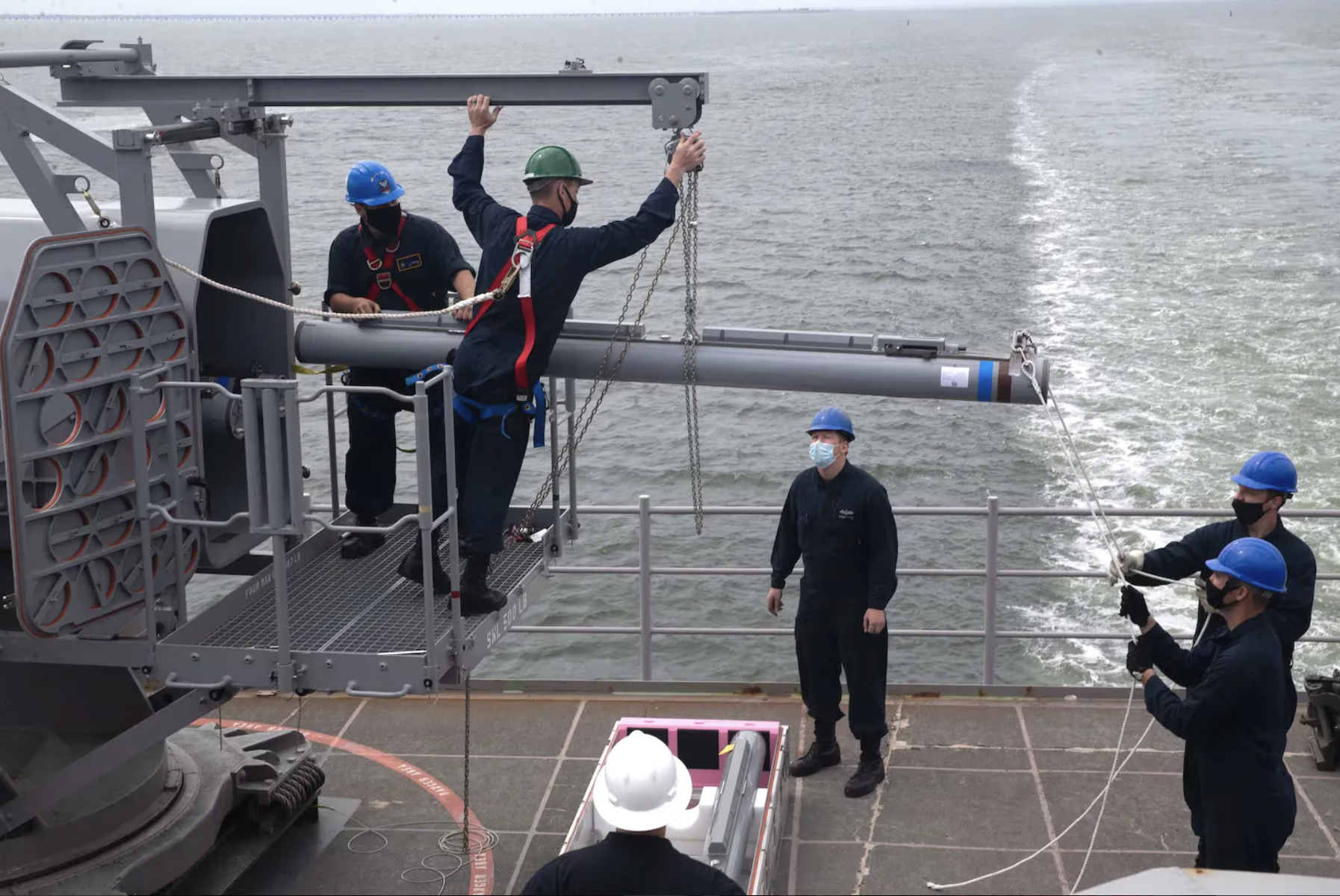
Members of the aircraft carrier USS Gerald R. Ford’s crew remove a RIM-116 missile from a Mk 49 launcher during qualification trials.
I must admit, I missed the two 30mm guns, presumably Mk38 Mod4s.
A Revolution in Coast Guard Readiness:
There is reference to containerized, modular, or off-board unmanned systems operating from or in conjunction with the FF(X).
That sounds like the promises that accompanied the LCS, but if the Navy delivers on these systems, it could revolutionize the way the Coast Guard meets its military readiness mission. There are already mine counter measures and missile launching systems.
The Navy could maintain the mission modules and identify those who would operate and maintain them and simply assign them to Coast Guard units upon mobilization. The Coast Guard maintains and operates the platform while the Navy maintains and operates the payload.
Towed Arrays and helicopters is what I think about first, but it might include mine clearance if a US port may have been mined–don’t have to wait for a mine countermeasures ship to get there, just fly in the equipment and the crew, have them operate from a CG station or perhaps a buoy tender.

“USS Savannah (LCS 28) conducts a live-fire demonstration in the Eastern Pacific Ocean utilizing a containerized launching system that fired an SM-6 missile from the ship at a designated target. The exercise demonstrated the modularity and lethality of Littoral Combat Ships and the ability to successfully integrate a containerized weapons system to engage a surface target. The exercise will inform continued testing, evaluation and integration of containerized weapons systems on afloat platforms.”
Mk70 missile launchers could be flown to Alaska and mated to a cutter already in the area.
 Chuck Hill's CG Blog
LCS presumed that opfor didn’t have much capability so speed could play a large part in the capability package for both offence and defense………..And it didn’t matter that the ship was fragile to achieve that speed or under crewed for a US ship because in ‘theory’ it wasn’t going to get hurt, much.
What I have come to understand is that you Americans don’t know what you want from this ‘ship’. Specify something sensible and you are shouted down by a crowd shouting ‘Mini Burke. We don’t want a Mini Burke’. And then you have another crowd thinking you want 2000 tonners for fighting wars in the littoral………..
That’s a huge Mistake that’s gonna come back to bite us and huant us. Whoever in the US navy thought of this should be fired Immediately.
At least a Mk48 VLS system should be on board. If ASROC is to be employed then some Tactical Length Mk41s will have to be present.
Mk48 could be amid ships or aft. Mk48 can be in, on or bolted to a bulkhead.
Iver Huitfeldt (Denmark), Sachsen F124 (Germany), De Zeven Provinciën (Netherlands), Fridtjof Nansen (Norway), F100 (Spain) and SIGMA frigate variants (Netherlands/export) all have Mk41 with tactical length cells.
Just a bit bigger than the NSC. Strip out all the ‘Euro kit’. 32 VLS cells…….space for HMS and VDS…….
Trying to adapt a European design to the USN is what led to Constellation being the mess it is. USN survivability standards are far too strict compared to other country’s standards to adapt foreign designs without it being a complete mess.
Do you really think NSC is more robust than Sigma?
Or are you just parroting the party line?
It is idle backward thinking like that as to why your country can’t do anything now.
One can must about robustness of the platform all you want. It does NOT improve ‘Survivability in Combat’. For that to be addressed one has to UNDERSTAND that you can float, and propel yourself through the water even in the Arctic in heavy seas . . . BUT if one cannot see the threat coming (detect, track, provide FIRE CONTROL) . . . YOU WILL NOT SURVIVE in the Modern Naval Battlespace. This is the very base design concept that drove the Aegis Cruiser, Aegis Destroyer, and SHOULD HAVE DRIVEN the design and building of an Aegis FRIGATE. We never completed that ship-set of a combat fleet . . . and we are still not doing it TODAY! All of our Allies have figured it out . . . and what does the USN propose?
Even if you do not put VLS on the new Small Surface Combatant . . . you STILL HAVE TO SEE THE THREAT COMING . . . in order to SURVIVE. This FUNDAMENTAL LACK OF UNDERSTANDING IS MORE THAN DISTURBING . . . and looks like a design driven by cost not effectiveness. It is a whole lot easier to just build Love Boats so they can be easily sunk and feed the fish instead of this shell-game of a false narrative of building a new Small Surface Combatant. We should not deliberately build disposable ships!!!
A non-rotating 3D AESA sensor is required just to defend against drones, and survive. The Shipboard Panoramic Electro-Optic-Infrared (SPEIR) cannot do everything so an Active Radar Sensor of the AESA type is required, and that sensor must not be rotating to provide sufficient detection/tracking/fire control to the Combat Management System JUST to survive. Why everyone INSIST on building survivable combat vessels is just baffling.
We are seeing lack of wisdom, combat experience, and vision in this specific Small Surface Combatant Program…IMHO!
I like the idea but the platform has already been selected, and it can be built readily and quickly . . . in more than one shipyard.
The Mk48 VLS is a bolt-on/in or hang from kinda system. Less expensive. Lighter in weight. Can be readily added to almost any platform that has the displacement and weights/balances to handle that weight. The NSC screams for this backfit.
As I have already stated before . . . THIS is our opportunity to develop the combat backfit for USCG NSCs, and not to take advantage of this opportunity is not just a mistake…
Everyone needs to calm down. The only way to ensure a delay is to put a VLS on this first ship. The whole point is an incremental increase in capability.
It’s the wrong ship for the job. Great at what is was designed to do. Competent. And handsome too.
After being told yesterday the Damen ship wasn’t as survivable as the NSC I did some more research to check my opinions. And you wouldn’t want to go to war in an NSC.
The latter might be fine pottering about outside the West Coast’s container ports. But within the 2nd Island Chain? No.
There may be a clever way to skirt around VLS cells on the new NSC-designed frigate and still allow the new FF(X) frigate to fire missiles.
Drones…
IF the stern boat launch ramp is kept, the FF(X) can launch USVs in 35-foot and 26-foot class. This is already being done with the USCG’s National Security Cutters that launch Interceptor RHIBs which are 35-feet.
I propose making a 35-foot USV with Sierra Nevada’s MAAWLR system, which has the BRAWLR pedestal that can fire AIM-9s “Sidewinders,” AIM-120 “AMRAAMs,” or Hellfire Longbows, and a 21-shot APKWS rocket pod for anti-drone, missile, and anti-helicopter defense. This will provide the FF(X) with mobile air defense in the order of at least 3-4 AAMs per USV and 21 rockets. Since the NSC has three USVs, at least 6-8 AAMs can be carried and 42 APKWS IIs deployed around the ship. Two of those missiles can be AIM-120s. It may not sound like a lot, but it’s better than the RIM-116 RAM which is a self-defense anti-missile system.
The Sierra Nevada MAAWLR has the radar, FLIR, sensors, and power packages included for self-deployed air defense; the BRAWLR is just the launch pedestal. The MAAWLR fits on a pickup truck, so why not a 35-foot USV?
===From Google AI about the BRAWLR====
The system’s capacity and loadout depend on the specific configuration of its four modular weapon stations:
The BRAWLR is designed for rapid deployment, capable of being set up by a single person in approximately 10 minutes.
https://www.sncorp.com/capabilities/air-defense-systems/
===From Google AI===
The Sea Archer drone is 40-feet and can carry 16 loitering munitions, or a 4-pack of Naval Strike Missiles, or cargo for logistics resupply. Google AI said that if the NSC’s stern boat ramp can launch a 35-foot Interceptor RHIB, the Sea Archer should be accommodated.
Now a US Navy officer posted that the NSC’s boat launch ramp is complex and should be changed, and a company posted that they make a better boat ramp with autonomous capture and recovery, so the FF(X)’s stern boat ramp may need a better one, that is IF it is retained in the FF(X).
Also, build a hangar garage to cover the USVs and hide them from overhead ISR view, and to protect the BRAWLR missiles. The NSCs just have tents over their Interceptor RHIBs or nothing at all.
Sea Archer has a range of 1,500-1,950 nautical miles and some of the smaller USV drones have a range in the hundreds of miles.
Furthermore…
The unmanned Sikorsky S-70 U-Hawk UAS has a range of 1,600 nautical miles and 14 hours on station. It can carry a UGV, launched effect drones and munitions, and provide ISR. The other helicopter can be the manned HH-60 for ASW.
Drones can make the FF(X) into a more lethal and useful light warship than the LCSs which have the same deck weapons fit.
I let NAVSEA and PEO Ships know, but since it’s the Holidays, I don’t know if they are aware or care.
The AI gave you some bad data. Sea Archer is 37′ long and they are working to get it to carry 1 NSM. From my own similar work Sea Archer is going to have some issues completing that integration. They are also working on a new, larger boat for 2 NSM. They can pretty much fit anywhere aside from the stern launch of an NSC.
Thanks, Andy, for the corrections.
It wasn’t Google AI, but Naval News that showed a quad-pack of NSM and the writer (not me) didn’t mention how many NSMs can fit inside a Sea Archer so I speculated that four NSMs can fit inside one Sea Archer. My mistake and I apologize for that.
Speculatively…
The USAF has gotten really good at making internal ejectable air-to-air missile carriages for its F-22 and F-35 stealth fighters. If Sea Archer can have AIM-120 ejectable racks when the top hatches open, then the FF(X) can have a bay of perhaps six AIM-120s for air defense since each AIM-120 is 12 feet long, so double the racks front and back.
Despite what I posted above, having missile rails like BRAWLR are somewhat frowned upon by the US Navy because of missile contact connection corrosion = the missile can fall off the rail at the contact points, especially when exposed to salt air and water, hence VLS cells that house the missiles from the elements. If Sea Archer can launch any AIM-120s, it will be like covered NASAMS. The NSC lacks a hangar for the small boats, so BRAWLR will be exposed to the elements and that’s not good for launcher and missile longevity.
If the FF(X) doesn’t have a stern boat launch ramp, then the cheapest and easiest way of having VLS will be the US Army’s Mark 41 VLS on a JLTV. The US Army is also developing Mark 41 VLS on an Autonomous Multi-domain Launcher, an unmanned MLRS. Park them on the helicopter pad, or on the rear of the FF(X), and they will provide a few VLS cells. The USMC got rid of their Mark 41s on trucks, so unless the USMC buys some, it’s the US Army that the US Navy needs to borrow from or have to tag along on frigate deployments if it wants real Mark 41s.
https://www.navalnews.com/event-news/indo-pacific-2025/2025/11/leidos-australia-and-kongsberg-seek-to-up-arm-usv-with-nsm/
The Constellation class cancellation so near to first delivery and quick switch to HII smells of the same political theatre we’ve see for decades with our UK cousins. Got to say finishing the 2 hulls seems like more wasted money, sure there was a contractual reason but they lack the unique potential of the Zumwalt’s to be useful to the fleet. Potentially best result will be to somehow sell them for pennies to an allied nation before sea trails. As for the switch to the NSC basically unchanged, except what appears to be the fantail, it doesn’t seem to meet the mission parameters. The recent Red Seas encounters and Ukraine experience would say deep AAW capability is a key requirement for an escort frigate. With this in might it would seem possible the first flight of nearly unmodified NCSs will be a small 2-4 buy to get hulls in the water as fast as possible (using the warmish NCS line). With a quick switch to the 16 cell VLS configuration that HII says is “ready to go”. If so I wonder if the first flight NCS-like ships will get transferred to the Coast Guard as soon as possible. A full Offshore Patrol Cutter buy is not likely and a small fleet of lightly used ex-Navy NCSs would seem to fill the gap until Cutter X can be built.
The Constellations are nowhere near delivery.
The last report was the design was severely overweight and too slow to be used in the roles intended.
There is talk of going to an aluminum superstructure to help address the weight.
That’s not a sign of a ship ready to be launched and who knows what that will do to the costs and timeline.
Somewhere along the line the program got seriously offtrack and blew past the cost, timeline and performance estimates that made the program desirable.
I hope the Navy, Gibbs and FMM can get the ships back on track but it is is not irrational for the Navy to hedge it’s bets.
Quantity is a quality all its own. Let’s get some hulls in the water and upgrade them over time. One or two lightly modified NSCs, followed by flights of 5 to10 or so, progressively upgraded.
it shouldn’t be difficult to eventually get to a non-Aegis FF with 1-57mm, 2-30mm Mk38 Mod4, 1 21-cell RAM, 32 Mk41 VLS, 4 Mk32 torpedo tubes fired from the hangars, supported by a VDS but no permanent towed array. If the COMBATSS-21 CMS is good enough, fine. If not, maybe consider CMS-330 which is gaining in popularity. Both are LockMart systems derived from the same code.
The US is stupid to build a non-Aegis escort. US adds hundreds of tonnes are to a perfectly viable European design. And then chooses to build one of its own without the glue that makes the USN so effective.
@ Torch
Would it be churlish to point out the USN ‘selected’ FREMM? Messed about, painted themselves into a corner, and the dumped the project with two of them on the slipway and billions peed away…………
Hopefully we learn from our mistakes, but…
U.S. Navy Cuts Constellation Frigate Program Short and Starts Over With FF(X) Ship Design.
https://www.armyrecognition.com/news/navy-news/2026/u-s-navy-cuts-constellation-frigate-program-short-and-starts-over-with-ff-x-ship-design