
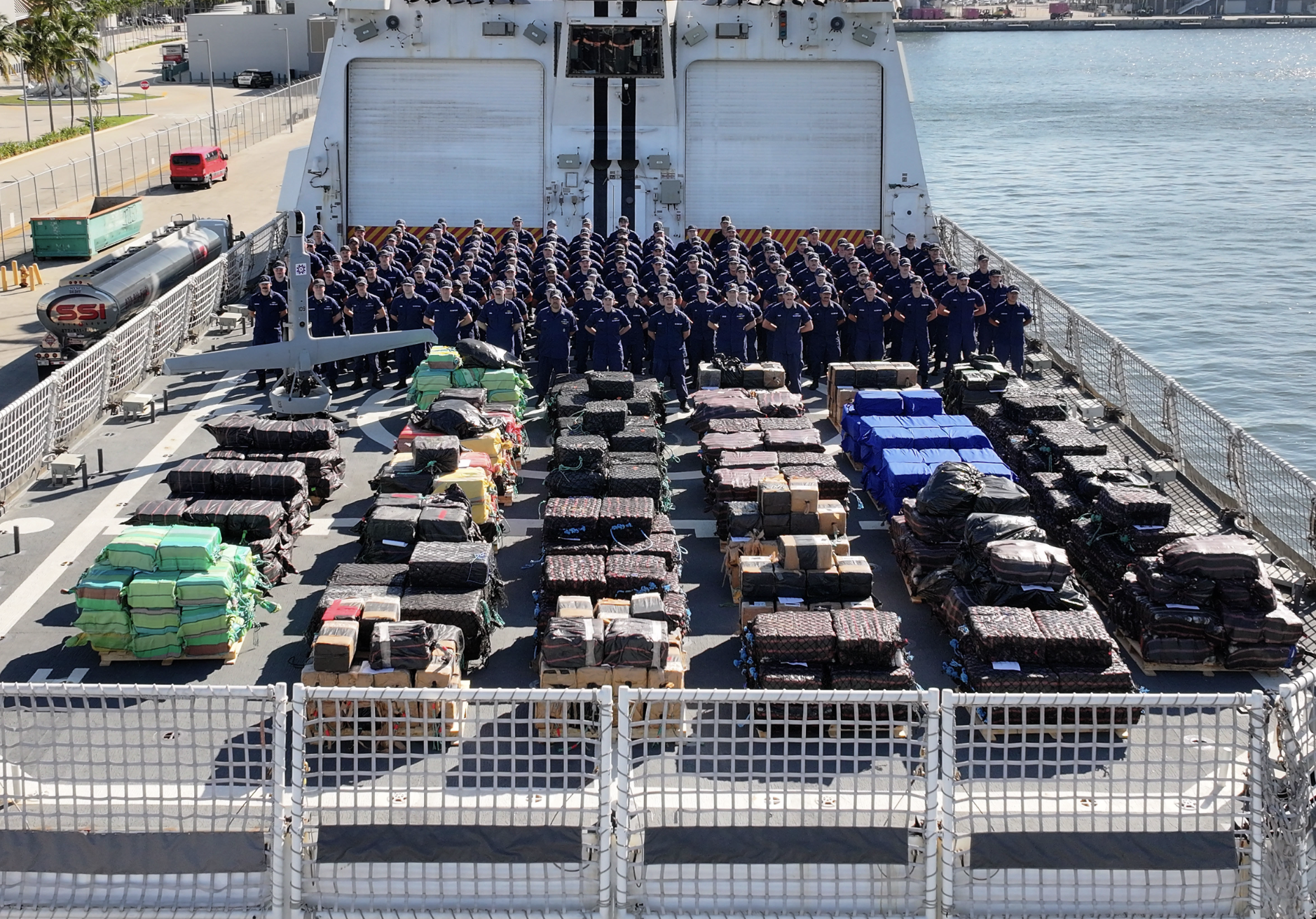
251118-G-G0107-1008
Coast Guard Cutter Stone’s crew poses for a group photo on the flight deck of the ship, Nov. 18, 2025, Port Everglades, Florida. Coast Guard Cutter Stone’s crew offloaded approximately 49,010 pounds of illicit narcotics worth more than $362 million. (U.S. Coast Guard photo by Cutter Stone’s crew) “The cutter took custody of 36 smuggling suspects during the mission, repatriated 29 to Ecuador for prosecution and referred the others to the Justice Department, the Coast Guard said in a statement.”
New York Times reports the Justice Department has in many cases chosen not to be bothered to prosecute the crews of boats seized by the Coast Guard.
“…for the most part, people captured by the Coast Guard in the same smuggling routes the U.S. military is bombing are being repatriated — either directly, before reaching the United States, or through deportation after briefly being questioned near U.S. ports.
“Some people who have been involved in the process caution that the strategy could erode the intelligence gathering operation that tracks the drug smuggling routes. It has helped the Coast Guard, by its own count, interdict 3,588 vessels and seize 3.26 million kilograms, or 7.19 million pounds, of cocaine and lesser amounts of marijuana since 2003.
This has resulted in closing off a source of intelligence that can result from plea bargaining in exchange for a reduction in the ten year mandatory sentence.
“…after Attorney General Pam Bondi directed prosecutors in February to mostly stop bringing charges against low-level offenders in favor of bigger investigations, the once steady stream of federal trafficking cases is drying up.”
Apparently the Coast Guard is still stopping more product than the Navy/Marine task force, and the threat of bombing does not seem to have discouraged others from making the attempt.
“Between Sept. 1 and Nov. 30, when the U.S. military blew up 22 vessels, killing 83 people in the Caribbean and Pacific Ocean, the Coast Guard interdicted 38 vessels suspected of smuggling drugs — three more than it had intercepted during the same period in 2024.”
The crews of the drug smuggling boats do not appear to be career cartel members. They are impoverished and cannot afford a legal defense. They are also not generally violent.
“But in the past five years, the Coast Guard says, there has been just one instance of a smuggling suspect being shot and killed during an interdiction. Lt. Cmdr. Steven Roth, the Coast Guard’s chief of media relations, described that instance as a ramming episode during a boarding operation that put members of the Guard at risk.”
As a result of the change of policy,
“The Coast Guard statement described the process this way: When the Justice Department “declines prosecution, the Coast Guard coordinates either the direct repatriation to the detainee’s country of nationality or transfer ashore to Department of Homeland Security custody for additional investigation and expedited removal.”
On the one hand, the people are deemed “so dangerous and so horrible” that the government has resorted to killing them, the agent said. On the other, capturing them would lead to their deportation because they are considered “so minor.”
A major question that has surfaced as a result of the decision to destroy rather than capture is could any of these boats be innocent?
A letter from the head of the Coast Guard released in December by Senator Rand Paul, Republican of Kentucky, reported that more than one-fifth of suspicious boats that were stopped by Guard forces from Sept. 1, 2024 to Oct. 7 of this year had no drugs.
A portion of that letter is quoted below.
- From September 1, 2024, to October 7, 2025, Coast Guard surface assets, operating under Coast Guard law enforcement authority, interdicted 212 suspected drug-smuggling vessels at sea headed toward the United States. Of the 212 interdictions, 41 vessels had no illicit contraband on board when interdicted: 24 of those 41 vessels without contraband did not appear to commit any federal criminal offense.
- Of the 212 total vessels interdicted during this period, 69 vessels were interdicted in the Caribbean Sea by Coast Guard surface assets, operating under Coast Guard law enforcement authority. Of these 69 interdictions, 14 had no illicit contraband on board when interdicted: 11 of those 14 vessels without contraband did not appear to commit any federal criminal offense. Of the 69 Caribbean interdictions, 14 vessels were interdicted off the coast of Venezuela. Three of the 14 vessels interdicted near Venezuela had no illicit contraband on board when interdicted, but one of the three violated other U.S. federal criminal statutes.
- The Coast Guard did not use lethal force against any of the 212 vessels interdicted at sea during this period. The Coast Guard used non-lethal force to warn and/or disable non-compliant vessels suspected of smuggling on 105 occasions during this period
The report also found no basis for linking the attacks on boats to overdose deaths from Fentanyl.
“Fentanyl, which comes from China, appears in only three years of Caribbean and Eastern Pacific Ocean seizures since 2003, and insignificantly so: about 38 pounds in the fiscal year 2021, 12 pounds the year before and a quarter-pound in 2023.”


No surprises here. The Coast Guard does real law enforcement work and does it well. Not seeking headlines and not trying to impress anyone. Just pure professionalism.
And yet roughly 100,000 Americans continue die every year from illegal (usually smuggled) drugs.
This is not to take away from the heroic men and women of the Coast Guard but it would be hard to say our strategy has been working.
Tactical successes certainly but the big picture has not changed.
Fun fact #1: Fenatyl doesn’t come from or through South America. I’d like to see Chinese ships blown up that carry it, but I don’t think that will happen, do you?
Fun fact #2: Most drugs come up through Mexico. What are the chances of US forces invading Mexico or carrying out substantial military action in areas that we’ve known about for 30 years?
Fun fact #3: OXY and other prescription drugs kill as many as illegal drugs. Where’s the effort and spending to IDENTIFY why Americans are the world’s largest drug market and WHY we are so troubled to have to feel we need to turn to something to sooth, calm, or distract us from those troubles? The market needs to be addressed just as much as the supply to the market.
I point out the need to do something different. Unfortunately, the CGs efforts were not effective in solving the problem just like Border Patrol’s efforts over the last number of years efforts to control the border were not effective despite tactical successes.
This is not to disparage the dedicated men and woman of those organizations, but if the grand strategy is not working, we need to consider alternatives.
There is no solution as long as the demand is there. If we made an effort to frame drug use as anti-social and destructive as we did with smoking, we might actually cut demand.
I mostly agree. The campaign against smoking was pretty successful.
People still smoke but far fewer than in the past.
We also have the ability to impose almost punitive taxes on cigarettes that we don’t on illegal drugs.
I think that helped as well.
A few more fun facts about the fake war on drugs
Many of our drug enforcement officers are now chasing the major threat posed by fruit pickers and yard workers, I think Arizona had something like 1/3 of the drug agents reassigned from drug enforcement leaving parts of the southern border wide open
Many large drug dealers have been pardoned, Silk Road guy and the guy that helped ship 400 TONS of cocaine into the U.S.
And let’s not forget the Mexican drug lord who got I think 17 members of his family good entry papers into the U.S.
Also not much for treating addiction in the U.S. and just sending a person to rehab is expensive and if they don’t want to go very difficult to force them. Most people just want the homeless to not be on their street, then they whine about the crime but won’t pay the taxes to deal with addiction in the homeless.
PS: I have seen where the price of drugs is way down due to an oversupply
A complex problem that will not be solved by a few sound bites
It’s not a complex problem. Demand needs to be reduced.
That’s easily done as the Chinese have shown.
Unfortunately for many in the US drugs are what the “cool” do, just as cigarettes used to be. We need to change that image.
The US spends as much per year on anti-smoking campaigns as it does on subsidising tobacco farmers.
Ironic isn’t it.