
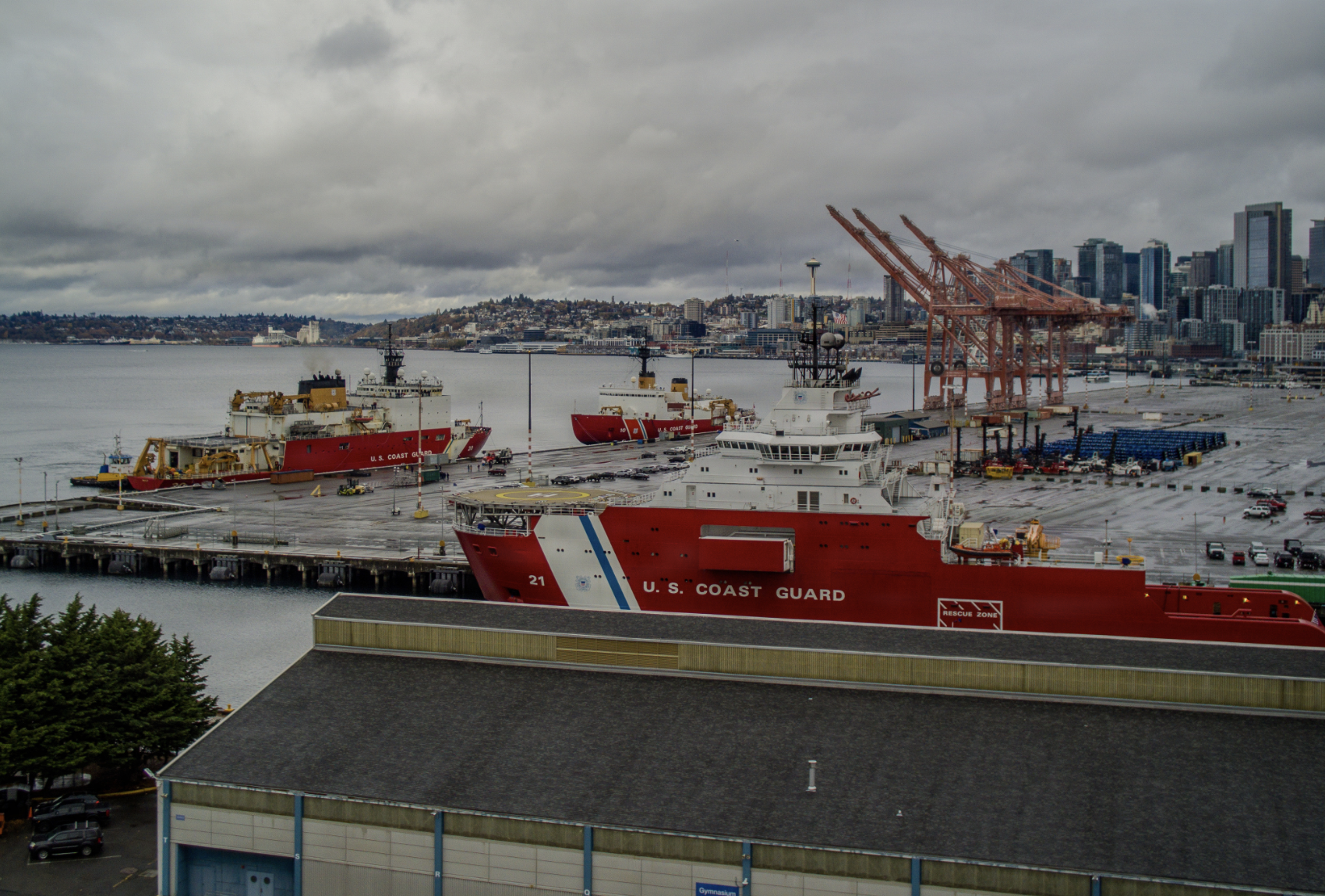
Polar Star, Storis, and Healy. U.S. Coast Guard Cutter Healy (WAGB-20) arrives at Pier 46 on Coast Guard Base Seattle, Oct. 26, 2025. The crew of the Healy transited over 20,000 miles, supporting Operation Arctic West Summer and Operation Frontier Sentinel, protecting U.S. sovereign rights and territory, and promoting national security in the Arctic. (U.S. Coast Guard photo by Lieutenant Christopher Butters)
Below is a post from MyCG.
It is worth noting that our ally, Canada, is also building a new generation of icebreakers in cooperation with the Finns. In fact the Arctic Security Cutters will be built to two designs shared with Canada.
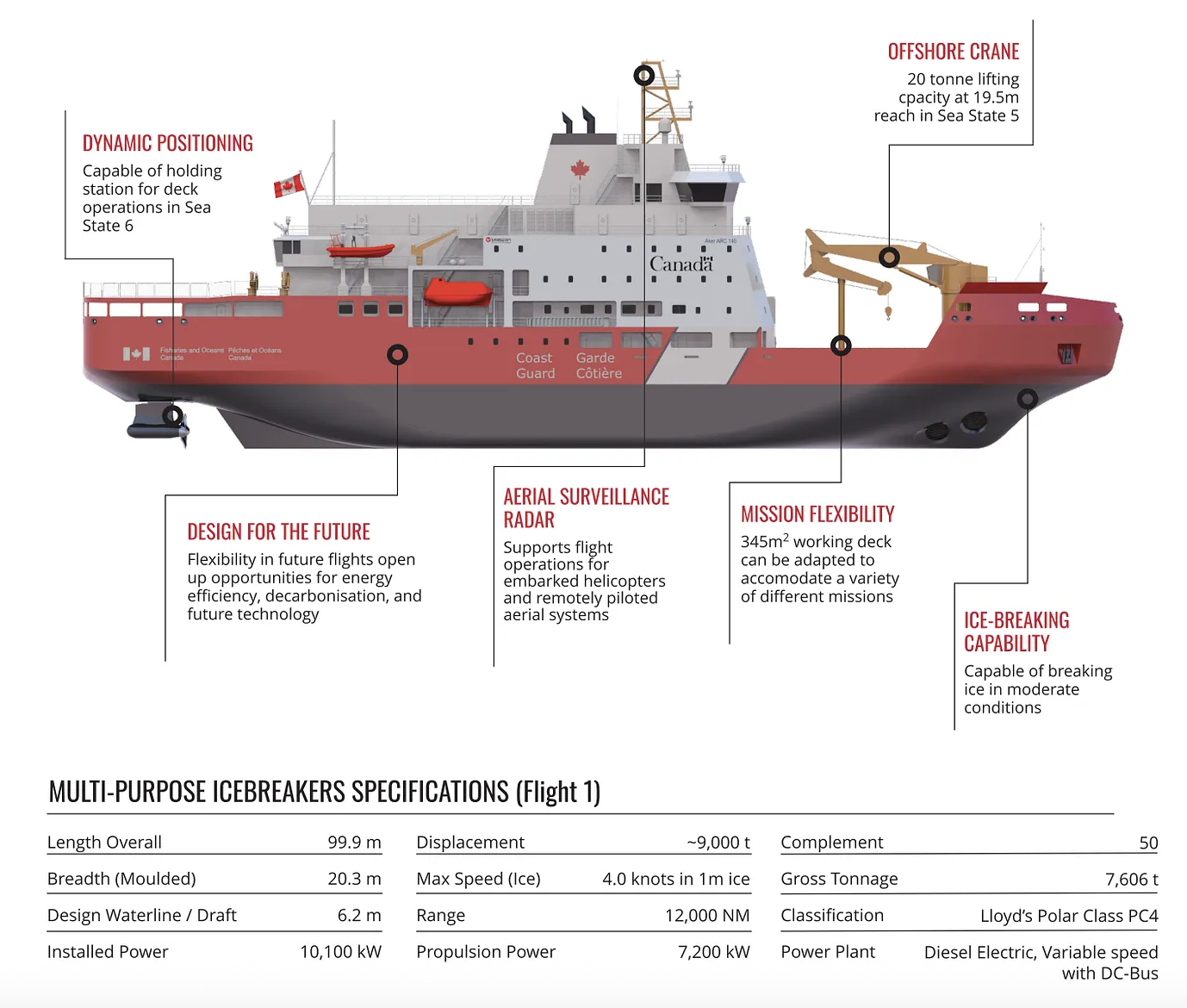
Canadian Coast Guard Multi-Purpose Icebreaker (MPI). Source: Seaspan
Note: The MPI image does not show the right propulsors; it will use Steerprop’s contra-rotating propulsors (CRP). Additionally according to Seaspan, the design could easily be upgraded to PC3. Confirmation from Seaspan and Aker Arctic.
A polar plunge: The Coast Guard bets on the burgeoning Arctic
By Katie Duckett, The Circuit writer
Editor’s note: This article was originally published in The Circuit C5ISC blog. (CAC required)
After decades of watching its polar fleet degrade toward obsolescence, the Coast Guard is now poised for a historic transformation in the world’s coldest waters. The spending bill signed on July 4, 2025 has delivered nearly $9 billion for icebreaker construction to the Coast Guard, the single largest polar investment in service history, setting the stage for what officials are calling a new era of American presence in the Arctic and Antarctic.
The timing couldn’t be more fitting. For years America’s polar ambitions have rested largely on the shoulders of USCGC POLAR STAR (WAGB-10), an icebreaker commissioned in 1976. Now 49 years old and nearly two decades past her designed service life, she remains the only American ship capable of punching through the thick ice surrounding McMurdo Station in Antarctica, a mission she has performed faithfully for 28 consecutive years during Operation Deep Freeze.
Alongside POLAR STAR, USCGC HEALY (WAGB-20) has spent a quarter century conducting Arctic research and patrol, identifying underwater volcanoes and mapping the seafloor while monitoring the increasing presence of Russian and Chinese vessels in polar waters. But electrical fires and mechanical strain have tested this workhorse; in December 2024, USCGC STORIS (WMEC-38) became the first polar icebreaker added to the fleet in 25 years, offering immediate relief. Commissioned in Juneau last August, she completed a 112-day inaugural Arctic patrol that fall, shadowing five Chinese research vessels operating in American waters. The purchase served as a bridge strategy, buying time until heavier reinforcements would arrive.
Announced this May, the Coast Guard’s Force Design 2028 initiative has designated polar capability a cornerstone of service transformation. FD28 explicitly calls for delivering “icebreakers needed to provide assured U.S. access and presence to the polar regions” while streamlining acquisitions to accelerate timelines that have historically lagged.
The Coast Guard’s vision for polar operations is now bankrolled at historic scale. This year’s spending bill allocates $4.3 billion for three Polar Security Cutters, massive 460-foot heavy icebreakers capable of smashing through ice 21 feet thick. The first of these, USCGC POLAR SENTINEL (WMSP-21), is expected to enter service around 2030. Another $3.5 billion will fund the Arctic Security Cutter program, which received a dramatic boost in October 2025 when the President signed an agreement with Finland to deliver 11 medium icebreakers, with the first five set to arrive by 2028. When combined with the additional light icebreaker funding included in the bill, the legislation enables construction of 17 new vessels in total, a number that would have seemed unthinkable just five years ago.
The urgency of Arctic operations extends beyond aging hulls. Russia currently operates more than 40 icebreakers, continuing to militarize its Arctic coastline. China, despite possessing no Arctic territory, has declared itself a “near-Arctic state” and deployed its own coast guard vessels alongside Russian patrols near Alaska. And a changing climate is unlocking shipping lanes and resources that will demand American presence and enforcement.
After decades of deferred maintenance and delayed procurement, the Coast Guard’s polar plans are finally scaled to the challenge. This frozen frontier, once patrolled by a single aging ship, will soon host a fleet befitting American strategic interests at both poles.
 Chuck Hill's CG Blog
Thanks Chuck
Ellen
“Canada, Finland, U.S. strengthen icebreaker alliance”
https://thewatch-journal.com/2026/01/05/canada-finland-u-s-strengthen-icebreaker-alliance/