
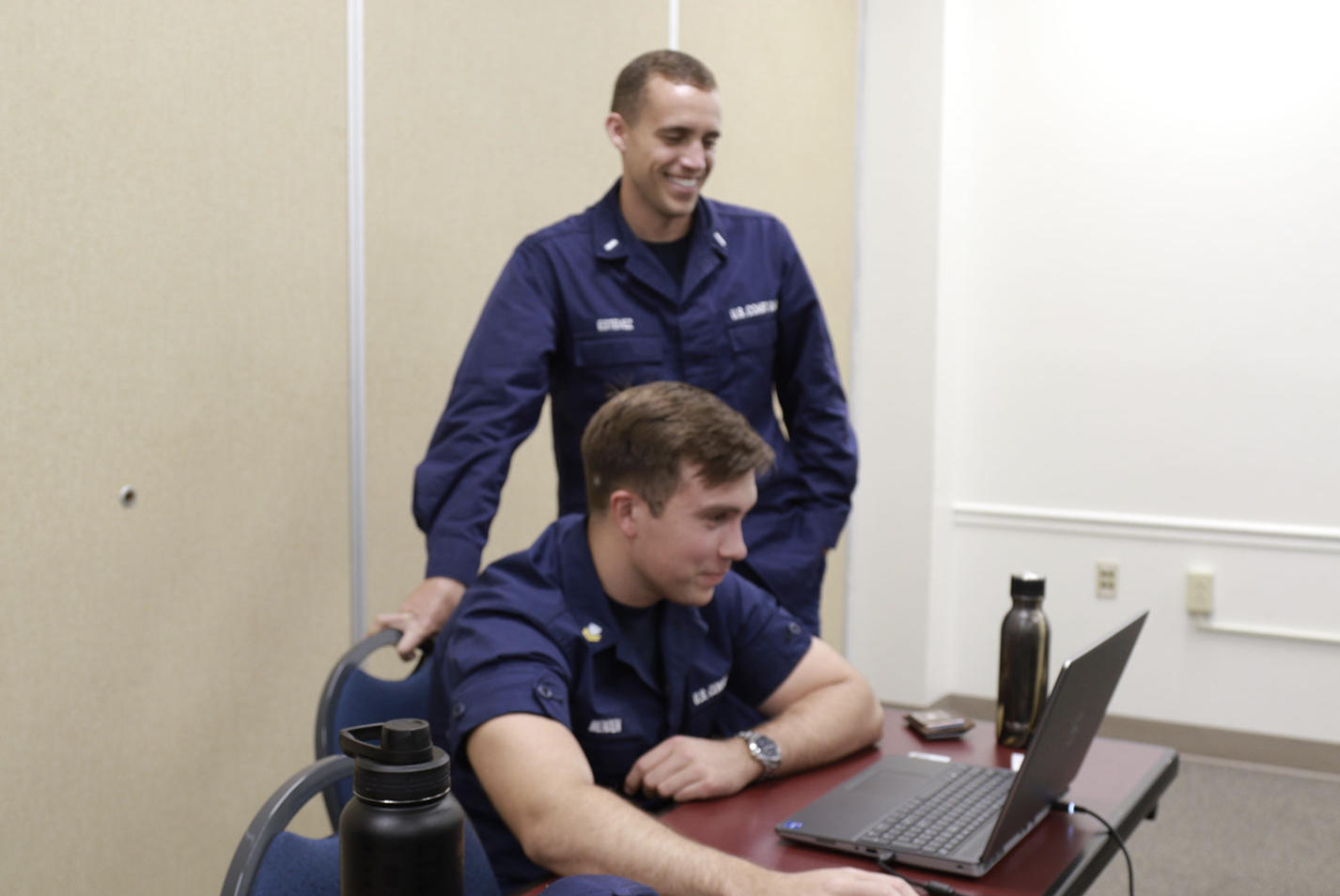
Army National Guardsmen and Coast Guardsmen participate in a 2022 U.S. Cyber Command drill in Arkansas. With historic funding, the Coast Guard has an opportunity to bolster its cybersecurity mission. U.S. ARMY NATIONAL GUARD
The NORTHCOM on line magazine, “The Watch” reports,
“The United States Coast Guard has a rare opportunity to make wholesale upgrades to its cybersecurity defenses, a fellow at the Center for Strategic and International Studies (CSIS) proposed in an October 2025 opinion article for the nonprofit think tank in Washington, D.C. Joel Coito, a CSIS defense fellow and U.S. Coast Guard commander, said the window of opportunity has been boosted by $25 billion in congressional funding, the result of rare political consensus among federal lawmakers on the importance of cybersecurity at the nation’s ports and maritime approaches. That consensus should be seized by policymakers to strengthen cyber defenses through bolstering the Coast Guard’s cybersecurity, Coito wrote.”
The post does not provide a link to the CSIS report it quotes but I believe this is it.
The U.S. Coast Guard and the Future of Maritime Cybersecurity
There is a lot of good information on the state of Coast Guard Cyber and the future path it might take including career opportunities.
“Regulatory, legislative, and policy developments have provided the U.S. Coast Guard (USCG) with new cybersecurity tools and expanded authorities to secure the marine transportation system (MTS) from cyber threats. At the same time, budgetary headwinds that historically plagued the service have shifted. With nearly $25 billion of funding in the One Big Beautiful Bill Act, the USCG finds itself in the favorable—if unfamiliar—position of having resource winds at its back. The result? A chance for generational change in safeguarding the maritime cyber domain and bolstering the USCG cyber workforce. This commentary prescribes a path to capitalize on these legislative, policy, and funding wins: confirmation of key USCG senior leaders, enhanced cyber talent management, passage of pending USCG cyber legislation, broader interagency integration of USCG cyber capabilities, and rapid integration of private sector tools.”
 Chuck Hill's CG Blog
The USCG’s new Deepwater Program equipment is very capable, but their combat system upgrades have not been demonstrated for mobilization.
The Deepwater Program replaced twelve Hamilton Class High Endurance Cutters with eight (8) National Security Cutters in the face of dramatically increasing tasking that had grown GLOBALLY. Congress recognized the deficiency and tried to fix that malady, but the USCG in its infinite wisdom now has truncated that NSC buy to ten (10) units. That was a mistake IMHO.
The OPCs cannot come on line fast enough and twenty five will probably be enough, but once again . . . the combat system upgrade for Navy support has not been demonstrated.
The Icebreaker problem seems to be well in hand with all the new costruction, but we are short of units presently with all the emphasis on the Arctic Region.
I do sincerely hope that the USCG does not squander this opertunity to increase/upgrade/improve/expand infrastructure. This service uses what they have more efficiently than any other serve save the USMC. They slhould be funded fully.
Just my 2ȼ.
TORCH OUT
We should never forget that the concept of Deepwater included the “crew rotation concept” which would have meant there would have been four crews for three ships and they would rotate which should have meant the 8 NSC would have provided almost as many shipways as 12 WWHECs and the 25 OPCs would have provided more ship-days than the 32 WMECs.
When the crew rotation concept was thrown out, no one increased the number of OPCs to compensate. To get the same number of ship days we need 44 ships.
Honestly the larger number of FRCs has helped somewhat but the demand for cutter days has really increased. If we get eleven Arctic Security Cutters it will help–particularly in Alaska.
I am not a big suporter of crew rotations. It works for submariners, but that group is not a standard, normal, group of mankind. Not every human being can be a submariner, but we have planners wanting to use them as such.
For technicians there is a function of ownership of your equipment. This enabled American crews to fight above their weight in two wars with substandard equipment from time to time, and why that function is ignored/denied is beyond me. I guess these planners never raced their muscle car as teenagers. Gearhead/farmer mindset/determination have driven American success in combat from shipboard in WWI to the Pacific in WWII. Ignore HiStory and Human Nature at your own peril.
Concerning USCG platforms . . . NAVSEA made every new Icebreaker a Command Ship. That has to be protected, and thy are not as well armed as LCC-19/20. THAT requires attention. There should at least be spaces for the MARDET to protect the Command Center.
@Torch, I think the crew rotation concept was dumped because they did recognize the need for the crew to have that feeling of ownership. But other than two extra NSCs there was no other action to give us the cutter days required.
Fortunately the FRCs proved able to do some WMEC work, but looks like demand is outpacing building particularly in the Pacific.
AMEN on the FRCs. They are going all over the Pacific except perhaps the Arctic.
I would like to see what the Ukrainians would do with an FRC for operations on the Black Sea. It probably would be a real missile boat.
Concerning ‘Ice Hardened Hulls’ and other Arctic considerations: https://blackout-news.de/en/news/german-navys-greenland-mission-germanys-navy-falters-due-to-ice-and-equipment/
@Torch, the same might be said about the US Navy, they have no ice capable ships. No one expects the German Navy to operate around Greenland but they do operate regularly in the Baltic.
The Coast Guard has regularly conducted exercises with the Danish, French, and Canadian Navy around Greenland using medium endurance cutters with no special ice strengthening.
Atlantic Fleet has been exercising in the high north near Norway, but Pacific Fleet seems to be hesitant to operate surface ships much north of the Aleutians. That may be because they don’t expect to operate surface ships any further North. That may be a reasonable assumption.
“That may be a reasonable assumption.” Without ‘Ice-Hardened” hulls that is correct. We used to build ships for such things, and the Russians still do. Arctic service is clearly a skillset that requires the right tools. We should provide them. Just operating away from ice is not good enough…IMHO.
We need cutter X now more than ever.
AMEN!
Like to recommend this which I think has a lot of bearing on Cyber.
https://wavellroom.com/2026/01/21/the-future-of-war-when-states-no-longer-own-the-means-of-war/