
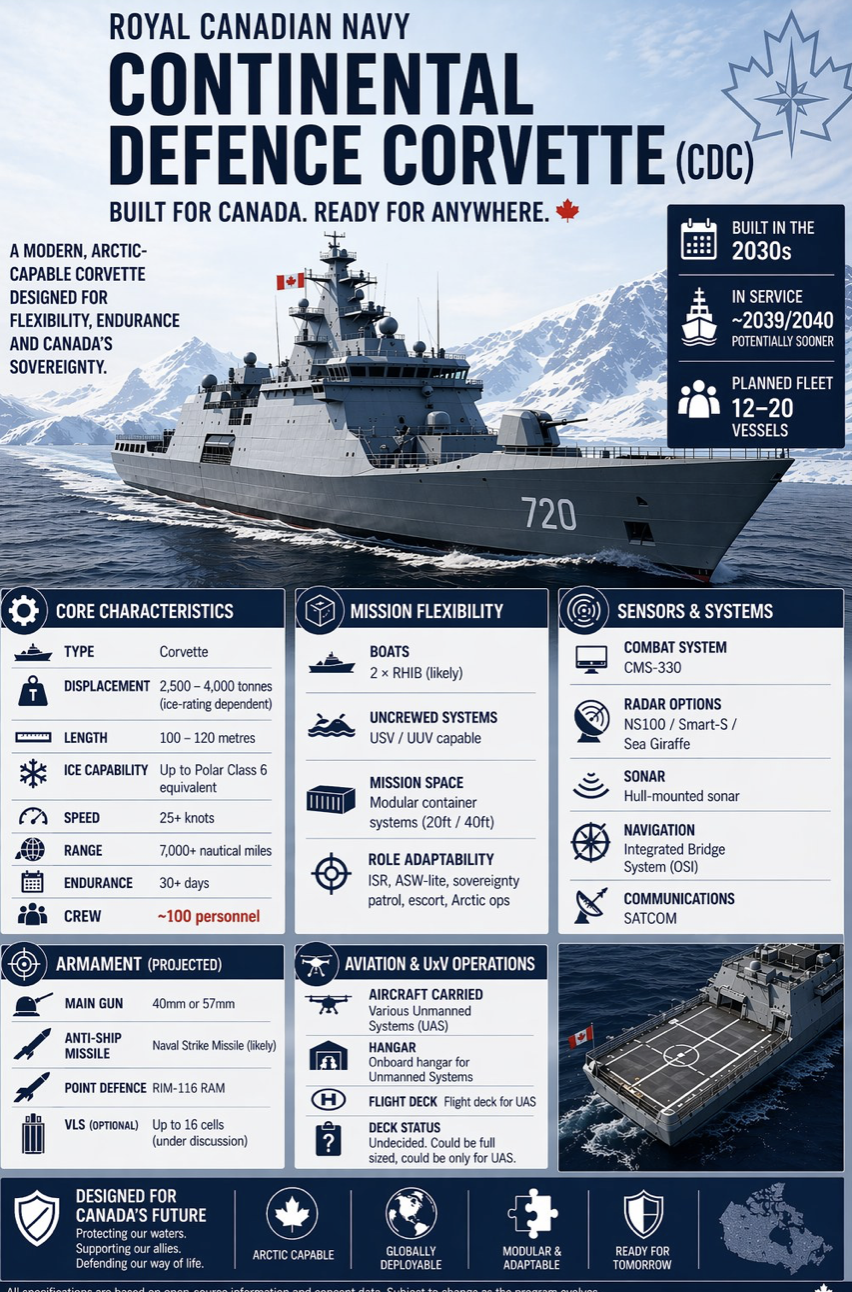
We talked about this project with a post May 31, 2023. As you can see reading the flyer above, these ships are still a long way from being finished, but I think Canada may be recognizing a need to speed things up. They have more than adequate shipbuilding capacity.
I think they are interesting ships with a design that might be useful as a Coast Guard cutter capable of operating in ice with a WMEC sized crew.

190729-N-AD499-1166 SEATTLE (July 29, 2019) The Royal Canadian Navy Kingston-class coastal defence vessel HMCS Edmonton (MM 703) participates in a parade of ships in Elliott Bay during the 70th annual Seattle Fleet Week. Seattle Fleet Week 2019 is a time-honored celebration of the sea services and provides an opportunity for the citizens of Washington to meet Sailors and Coast Guardsmen, as well as witness firsthand the latest capabilities of today’s maritime services. (U.S. Navy photo by Mass Communication Specialist 3rd Class Victoria Foley/Released)
Canadian Coast Guard cutters are not armed and they do not have large patrol ships. The Canadian Navy fills this role. These ships are to replace the 12 Kingston class Coastal Defence Vessels (Brits and Canadians spell defense with a c). We routinely saw Kingston class doing drug enforcement in the Caribbean. Eight of the class have already been decommissioned. To some extent these were replaced by the five ships of the Harry DeWolf class.

HMCS Margaret Brooke is finishing warm weather trials on the ships cooling systems. HMCS Harry DeWolf is finishing a Op Caribbe with the USCG.
The Kingston class are smaller and less capable than the WMEC 210. The Vigilance class began as a replacement but have grown into something that promises Halifax class like capabilities.
Manning Requirements:
The Canadian Navy is much smaller than the US Coast Guard and is having a much more serious recruitment problem.
Officially, the RCN consisted of 7,700 Regular Force and 4,100 Primary Reserve sailors, supported by 3,800 civilians.
The “effective strength” of the RCN is somewhat lower than official numbers would suggest due to serious personnel shortages. In late 2023, the commander of the RCN, Vice-Admiral Angus Topshee, reported that only 6,226 naval personnel could be considered part of the “effective strength” of the RCN, making numerous ships in the RCN inactive due to both crew shortages and broader operational readiness issues. In late 2025, Vice-Admiral Topshee stated that the Navy’s personnel problem had not been solved and remained dire, while the Auditor General of Canada reported deeper systemic problems with Canadian military recruitment. In early 2026, Rear Admiral David Patchell, the commander of Canadian naval forces in the Pacific, reported that the navy was short about 2,000 personnel, or about one-quarter of its authorized strength in early 2024 it was reported that 54 percent of the navy’s frigates, submarines, arctic and offshore patrol ships, and maritime coastal defence vessels were considered “unserviceable”
Canada probably does not want to build ships it may not be able to man.
Canada’s most numerous surface combatants are the 12 ships of the Halifax class each of which has a crew of 225 or 2700 total equalling 35% of the “Regular Force.” These ships are now 30 to 34 years old so they must be replaced.
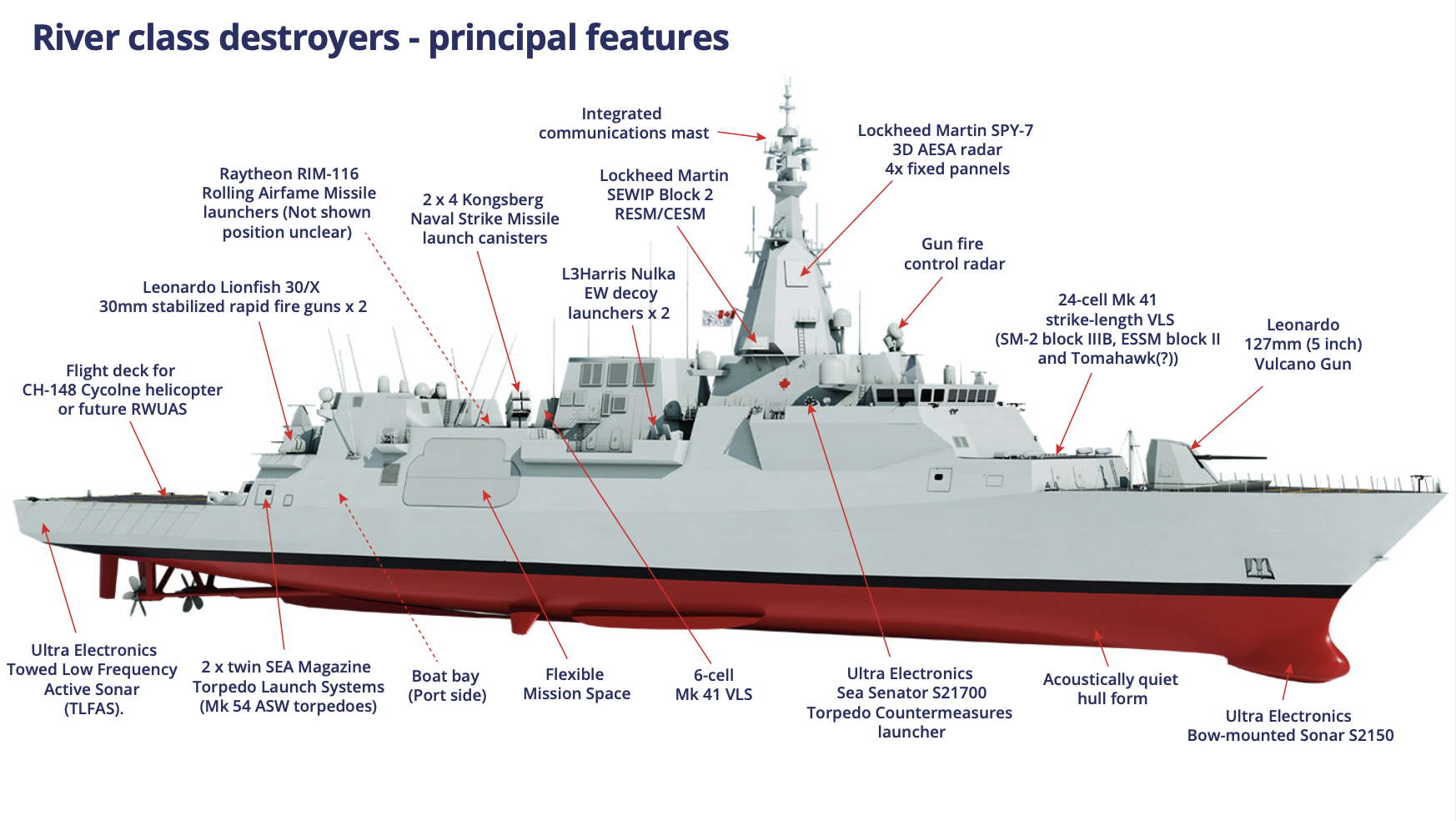
A guide to the future Canadian Surface Combatant – the River-class destroyers https://www.navylookout.com/a-guide-to-the-future-canadian-surface-combatant-the-river-class-destroyers/
Canada plans to replace the Halifax class and the four already decommissioned Iroquois Class Destroyers (which had a crew of 280 each) with up to 15 River class but that would require a total complement of 3,150. The River Class are about twice the size of the Halifax class. Three were ordered 3 March 2025, but none are expected to be completed until 2030.
The River Class is the Canadian version of the Royal Navy’s type 26 frigate, a design also being used by Australia and most recently Norway. The Royal Navy had originally intended to build 13 but that has been cut to eight.
Australia had planned to build nine but that has been cut to six. They now planned to build a class of “tier 2” frigates, improved Japanese designed Mogami class.
I would not be surprised to see Canada cut the number as well, in fact I would be surprised if the did in fact build 15 since that would require a total complement for the totaling 3150 billets.
A Fleet with the Same Manpower:
Canada is replacing a fleet that in 2000 included 28 patrol or escort ships, four Iroquois class, twelve Halifax class, and twelve Kingston class. That required manning to 4264 billets:
- Iroquois class: 4 ships, 280 billets each: 1120 total
- Halifax class: 12 ships, 225 billets each: 2700 total
- Kingston class: 12 ships, 37 billets each: 444 total
As of now the Canadian Navy includes 21 patrol or escort ships, twelve Halifax class, five Harry DeWolf arctic offshore patrol ships, and four Kingston class. That fleet requires 3173 billets:
- Halifax class: 12 ships, 225 billets each: 2700 total
- Harry DeWolf class: five ships, 65 billets each: 325 total
- Kingston class: four ships, 37 billets each: 148 total
How could they provide 28 ships with no essentially no more billets than they have right now? The new fleet could include:
- River Class: 5 ships, 210 billets each: 1050 total
- Vigilance Class: 18 ships, 100 billets each: 1800 total
- Harry DeWolf Class: five ships, 65 billets each: 325 total
- Grand Total 3175 billets.
This would provide a total of 23 combatants with up to 408 VLS. Of course this will stretch over many years and if recruitment improves and the Royal Canadian Navy increases in size, it would be possible to replace some of the Vigilance class with additional River class.
Alternatives:
I was surprised that the Canadians would build a combatant with a potential ASW mission that could not hangar a helicopter. Maybe they should look at the Finnish Pohjanmaa class, which has an even smaller complement.
 Chuck Hill's CG Blog
I hope Canada remains on its path of naval improvement.