
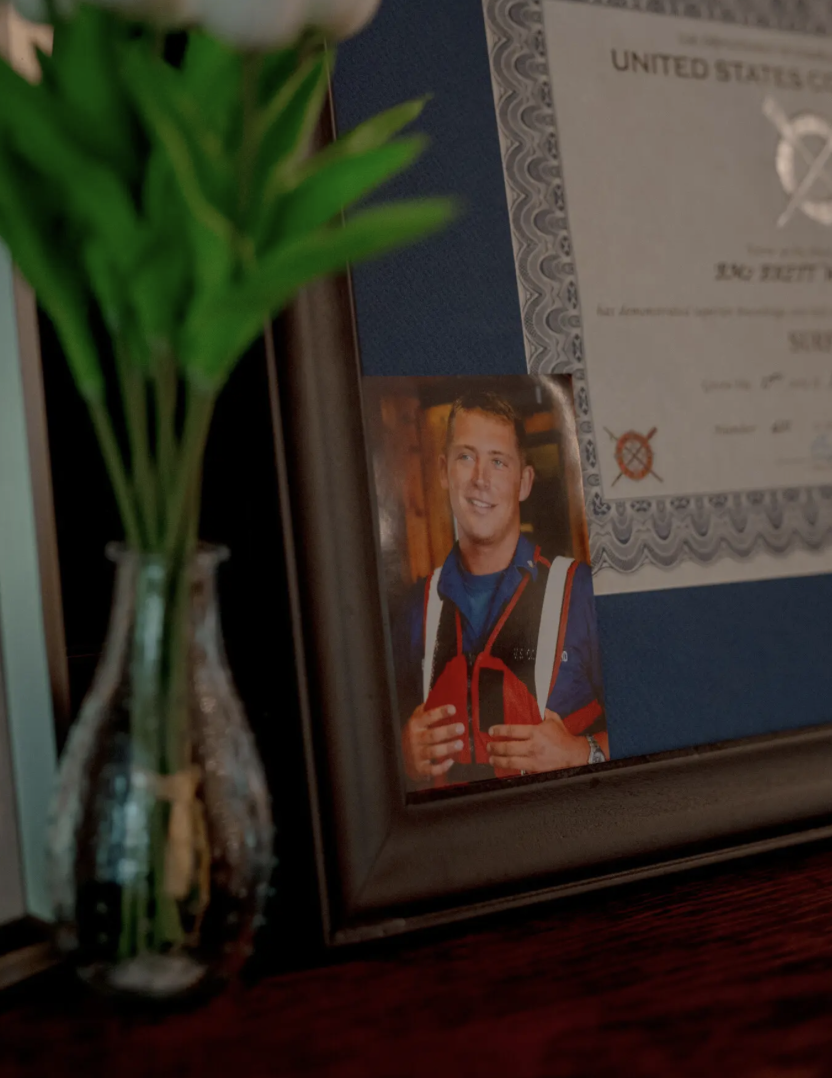
Brett Bonner served in the U.S. Coast Guard for 21 years.Credit…Mike Belleme for The New York Times
There is not a lot in this story, just a report of one man who retired with 21 years service in 2022 and committed suicide in 2025 after exhibiting irrational behavior.
I think we all recognize that being a surfman is hard on the body, maybe it is hard on the brain as well. Hope we are tracking this question.
Thanks to Pat for bringing this to my attention.


https://www.nytimes.com/2026/07/31/us/31nat-coast-guard-brain-injury-boat-waves-surfmen.html
“Coast Guard Vows to Protect Crews from Brain Injuries Caused by Rough Seas”
Got this as an email but somehow missed it. So better late than never, I am just passing this along.
inda.renn@gmail.com
To: chuckhhill@aol.com
Jul 31, 2026 at 6:15 AM
Hello Chuck,
My name is Linda Renn, and I’ve worked in healthcare for over 55 years now. As a young girl, I grew up in and around my local fire station, as my Dad was a firefighter and a scoop-and-run ambulance crew.
As a young lady, I graduated from college and went on to work in healthcare, where I have been ever since.
A few years back, while attending my national professional association’s annual convention in Baltimore, Maryland, I heard Dr. Bennet Omalu speak. He was one of our keynote speakers that year.
One thing I took away from his presentation. An association, organization, and/or professional group needs to organize and appoint its own task force to study this health concern for active/retired and/or suicide and/or homicide and/or PTSD and/or behavioral issues within Coast Guard ranks having served in these active, forward duty capacities.
Consider these options as opportunities to build a Coast Guard Trauma Registry to track the following:
I can help if you need me. Should you have any questions, let me know.
Thank you for your service and best wishes always.
— Sincerely,Linda Renn, RHIT,
ATC-HSA, CHPS, CCS, CPC, COC, CRC, CHTS – TRHealth Information Management Leader and Consultant
AHIMA Certified in Healthcare Privacy and Security (CHPS®)
AHIMA Approved ICD-10-CM/PCS TrainerAHIMA Certified Healthcare Technology Specialist TrainerFHIMA Education CommitteeOffice / Fax: (352) 787-9590Email: linda.renn@gmail.com
Coast Guard Commandant Lunday Warns of TBI Risk From High-Speed Craft
https://www.military.com/coast-guard-commandant-lunday-warns-tbi-risk-from-high-speed-craft?lid=oswyvvxk2n9h&utm_source=MLT-nl_coast-guard_ad_2026-10-14_sponsored_margin-fix&utm_medium=newsletter&utm_campaign=MLT-202610141900&user=Y2h1Y2toaGlsbEBhb2wuY29tOm1sdA