
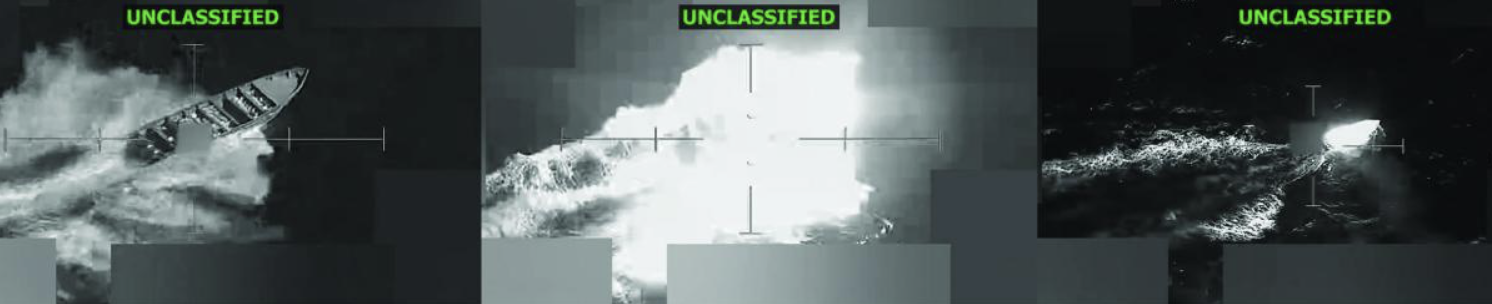
Still frames from footage of a November 2025 lethal strike on a vessel in the eastern Pacific Ocean as part of Operation Southern Spear. U.S. Southern Command
There is an unusual article in the new US Naval Institute Proceedings that suggests that the lethal strikes against suspected drug smuggling boats may be doing psychological harm to those involved. The author compares recent events in the Caribbean with what appears to have been a simpler case of seizure of a Cuban fishing boat during the Spanish American War which may have lead to at least one suicide and perhaps others, as related in a USNI Naval History, June 2026 article, “The Capture of the Paquete Habana,” by Charles Robbins.
Reading Robbins’ account in the spring of 2026, it is impossible not to see parallels to what is being asked of U.S. pilots and weapons officers right now. Since September 2025, under Operation Southern Spear, U.S. military forces have conducted lethal strikes on small boats in the international waters of the Caribbean and eastern Pacific. As of June 2026, these strikes have killed at least 200 people in more than 60 separate engagements. The legal framework rests on domestic counterterrorism designations rather than prize law, but the structural question is the same one Justice Horace Gray confronted in 1900: Can the executive branch use military force against small, civilian-type vessels in international waters while bypassing judicial review and the customary norms of the law of nations? Gray’s answer—that it could not—rested on five centuries of international law.
Gray’s answer rested on a principle that still stands, “International law is part of our law, and must be ascertained and administered by the courts of justice . . .”
 Chuck Hill's CG Blog
Another article on the Caribbean strikes
Subject: Classified documents reveal Trump Pentagon committed ‘murder’: senator –
Alternet.org Date: 2026-08-03 14:09
https://www.alternet.org/amp/boat-strike-2677650240 —
This is the kind of hyper-partisan garbage that led to me terminating my relationship with USNI. The use of force against noncompliant vessels has a very long history, and the practical impossibility of cruiser rules for submarines and especially aircraft was very thoroughly established in the first half of the 20th century. This is a thoroughly settled area of international law.
If you want to talk about moral injury, you should be looking at the people trying to convince servicemembers to disobey lawful orders. Disagreeing with the President’s policy is a civilians’ right, but joining the service means signing that discretion away. Because this piece is in a professional military publication, it is clearly intended to politicize the military and encourage disobedience or even a coup as I explained in this article from just before the 2020 election.
http://cimsec.org/in-divided-times-the-military-must-maintain-neutrality/46294
While I think that most embrace counter-narcotics efforts, the USCG is the appropriate vehicle for that. If you don’t think they’re doing enough, then give them the resources to do more: detect, interdict, arrest and convict those who are bringing illegal drugs to the country. Of course, should such vessels fire on a US ship, boat or aircraft, they have the rights to defend themselves up to the proportionality of the event.
Just my 25 cents. Inflation you know.
My feeling is that you only kill people when you have to. In most of these lethal strikes, it looks like it would have been possible to intercept the boat, board, inspect, and arrest.
The Coast Guard with help from land based air, continued to do that and I think they probably stopped more product than the much more expensive Navy task force.
The claim that they were stopping fentanyl does not seem to be supported by the facts.