
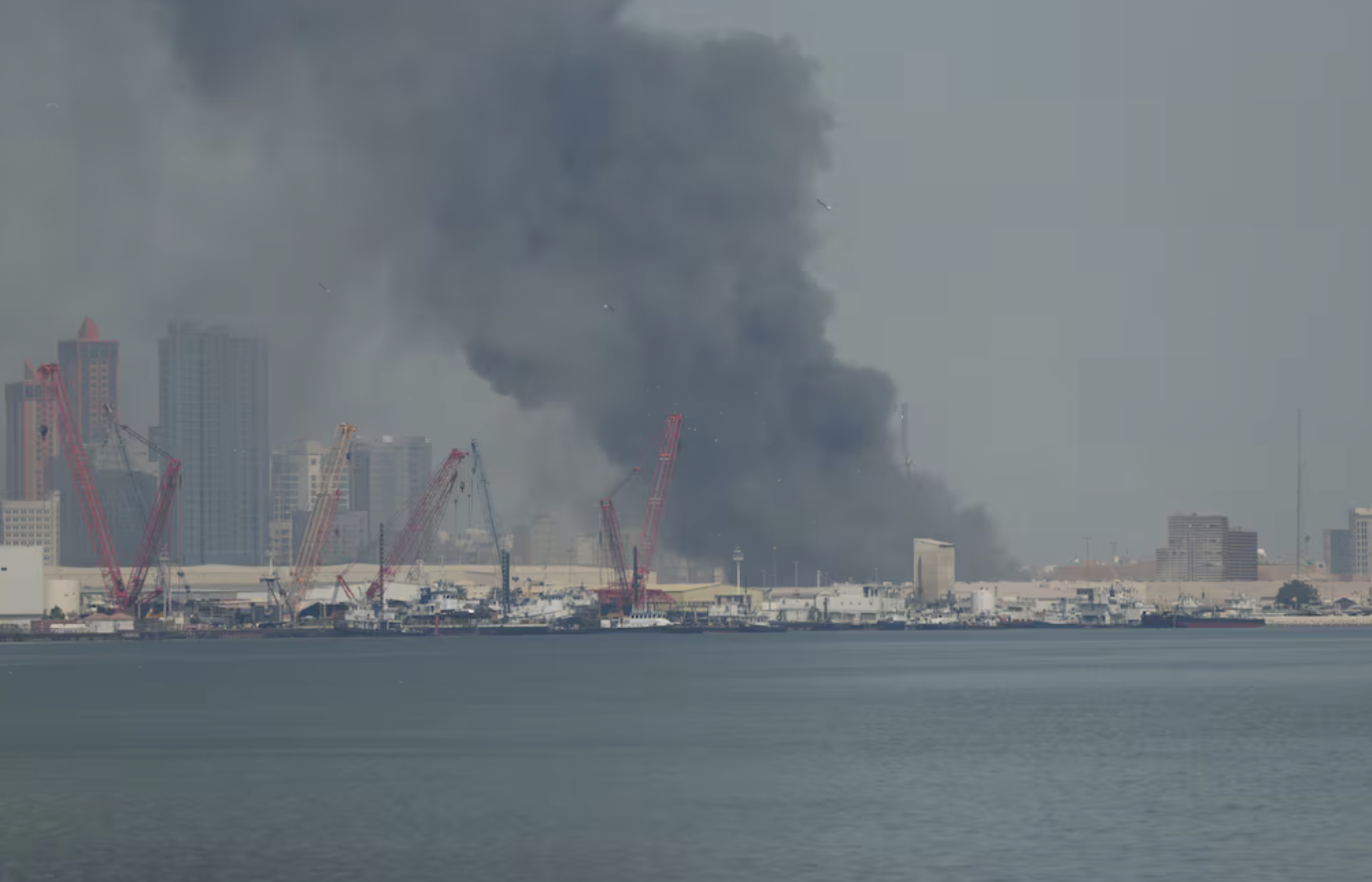
Smoke rises after Iran carried out a missile strike on the main headquarters of the U.S. Navy’s 5th Fleet in Manama, Bahrain. (Anadolu via Getty Images)
“”The more we learn about the attacks on the U.S. Naval Support Activity (NSA) in Manama, Bahrain, during the opening days of Operation Epic Fury, the clearer it becomes why the news of its near destruction was not initially reported or acknowledged.
“Extensive damage to one of our most significant forward bases in the Middle East is likely to have profound tactical and strategic repercussions that are only now coming into focus.”
What did we loose when the six patrol boats left 5th Fleet and the squadron became “expeditionary?”
PATFORSWA was the largest Coast Guard unit outside the US. It included a training facility to train boarding parties and the patrol craft made a number of seizures including drugs (here and here) and arms being smuggling to Yemen (here and here). The cutters could be maintained in their homeport.
PATFORSWA had a long term continuing relationship with 5th fleet including Unmanned system experiments over many years.
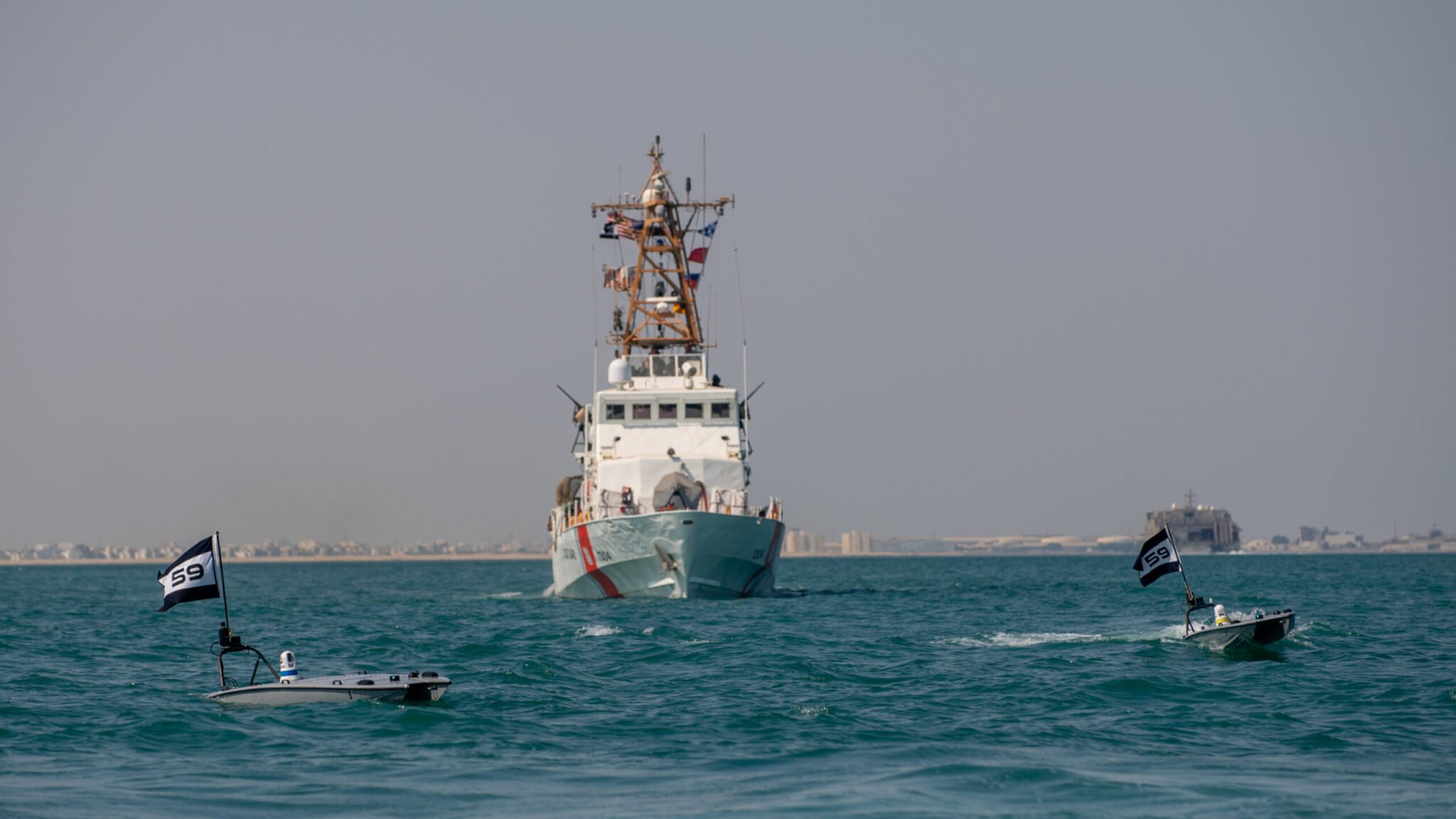
Two MANTAS T-12 unmanned surface vessels operate alongside a U.S. Coast Guard patrol boat during exercise New Horizon in the Arabian Gulf. (U.S. Navy photo by Mass Communication Specialist 2nd Class Dawson Roth)


The more I learn, the more I go ‘we should never have had a base there to begin with’. To me, this is illustrative of why the USN shouldn’t buy diesel submarines. You’d have to base them at a facility in the potential conflict zone, and that is clearly not a great idea.
The future is going to be, expeditionary. A light footprint. Depending how and where future attacks occur will depend how extensive. Imagine a new way of war even in CONUS.
War is changing. Weapons are longer ranged smarter and in some cases can be produced relatively cheaply.
The proliferation of cheap drones, ballistic missiles and cruise missiles have changed warfare.
We see it in Ukraine and we see it in the Gulf.
The US Navy made air-defense a priority for many decades and that shows in this conflict.
The US Army didn’t and that also shows in this conflict.
The Navy needs to learn how to do air defense more cost effectively.
The Army has to relearn how to do it.
The entire US Miltary machine has to adjust to a world in which total air dominance cannot be taken for granted.
I would just add that the Coast Guard needs to be able to do basic air defense as well and the .50 caliber is not adequate and never has been.
For defense against ballistic and hypersonic threats we will have to rely on others providing area defense but for the sneaky cheap low and slow threats, the counters need to be organic and they are already available in the form of the remote weapon systems being used in new Marine and Army short range air defense systems.
We need to pick a system. Make it Coast Guard standard, and put it on every cutter.
These systems would also increase our effectiveness against surface targets.
Questionable area is, do we want to be able to have an organic defense against supersonic threats?
The Navy has chosen a littoral anti-drone solution.
https://www.navalnews.com/naval-news/2026/09/us-navy-l3harris-vampire-counter-drone/
The Navy chose the Vampire C-UAS system as it’s standard littoral C-UAS system.
With the Navy chosing Vampire, maybe the Coast Guard will get on board.
Cost per shot is cheaper than even Stringer and it has been successfully used in Ukraine.
With both the Army and Navy using Vampire, development and support should be there.
https://www.navalnews.com/naval-news/2026/09/us-navy-l3harris-vampire-counter-drone/