
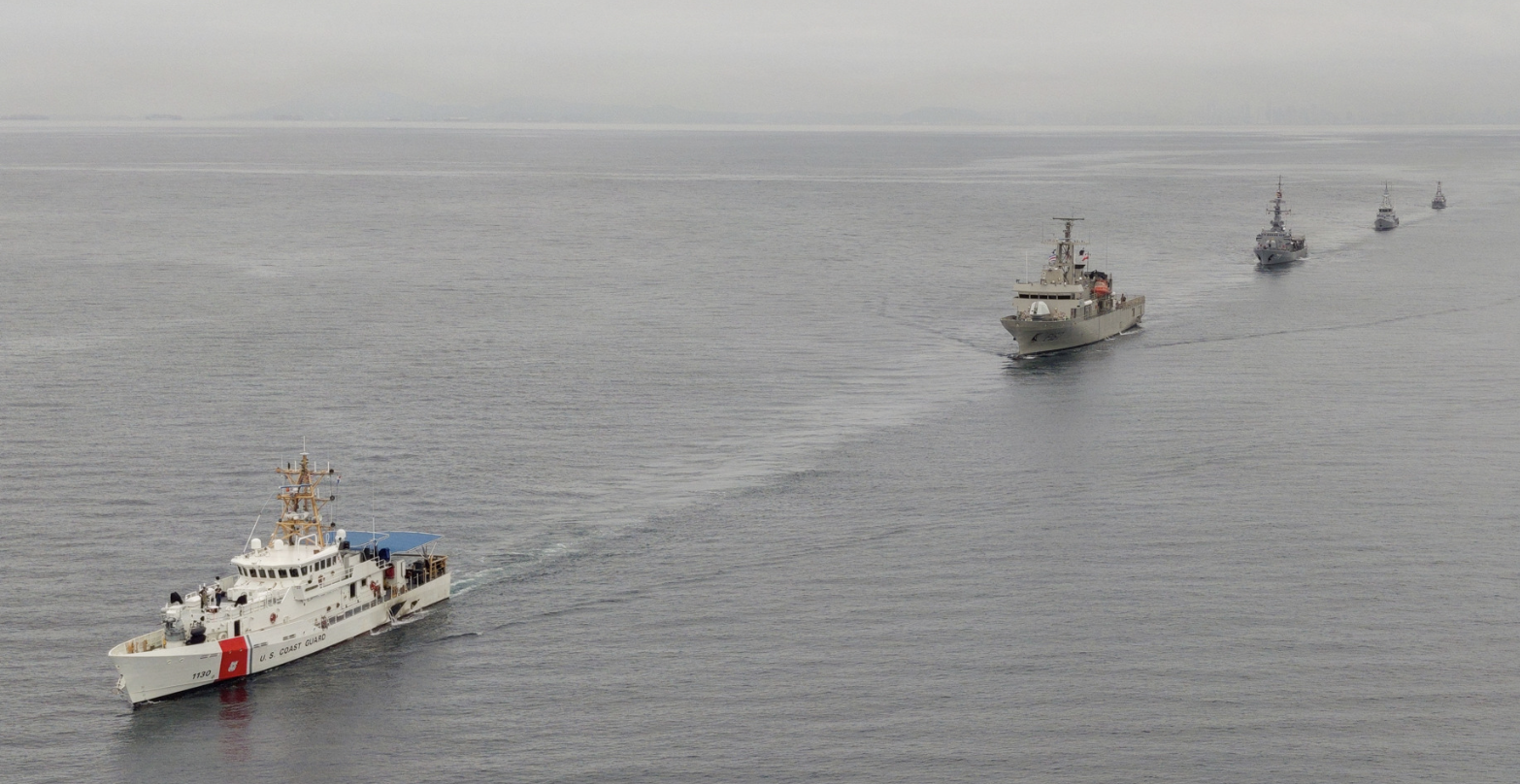
U.S. Coast Guard and partner nations conduct a formation sail during PANAMAX 2026
From left to right, U.S. Coast Guard fast response cutter USCGC Robert Ward (WPC 1130), Mexican navy ARM Jalisco, Ecuadorian navy BAE Loja, Colombian navy coastal patrol vessel ARC Isla Gorgona, and the Panamanian National Aeronaval Service Panquiaco (P-301) perform a formation sailing exercise in the Pacific Ocean near Panama, during PANAMAX 2026, Aug. 6, 2026. PANAMAX 2026 scenarios help the defense and public security forces of participating nations improve interoperability, hone their skills during scenarios involving coalition and all-domain operations, forge strong cooperative partnerships, and demonstrate their collective capacity to respond to and deter threats to the region and its critical waterways. (U.S. Coast Guard photo by Petty Officer 3rd Class William Kirk)
Below is a District SW news release.
This is another example of a Pacific Area Webber class WPC that has gone far from home (more than 3000 nautical miles in this case) and stayed away about two months. USCGC Robert Ward also participated in the PANAMAX 2026 exercise in early August (here and here). It will probably be at least ten days before she returns home.
Sept. 12, 2026
ALAMEDA, Calif. — The U.S. Coast Guard Sentinel-class cutter Robert Ward (WPC 1130) crew concluded participation in GALAPEX 2026 offshore of the Galapagos Islands from Aug. 17 – Sept. 03, 2026.
Ecuador hosted participants from 12 partner nations, including the United States, for the fourth iteration of GALAPEX. Comprehensive joint exercise events provided participating nations an opportunity to strengthen partnerships and interoperability to counter illicit maritime activity, including illegal, unreported, and unregulated (IUU) fishing in the region.
IUU fishing represents a critical strategic and economic threat to global maritime security. By depleting marine resources, it undermines food security, destabilizes vulnerable coastal economies, and negatively impacts law-abiding maritime commerce. Moreover, IUU fishing networks frequently intersect with broader illicit maritime activity such as human, drug, and weapons trafficking. Active counter-IUU fishing enforcement provides maritime law enforcement authorities with the ability to disrupt transnational criminal organizations and safeguard the global maritime domain.
Participating nations included Argentina, Canada, Chile, Colombia, Costa Rica, Dominican Republic, Ecuador, Guatemala, Italy, Japan, Peru, Spain, and the United States. Other military branches represented included the U.S. Navy and U.S. Air Force. Participating agencies included the United Nations Office on Drugs and Crime, Global Fishing Watch, WildAid, and the Indo-Pacific Regional Information Sharing platform.
U.S. Coast Guard personnel from the CGC Robert Ward, Southwest District enforcement, and Pacific Area conducted joint exercises and simulated maritime enforcement scenarios with partner nations throughout the exercise.
The CGC Robert Ward crew conducted simulated High Seas Boarding and Inspections (HSBI) alongside partner forces to review a vessel’s compliance with maritime law and detect signs of illicit activity. Additionally, the crew participated in a joint high speed pursuit exercise and steamed alongside international partners to enhance at-sea formation proficiency and multi-ship coordination. Shoreside, the crew marched in several GALAPEX parades in Santa Cruz and San Cristobal Islands, Galapagos. In recognition of participation, San Cristobal’s Honorable Mayor, Rolando Caiza Carrillo, presented the keys to the city to the commanding officer of CGC Robert Ward, Lt. Jak Loewenstein.
“Partnerships built through exercises like GALAPEX are essential to our shared maritime security,” said Loewenstein. “The scope of nations represented in this year’s exercise reflects a collective recognition of the importance of collaboration to strengthen partnerships and counter illicit maritime activity.”
“Exercises like GALAPEX strengthen essential maritime security partnerships to effectively combat illegal, unreported, and unregulated fishing and enhance the overall collective maritime security in the region,” said Capt. Jason Hagen, chief of enforcement, Southwest District. “Operations of this scale depend on cross-border cooperation, and the Coast Guard remains committed to working alongside our international partners throughout the Eastern Pacific.”

