
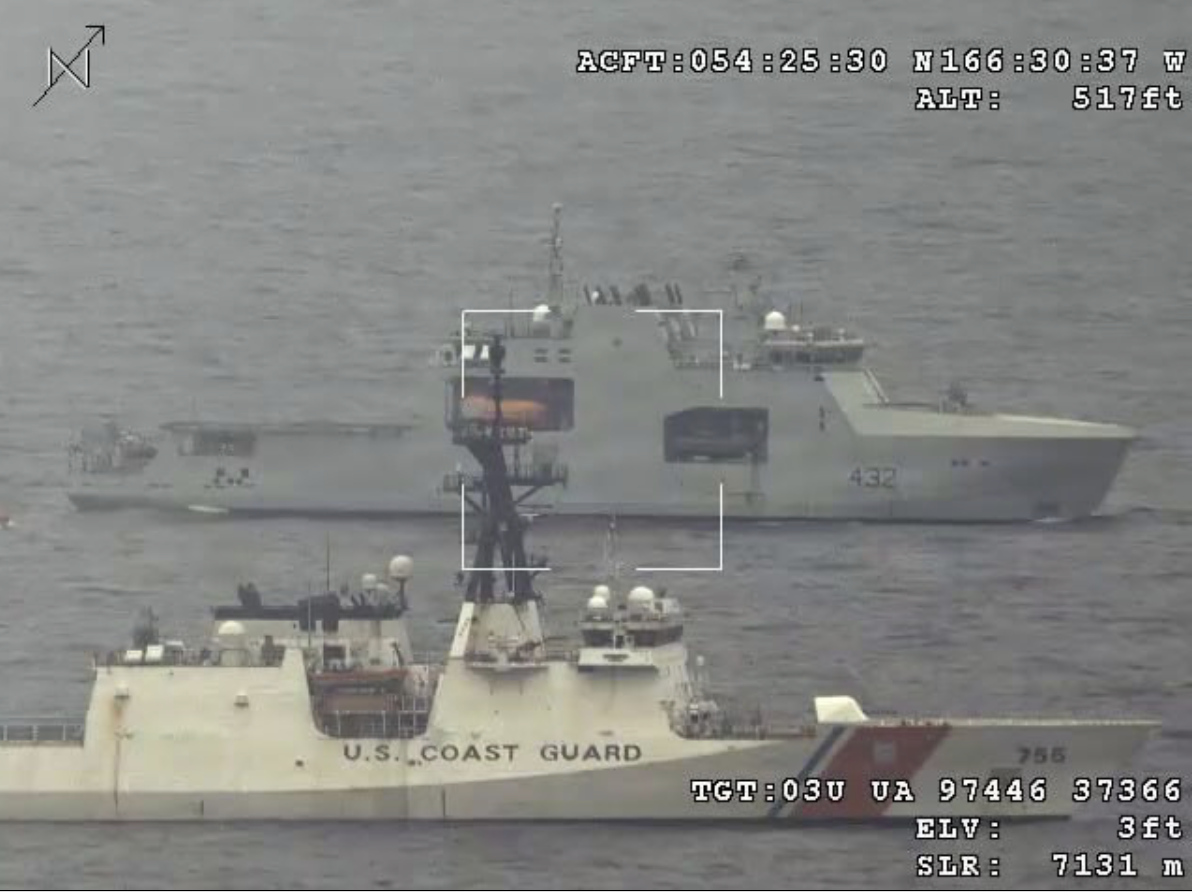
USCGC Munro and HMCS Max Bernays. “Aircraft can cover large areas quickly but operate for limited periods, while ships can remain in strategically important waters and maintain surveillance longer. The U.S. Coast Guard and Royal Canadian Navy demonstrated that role earlier in September when USCGC Munro and HMCS Max Bernays conducted a September 8-9 combined sail through the Bering Sea under TUNDRA MERLIN. U.S. Northern Command described the activity as part of the effort to sustain maritime presence, improve domain awareness and integrate U.S. and Canadian capabilities across North America’s Arctic approaches.”
Army Recognition’s Navy News reports,
The United States and Canada are testing a faster Arctic kill chain near Russia, using Alaska-based F-35 fighters, E-3 Sentry airborne warning aircraft, and maritime forces to accelerate the detection, tracking, and engagement of threats approaching through the Bering Sea. During Operation TUNDRA MERLIN from September 18 to 22, 2026, the two countries are linking sensors and combat platforms roughly 100 nautical miles north of Dutch Harbor to reduce the time between initial contact and a coordinated response.
It is clear that at least USCGC Munro is a significant player in this exercise. It appears the surface ships, both USCG and RCN would be used to shadow Russian and Chinese ships to look for suspicious activity (called taking custody in the report). They might also be called upon to inspect suspicious vessels.
The second requirement is tracking and maintaining target custody. Detecting an aircraft or vessel once is insufficient if commanders lose its position, identity, or movement before an interception can be organized. Maritime patrol aircraft can search broad ocean areas and classify contacts, while surface and subsurface vessels can maintain closer surveillance of the maritime target. Combining their information with airborne radar and other sensors allows U.S. and Canadian commanders to construct a continuously updated operational picture rather than relying on isolated detections from individual aircraft or ships.
I can appreciate the fact that aircraft are the weapon of choice given the way the allied surface ships are armed. The Coast Guard cutter is better armed than the RCN Arctic Offshore Patrol Ships, (AOPS) but given that cruise missiles fit nicely in a 40 foot container, on a variety of potentially hostile ships, I would like to see the surface ships be able to quickly respond with deadly force if a merchant ship suddenly reveals an offensive capability. The 57mm Mk110 is not enough. A 25mm Mk38 certainly is not enough. The AOPS and cutter can currently perform only a trip wire function.
Both the National Security Cutters and the Canadian AOPS do have data link which is really a requirement for this mission.
The AOPS is capable of operating in light ice but otherwise it is not as capable as the NSCs.
Speed could be important for this mission, both for making the initial intercept and for the ability to stay with a contact of interest. The AOPSs’ 17 knots may not be adequate. Canadian conventionally powered submarines might also have trouble keeping up with faster ships. Canada does have frigates stationed on the West Coast and they or the proposed “Vigilance Continental Defense Corvette” would generally equal the NSC and provide better armament.
CGAS Kodiak C-130Js equipped with Minotaur, could be an important contributor to Maritime Domain Awareness in the Arctic, but they were not mentioned in the report.
At some point the Coast Guard will have long range, longe endurance, shore based, medium altitude UAS which would also be very useful in this type of operation. They might ultimately replace a cutter or AOPS in monitoring Russian or Chinese traffic.
What about the US Navy? The Pacific Fleet virtually never sends surface ships much North of the Aleutians. They do send submarines. They really need to reopen NAS Adak, Navy P-8 Maritime Patrol Aircraft could be very useful.


“US watching Chinese marine presence off Alaska, Arctic Coast Guard chief says”
https://www.defensenews.com/news/your-military/2026/09/21/us-watching-chinese-marine-presence-off-alaska-arctic-coast-guard-chief-says/