
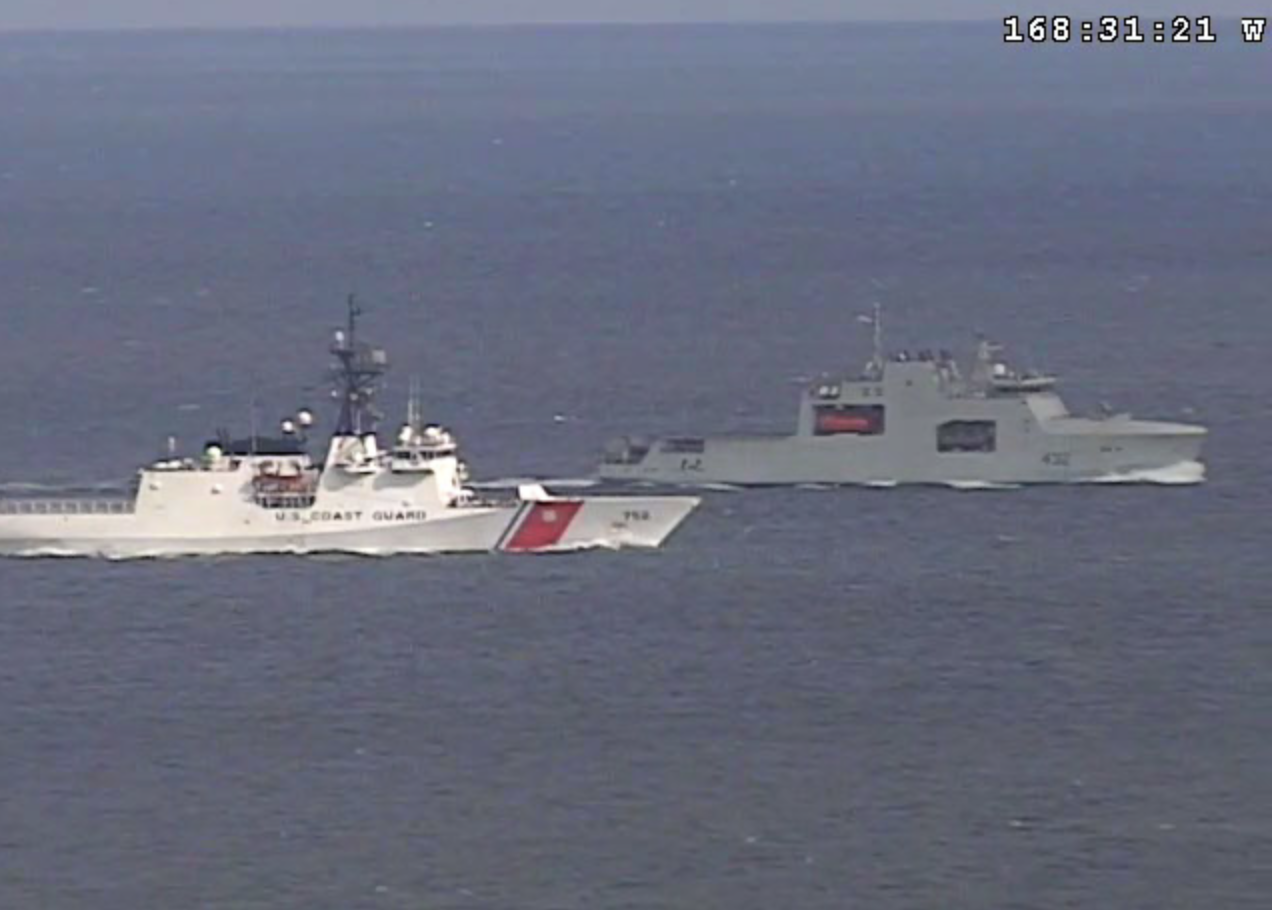
USCGC Stratton (WMSL 752) conducts a joint sail with the Canadian offshore patrol vessel HMCS Max Bernays while patrolling the Bering Sea, Aug. 11, 2026. The evolution strengthened maritime interoperability and increased operational coordination between the U.S. Coast Guard and Royal Canadian Navy in the Arctic region. (U.S. Coast Guard courtesy photo by Troy Askew)
Below is a news release from District SW.
Significantly there were two National Security Cutters on Alaska Patrol for most of this period.
“…Munro (WMSL 755) returned to their Base Alameda homeport on Coast Guard Island Oct. 9, 2026, following a 112-day Alaska patrol that covered more than 23,000 nautical miles across the Bering Sea and Arctic Ocean.
Both supported Operation Tundra Merlin. “TUNDRA MERLIN has run across Alaska since the summer, including a HIMARS deployment to Nome and an 800-mile combined Bering Sea and Bering Strait patrol.”
Operation Tundra Merlin was a targeting exercise.
“‘Simulated maritime target engagements’ is unglamorous phrasing for something genuinely difficult. A Canadian patrol aircraft finds a contact. That contact has to become a track, the track has to reach whoever can shoot at it, and the shooter has to trust the data enough to act on it — across two air forces, a navy, a coast guard and a combatant command, over a stretch of ocean with no permanent radar coverage and famously hostile weather.
“USNORTHCOM’s own framing is that the exercise is about ‘validating targeting information flow and exercising engagement processes.’ That is the kill chain, and the chain is where these things break.”
Sounds like it comes down to denying potential enemies access to the Bering Strait, an increasingly important choke point. The Coast Guard and Canadian surface units seem to have been playing the same role Soviet AGIs used to play, acting as a tattletale on enemy surface units.
It was always assumed AGIs would be destroyed as soon as the shooting started, though some had 30mm gatling gun and a few torpedo tubes below the waterline.
As a role in the period before hostilities, the National Security Cutters are certainly better for this than the Canadian AOPS by virtue of their higher speed, better armament, and probably better communications, but they are still pretty vulnerable. I would feel a lot more comfortable if the cutters had SeaRAM in place of the Phalanx and some containerized Naval Strike Missile mounted on the Foc’sle.
It appears Stratton made the deployment without an embarked helicopter detachment. Presumably she carried a V-BAT UAS. I saw no indication Munro carried a helicopter during their Alaska patrol either. Is this a trend?
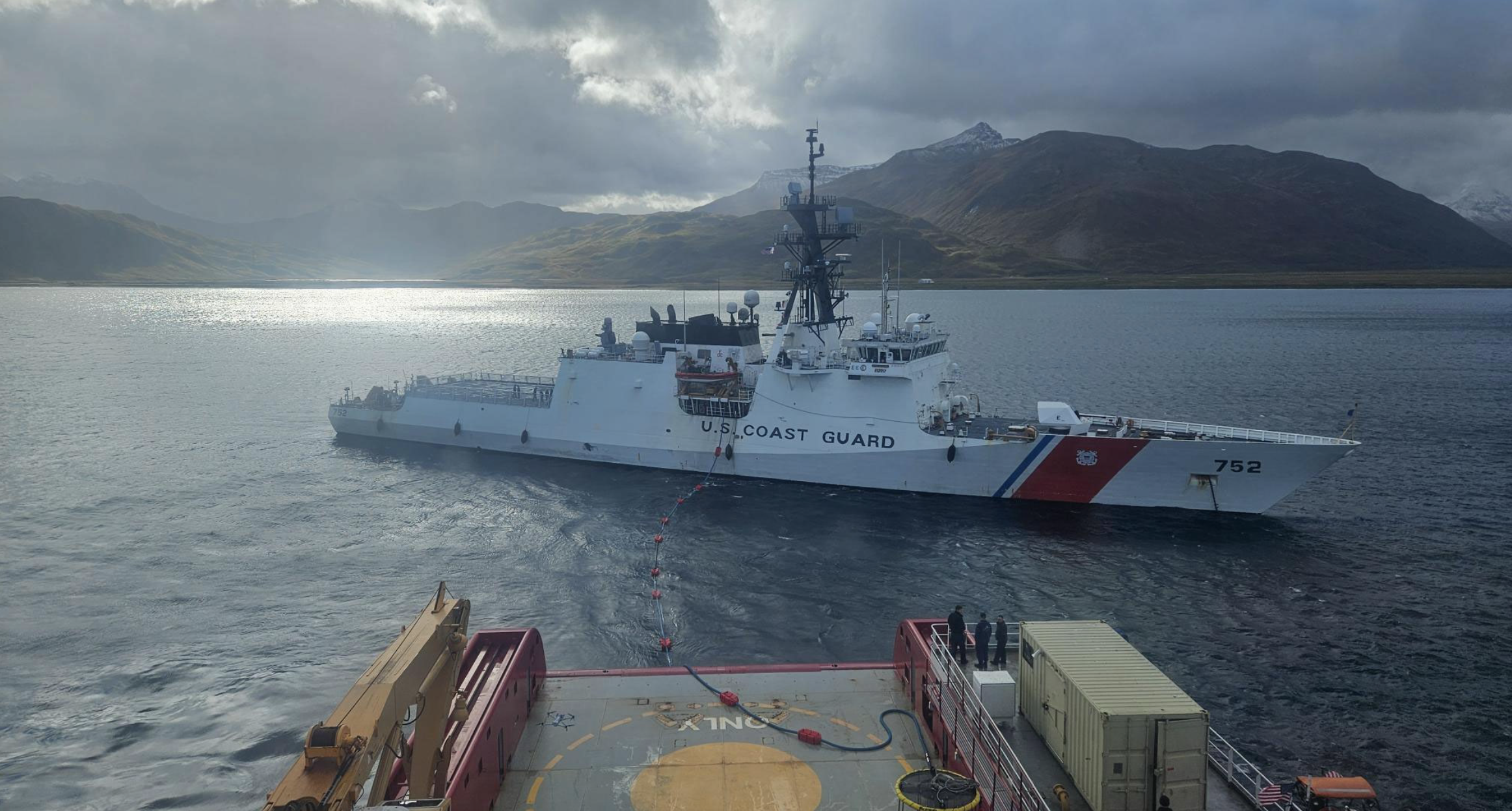
USCGC Stratton (WMSL 752) conducts a simulated fueling-at-anchor evolution with USCGC Storis (WAGB 21) in Broad Bay, Alaska, Oct. 6, 2026. The training evolution demonstrated Storis’s ability to refuel other Coast Guard cutters while at anchor, enhancing operational flexibility and endurance for Coast Guard assets operating in remote Alaskan waters. (U.S. Coast Guard photo by Ensign Maddox Holmes-Selby)
Oct. 6, Stratton conducted a simulated fueling-at-anchor evolution with USCGC Storis (WAGB 21) in Broad Bay, Alaska. This seems to be a capability the Coast Guard is developing, though notably, this was “simulated” so Stratton did not actually refuel from Storis.
The Canadian Navy vessel mentioned, HMCS Max Bernays (AOPV 432), is a DeWolf class Arctic Offshore Patrol Ship (AOPS), a light icebreaker armed with a single 25mm Mk38 mount modified for the Arctic environment. She is one of six of this class in the Canadian Navy. Two of the class are being built for the Canadian Coast Guard.
Earlier in the year, March 29, Stratton completed a 79 day patrol in the Caribbean, a bit surprising for a cutter based in Alameda California. So she was away from home port 182 days this year.
Rear Adm. Dorothy Hernaez, the former CO of Stratton, has had an interesting career. Check out her background.
Coast Guard Cutter Stratton returns home after 103-day patrol
ALAMEDA, Calif. — The crew of U.S. Coast Guard Cutter Stratton (WMSL 752) returned to their home port in Alameda on Saturday, after a 103-day patrol in the Arctic and Bering Sea, where they worked diligently to reinforce maritime safety, security and national sovereignty in one of the most demanding operating areas in the world.
As access to the Arctic continues to increase, demand for Coast Guard presence and search and rescue in the high north continues to grow. Stratton’s crew executed a full range of cutter missions while operating alongside U.S. and Canadian partners under Operation Frontier Sentinel and Operation Tundra Merlin.
“I am proud of this crew for the professionalism they showed during a long and demanding patrol in the Arctic and Bering Sea,” said Capt. Matthew Press, Stratton’s commanding officer. “From search and rescue response and safeguarding U.S. sovereignty, to joint operations with our Canadian partners and engagement with Alaskan communities, they delivered presence and readiness where it mattered most.”
Stratton conducted flight operations with a U.S. Coast Guard MH-60T Jayhawk helicopter off Kotzebue, Alaska, on Aug. 11, building proficiency between cutter and aviation crews for search and rescue and maritime response. That same day, the cutter conducted a joint sail with the Canadian offshore patrol vessel HMCS Max Bernays in the Bering Strait, strengthening interoperability with the Royal Canadian Navy in the Arctic region.
On Aug. 24, Stratton held a change of command ceremony at anchor in Kotzebue in harsh Arctic conditions. Rear Adm. Jeffrey Novak, (deputy commander–Chuck) commander of Southwest District presided, as Press assumed command from Rear Adm. Dorothy Hernaez. The ceremony marked a seamless transition of leadership and sustained the cutter’s mission readiness for continued operations in the Arctic.
Stratton also conducted a live-fire gunnery exercise with its Mark110 57mm gun off the coast of Unalaska on Sept. 30. The crew engaged multiple targets and tested and maintained the cutter’s weapons systems, reinforcing gunnery proficiency for operations in the Bering Sea and Aleutian Islands.
On Oct. 6, Stratton conducted a simulated fueling-at-anchor evolution with Coast Guard Cutter Storis (WAGB 21) in Broad Bay, Alaska. The training demonstrated Storis’ ability to refuel other Coast Guard cutters while at anchor and expanded logistical flexibility for assets operating in remote Alaskan waters.
While on patrol, Stratton’s crew spent 26 days above the Arctic Circle protecting U.S. sovereignty and territorial integrity, earning the Coast Guard Arctic Service Medal. The crew conducted port visits in Seattle, Kodiak, Dutch Harbor, and Victoria, Canada. In Seattle, Stratton participated in the Fleet Week Parade of Ships and provided tours to more than 2,500 members of the public. Stratton also hosted a flight-deck reception during Seattle Fleet Week for guests from the Coast Guard, Navy, and Royal Canadian Navy, along with civic leaders from the Seattle area.
Commissioned in 2012, Stratton is a 418-foot Legend-class national security cutter homeported in Alameda. National security cutters have a top speed in excess of 28 knots, a range of 12,000 nautical miles. Stratton is equipped with a flight deck and hangar capable of supporting multi-mission helicopters. The cutter is named for Capt. Dorothy C. Stratton, director of the Coast Guard Women’s Reserve (SPARS) during World War II, and was the first national security cutter named after a woman.

