
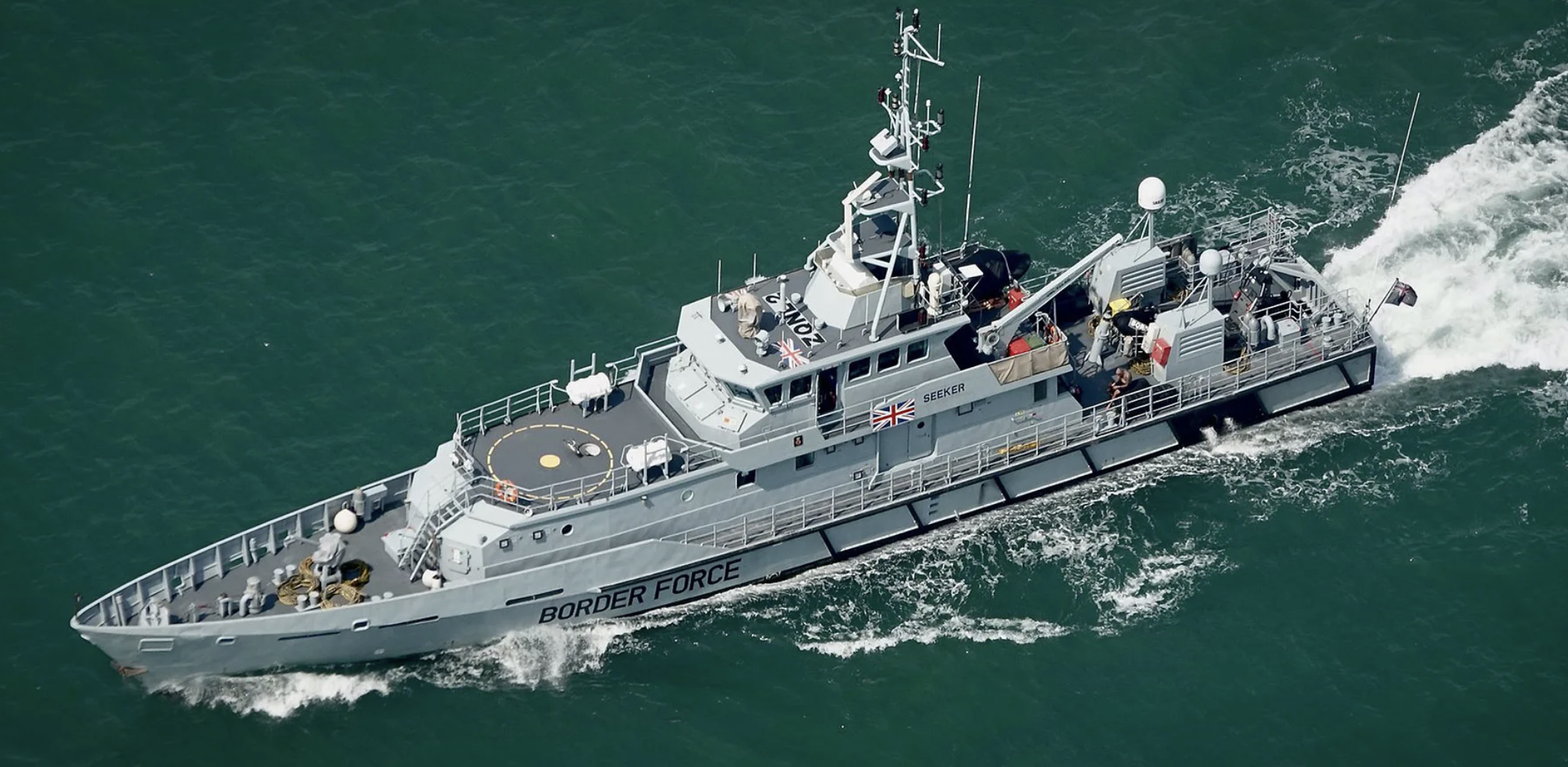
“Britain’s ageing Border Force cutters are at risk of becoming unseaworthy years before their replacements arrive, forcing the Home Office to seek an interim fleet. The emerging gap has parallels with the RN’s frigate crisis and raises another question over whether government orders can benefit British shipbuilding.”
The UK has the fifth largest EEZ in the world, after France, the US, Australia, and Russia. Still it is more than half as large as that of France or the US.
Its Maritime Law enforcement organization is much different that than that of the US.
The UK’s Border Force may sound like a Coast Guard but its missions are much more limited. In many ways it is more like INS or Customs and Border Protection. The craft pictured above is one of a class of four cutters. The design is a bit smaller (140’/257 tons), but closely related to the design from which the Webber class WPC (154’/353 tons) evolved. The Border Force has one slightly larger vessel (163’/423 tons) and six 18 meter (58.2′) fast patrol boats. All are normally unarmed. These vessels are sometimes cynically viewed as taxis for bringing migrants ashore.
The UK does have HM Coast Guard. It primarily a SAR coordination agency. They have no ships and no general policing, customs, or smuggling enforcement powers. The Royal Navy does fisheries protection except off Scotland which has a separate agency. The Royal Navy has eight offshore patrol vessels we would consider MECs. Lately two have been deployed in the Pacific, two in the Mediterranean, one in the Caribbean, and one in the Falklands.
All five of the Border Force’s larger vessels are more than 22 years old, up to ten years older than the oldest Webber class.
It seems some of the recent decommissioned 87 foot Marine Protector class that are now excess might be used as interim patrol vessels and that Bollinger might build four or more additional simplified Webber class to replace the existing vessels potentially delivering four or five in 2029/2030. That would be earlier than the replacements are currently expected.
Thanks to Lee for bringing this to my attention.

